
Short Answer: The three big causes of brown turf in a Murfreesboro July lawn look similar from the curb but behave differently up close. Heat dormancy is uniform and the soil is still moist. Drought is patchy and the screwdriver stops in the top two inches. Disease shows up in defined shapes with bleached or sunken centers and spreads week to week. The fix for each one is different, and treating dormancy like disease is one of the fastest ways to waste a fungicide and stress a healthy lawn. Below is the step-by-step walkthrough we use across Rutherford County.
Every July we get the same call from homeowners across Murfreesboro, Smyrna, La Vergne, Eagleville, Christiana, and Rockvale. The lawn looked great in May, turned uneven in June, and now there are brown patches. The honest answer is that there are usually three things going on at once and the right response depends on telling them apart. This guide is the diagnostic walk we do before we recommend a fix.
Middle Tennessee summers are not subtle. July highs in Murfreesboro commonly sit between 90 and 94 degrees, humidity stays in the 60s and 70s, and thunderstorms can dump an inch in twenty minutes and then leave us dry for ten days. That stresses every common grass differently. Bermuda is built for it but suffers when soil compacts. Zoysia handles heat well but goes off color if water is short. Tall Fescue, which dominates the shaded portions of older Murfreesboro yards, struggles every summer and is the easiest of the three to misdiagnose.
Step 1: Walk the Lawn at 7 a.m. and Read the Pattern
The first walk should always be early morning, before the sun burns off the dew. Dew is a free diagnostic tool. It collects evenly on healthy turf, drains off diseased turf in characteristic patterns, and outlines mycelium and fungal arcs that are invisible by noon. Stand in three places on the property: the front yard from the street, the back yard from the deck or patio, and a side yard near the AC condenser. Look at the lawn as a whole first.
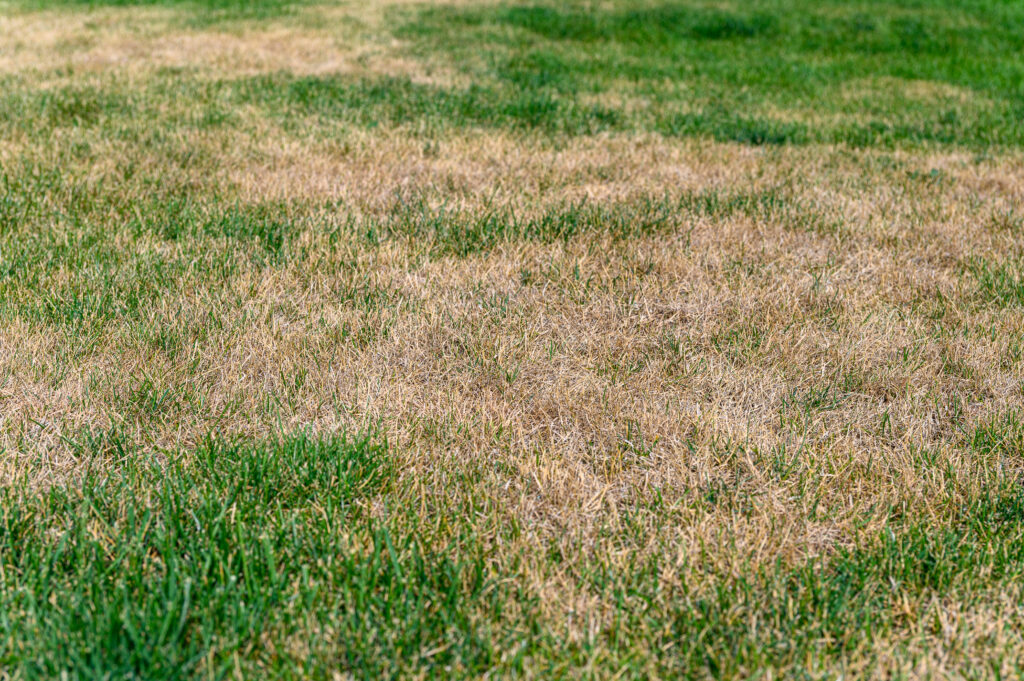
Ask three questions while you walk. Is the off-color area uniform across the lawn, or limited to certain exposures? Does the damage have a defined edge or does it fade gradually? Are the brown patches expanding compared to last week? Uniform color across an entire lawn with no defined edges almost always points to dormancy or seasonal heat stress, not disease. Patchy damage concentrated on south- and west-facing slopes with sharp edges points to drought. Defined circles, rings, arcs, or frog-eye shapes that grow week over week point to disease.
Most Murfreesboro lawns have a combination. The new construction subdivisions across Blackman, the Avenue, and the east side of town often sit on compacted clay subsoil where the topsoil was scraped during grading. Those lawns drought-stress first on the high points and disease-stress in the low collection areas. Older established neighborhoods around MTSU and the historic core have more even soil but more shade, which favors disease on Fescue.
Step 2: The Screwdriver Test Separates Drought From Everything Else
Take a long flat-blade screwdriver, at least eight inches of shaft, and push it into the soil in three places: a healthy area, a brown area, and a transition area between them. A healthy Murfreesboro lawn in July with adequate moisture should let the screwdriver slide in four to six inches with steady pressure. Two inches or less in the brown area, and easy penetration in the healthy area, means the brown spots are dry. That is drought, not disease, not dormancy.
If the screwdriver slides in four to six inches across the entire lawn including the brown areas, the moisture is fine and the brown is something else. That is the moment to start looking at heat dormancy and disease as the real suspects.
Rutherford County clay seals at the surface when it dries, which makes the screwdriver test extra useful. We see this constantly on properties out toward Christiana where the clay is heaviest. Water beads off the crust, the homeowner runs the irrigation longer, and the lawn never gets the soak it actually needs because the surface is shedding. The screwdriver tells the truth where a guess never will.
Step 3: Identify Heat Dormancy Before You Treat It
Heat dormancy is a survival response, not a problem. Tall Fescue in particular shuts down growth and turns straw-colored when soil temperatures climb past about 80 degrees and stay there. The blades brown from the tip down but the crown of the plant (the white tissue at the soil line) stays alive and ready to regrow when conditions cool in September. Bermuda does not heat-dormant in our climate; it goes brown only in cold dormancy. Zoysia rarely goes dormant from heat alone.
Three signs you are looking at heat dormancy rather than disease or drought on a Fescue lawn. First, the discoloration is uniform across the entire lawn, including areas you know are getting plenty of water. Second, the screwdriver slides in easily. Third, when you part the canopy and look at the crown of individual plants, the white tissue at the soil line is still firm and pale green, not brown and mushy. If all three are true, the lawn is dormant. Fungicide, extra fertilizer, and aggressive watering will not help and may hurt.
The right response to heat dormancy on Fescue in Murfreesboro is to back off. Water deeply but only enough to keep the crowns alive (about half an inch per week, applied in one morning soak), raise the mowing height to four inches if you have not already, do not fertilize, and wait for September. The lawn will come back. Pushing a dormant Fescue lawn to look green in July is how homeowners end up with no lawn at all in August.
Step 4: Read the Disease Signature Carefully
Disease in a Murfreesboro July lawn has a few characteristic looks, and once you know them, they are hard to miss. Brown patch on Tall Fescue is the most common disease we see across Rutherford County in late July and August. It shows as roughly circular patches two to six feet across with a smoky purple-gray ring at the leading edge in early-morning dew. Inside the ring the blades have tan, water-soaked lesions with darker borders.
Dollar spot shows up on Bermuda and Zoysia as bleached spots the size of a silver dollar, often connecting into larger irregular shapes. The blade lesions have an hourglass shape with a tan center and reddish-brown borders. Dollar spot is more common when nitrogen is low and overnight humidity is high.
Pythium blight is the disease to act on fastest. It looks like dark, water-soaked, greasy patches in the early morning, often with cottony mycelium visible in the dew. The patches can be small but they collapse and merge quickly, often in 24 to 48 hours, especially after a heavy thunderstorm followed by warm overnight temperatures. Pythium hits lawns with poor drainage, frequent shallow watering, and high nitrogen. If you suspect Pythium, do not wait; treatment within a day of onset is the difference between a small scar and a major loss.
Step 5: Account for the Insect and Animal Damage That Looks Like Disease
Three insect issues in Middle Tennessee can mimic disease or drought and cost a lot of money if treated wrong.
- Armyworms arrive in Rutherford County from July through September and can strip a Bermuda or Fescue lawn in 48 hours. The damage looks like rapid uniform browning, often along a clean leading edge that moves across the lawn day by day. Birds congregating in one area of the yard are a classic tell. Check by parting the canopy and looking for green caterpillars with stripes down the body.
- Grubs feed on roots in July and August. The damage looks like irregular brown patches that lift off the soil when you tug, because the roots are gone. The screwdriver will slide in easily and feel spongy. The tell is when the dead turf rolls back like carpet.
- Fire ant mounds are increasingly common across Middle Tennessee and especially in Murfreesboro and Smyrna. The mounds themselves are obvious; the surrounding turf damage from soil disturbance is what people misdiagnose. Treat the mound directly, not the whole lawn.
Japanese beetle adult feeding shows up on ornamentals more than on turf, but their larvae are the grubs above. A heavy beetle presence in mid-July predicts a heavy grub pressure in August and September.
Step 6: Decide What to Actually Do
Once the diagnostic is done, the response is straightforward.
- Drought: water one inch per week in two deep morning soakings, broken into pulses if the clay is sealing the surface. Most lawns respond within seven to ten days.
- Heat dormancy: protect the crowns with light morning watering, raise the cut, do not fertilize, and wait for cool weather.
- Brown patch: morning-only watering, four-inch mowing height on Fescue, and a curative fungicide if patches are expanding week over week.
- Pythium: act within 24 hours; targeted fungicide and a complete review of drainage and watering.
- Armyworms or grubs: confirm the pest first, then treat with the right product at label rate.
- Compacted soil from new construction: note it for the fall aeration plan and avoid making the symptoms worse with summer fertilizer.
The point of the walkthrough is to avoid treating the wrong problem. A fungicide on a dormant lawn does nothing. A heavy watering on a disease pressure makes it worse. Skipping a real drought because the lawn looks like it should be dormant kills turf you could have saved.
What to Do Next
If you would rather have a trained eye walk the lawn, do the screwdriver test in the spots that matter, identify what is actually happening, and put together a July through August plan that does not waste money on the wrong treatments, that is exactly what we do.
Lawn Squad of Murfreesboro serves homeowners across Murfreesboro, Smyrna, La Vergne, Eagleville, Christiana, and Rockvale.
Call us at 615-622-6918 or request a free quote at lawnsquad.com. Our VitaminLawn program is built around Middle Tennessee’s transition-zone climate, the limestone-influenced clay soils common across Rutherford County, and the July through September disease and insect pressure that drives most of the calls we get this time of year. We diagnose first, then treat, so the work we recommend matches what your lawn actually needs.