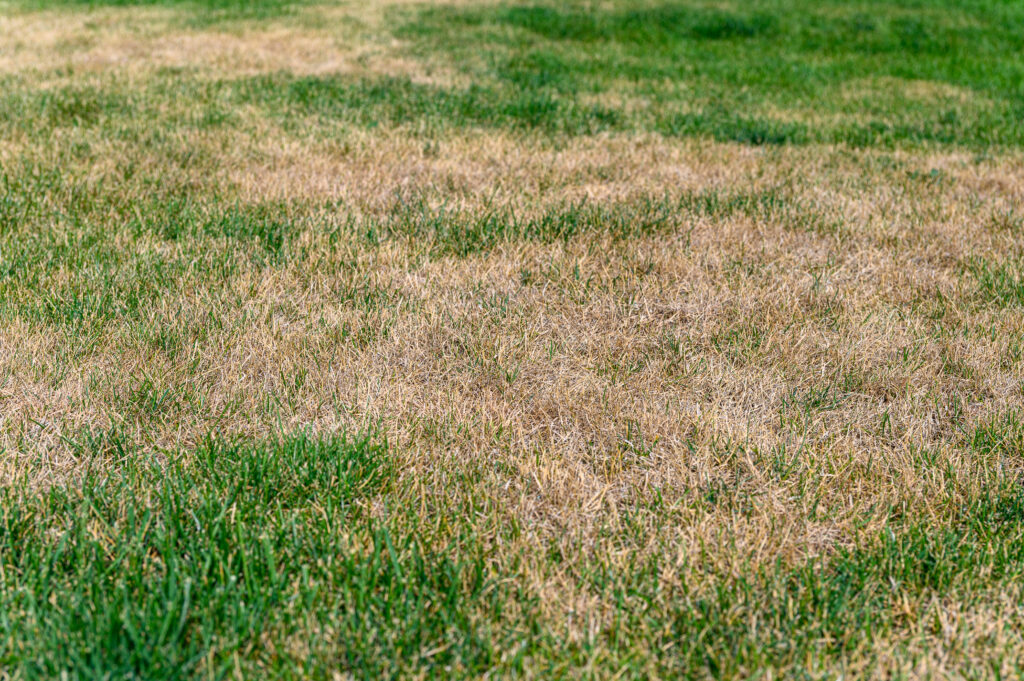
Short Answer: When a Huntsville Bermuda, Zoysia, or Fescue lawn browns in July despite regular watering, drought is rarely the actual cause. The six most common reasons across Huntsville, Madison, Decatur, and the Tennessee Valley are: shallow watering creating shallow roots, limestone-derived clay sealing the surface against water absorption, thatch intercepting water above the soil, brown patch and dollar spot exploiting humid valley nights, chinch bug feeding in hot sunny patches, and Fescue summer dormancy that should not be confused with damage. Each cause has a different fix, and watering more makes some of them visibly worse.
July across the Tennessee Valley brings the kind of phone calls we expect every year. A Madison homeowner with a brand new Tifway Bermuda lawn watching tan patches creep across the front yard. A Hampton Cove Zoysia lawn that was perfect on the Fourth and now has rings of brown by mid-month. A Five Points fescue lawn going crispy across an entire south-facing slope. The homeowner is watering, the sprinklers are running, and the lawn is still browning. “I do not understand what is happening.”
Here is what we have learned from years of walking Huntsville lawns through July: the cause is almost never simple drought once a working irrigation system is in place. By the time a Tennessee Valley lawn is browning in mid-July with water on the schedule, the issue is between the sprinkler and the roots, or it is something else exploiting heat stress. Adding more water to a misdiagnosed problem makes most of these causes worse.
These are the six causes we rule in or out on every Huntsville summer service call, with the simple tests that point you to the right fix.
1. Shallow Watering Built You Shallow Roots
The most common cause we find on browning Huntsville Bermuda lawns is a sprinkler schedule running fifteen or twenty minutes every morning. It feels generous. It is also the most damaging schedule possible. Light frequent water keeps only the top inch of soil moist, and Bermuda roots respond to where the water is. If moisture lives in the top inch, that is where the roots stay. When a 93-degree afternoon dries the top inch out faster than the irrigation can replenish it, the lawn browns because the roots never reached the moisture sitting six to eight inches down.
The screwdriver test is the fastest diagnostic. Push a long screwdriver into the lawn an hour after a watering cycle. It should slide easily six to eight inches down. If it stops at three inches, water is not reaching the depth where the root system should be. Reset the controller to two cycles per week of about half an inch each, between 4 and 8 a.m., and the roots will start chasing moisture deeper.
2. Limestone-Derived Clay Sealing the Surface
Huntsville soils are unusual. The Tennessee Valley sits on limestone bedrock with limestone-derived clay topsoils that are higher in pH (typically 6.5 to 7.5) than the more acidic red clays just south of us. This soil holds nutrients well but compacts hard and seals at the surface when it dries. The shallow soils around Monte Sano and Green Mountain especially seal quickly. Newer subdivisions out toward Athens and Harvest, where construction stripped the topsoil and left compacted subsoil, are even worse.
Test it with the same screwdriver. If the brown area resists penetration noticeably more than a healthy green area within the same yard, compaction is in the picture. Core aeration during active warm-season growth, which is late May through early August across our service area, is the fix. Aerated lawns absorb water at roughly twice the rate of compacted ones, which means the same amount of irrigation suddenly becomes useful.
3. Thatch Intercepting Water Like a Sponge
Bermuda is a thatch builder. Zoysia, especially Meyer and Emerald varieties common in older Huntsville neighborhoods, can be worse. A thick thatch layer is hydrophobic when dry. Water hits it, beads up, runs sideways, and the roots below the thatch get little of what you put down.
Diagnose with the wedge test. Cut a four-inch pie-shaped wedge out of the lawn with a serrated knife. Look at the side of the wedge. If you see more than half an inch of fibrous brown material between the green canopy and the dark soil, thatch is intercepting your water. The midsummer answer is to keep watering deeply and plan a verticut or aeration during the next active growth window. On Bermuda we like late May through June. On Zoysia we typically wait until June.
4. Brown Patch and Dollar Spot on Humid Valley Nights
Tennessee Valley nights in July stay warm and humid. Dew settles heavily on lawns by 9 p.m. and does not burn off until 9 a.m. When the leaf canopy stays wet that long, fungal pathogens move aggressively. Brown patch (Rhizoctonia) hits Zoysia hard in shaded yards across Hampton Cove and Twickenham, showing as roughly circular orange-tan patches three feet to several feet across with a darker advancing ring. Dollar spot shows on Bermuda as silver-dollar-sized straw-colored spots that merge over a week or two.
Fescue browns from a different fungus: brown patch on fescue is a leaf and stem disease that turns large irregular areas tan-brown with a characteristic smoke ring at dawn. The pattern is the giveaway. Drought damage is uniform across the affected area. Fungus has edges, rings, or distinct circles. Walk the lawn at first light. If you see cottony white fuzz on the leaf blades where the patches are spreading, that is mycelium and confirms a fungal diagnosis.
Watering more makes this worse. Move all irrigation to before 8 a.m. so the canopy dries quickly, raise the mowing height a notch on Zoysia and Fescue, and apply a labeled fungicide if the area is expanding more than a foot per week.
5. Chinch Bugs Working Sunny Stress Zones
Chinch bugs are less common in north Alabama than they are in central and south Alabama, but they show up in Huntsville every summer, especially on Bermuda lawns in full-sun strips between sidewalk and curb, along driveway edges, and against south-facing brick walls. The damage looks exactly like drought, which is why so many homeowners pour more water on it for two weeks while the bugs feed undisturbed.
The float test is fast. Push a metal can with both ends cut out into the soil at the edge of a brown area, fill it with water, and wait five minutes. If chinch bugs are present, they float to the top. We covered this in detail in our recent Birmingham chinch bug post. Treatment with a labeled pyrethroid or chlorantraniliprole product, applied with enough water volume to reach the thatch where the bugs live, knocks the population down within a few days.
6. Fescue Summer Dormancy That Is Not Damage
Huntsville is at the northern edge of the warm-season transition zone, which means a real portion of our service area has tall fescue lawns. Fescue is a cool-season grass and it does not enjoy July in north Alabama. Even with regular watering, fescue lawns will look pale, thin, and stressed by mid-summer, and a portion of the lawn may go semi-dormant with crispy upper blades while the crowns stay alive at the base.
This is not damage you need to fix. It is summer survival mode for a grass species that prefers spring and fall in our climate. The trap is in over-watering it. Fescue roots stressed by July heat are vulnerable to brown patch and pythium when the soil stays consistently wet. The right management is one inch of water per week split into two cycles, no fertilization until September, mowing height raised to 4 inches, and acceptance that the lawn will not look its best until temperatures drop again. We plan fescue overseed and renovation projects for late September across Huntsville for exactly this reason. Trying to push fescue through July with extra water sets up worse problems.
The Tennessee Valley Decision Tree
Once you know the six causes, the diagnosis is usually clear from the pattern. Here is the rough order we work through on a Huntsville service call:
- Uniform brown across the lawn, screwdriver stops shallow: shallow roots and possible compaction. Water deeper, aerate.
- Circular or ringed patches, white fuzz visible at dawn: brown patch or dollar spot. Reduce moisture timing and fungicide.
- Expanding patches in full sun by hardscape: chinch bugs. Float test, targeted insecticide.
- Wedge test shows over half an inch of thatch: water interception. Plan a verticut.
- Fescue lawn looking pale and thin across most of the yard: summer dormancy. Maintain at one inch per week, do not overwater, plan fall overseed.
- None of the above and soil is dry six inches down: actual drought. Increase to one inch per week in two cycles.
The good news is that Bermuda and Zoysia in particular are very forgiving once you find and fix the actual cause. Even a half-acre patch of damage can recover in three weeks during active July growth as long as the crowns and stolons are alive. Fescue is less forgiving in July, which is why diagnosis matters more on those lawns.
What to Do Next
If your Huntsville lawn is browning despite regular watering, the answer is rarely more water. Run a screwdriver test, a wedge test, and a float test and you will narrow it to the right cause in about fifteen minutes.
Lawn Squad of Huntsville serves the Huntsville metro area including Huntsville, Madison, Decatur, Athens, Meridianville, Owens Cross Roads, Hampton Cove, Harvest, Brownsboro, New Market, and the surrounding Tennessee Valley.
Call us at 983-233-6002 or request a free quote at lawnsquad.com. Our VitaminLawn program is calibrated for Tennessee Valley limestone-derived soils, the mix of warm and cool-season grasses we see in our service area, and the specific disease and pest pressures of north Alabama summers, with a customized plan rather than a generic schedule.