Short Answer: Pull a tuft of grass and look at the crowns at the base. If they are firm and pale green, the lawn is heat dormant and will recover when temperatures drop. If you see circular tan patches with darker smoky rings, especially on fescue in shaded valley properties, that is brown patch disease. If the blades fold lengthwise, footprints stay visible after you walk across the lawn, and the soil is bone dry at 3 inches, that is drought stress. Heat dormancy needs patience. Disease needs a targeted fungicide and watering changes. Drought needs a deep early morning soak. Mixing up the three is the most common reason a Chattanooga lawn fails in late July.
It is the last Saturday of July in Ooltewah. You walk to the mailbox and your bermuda along the driveway looks gorgeous, but the fescue under the maple by the front walk has a tan circle in it that was not there two weeks ago. Around the back, the zoysia next to the patio has a soft patch where the color faded from green to straw in maybe five days. You water it that night. The next morning the patch is bigger. What is going on?
The honest answer is that in July, three completely different things look almost identical from across the yard. Heat dormancy, fungal disease, and true drought stress all show up as discolored grass. The treatments for each are different, and one of them (watering at night to fix what looks like drought) actively makes another one (disease) worse. Here is how we walk through a diagnosis on Chattanooga and North Georgia lawns, the same way we do it on service calls.
Why July Is the Hardest Month in the Transition Zone
The transition zone is the lawn region that gets too cold for warm-season grasses and too hot for cool-season grasses. We sit in the middle of it. That means most properties we work on have at least one grass type that is fighting the weather right now, and a lot of properties have two grass types running side by side, each one struggling with something different.
Across our service area we see fescue dominate the higher elevations and the shaded north-facing slopes (Signal Mountain, Lookout Mountain, the wooded lots in Red Bank and parts of Hixson). Bermuda dominates the full-sun lots in East Brainerd, Ooltewah, the Cleveland TN valley, and most of Dalton GA and Ringgold. Zoysia shows up on the newer subdivisions in Collegedale, Apison, and the higher-end residential builds across the area. Many properties run a fescue front yard and a bermuda backyard, or fescue under shade trees with bermuda or zoysia in the open sun. By late July, those two grasses are reacting to the same week of weather in opposite directions.
Late July through early August is the peak risk window for everything bad that can happen to a transition zone lawn. Soil temperatures are at their annual high, humidity holds overnight, and afternoon thunderstorms create the cycle of wet canopy and warm air that fungal pathogens love. If you are going to lose a lawn, this is when it happens.
Step One: The Tug Test
Before anything else, get on your hands and knees in the affected area. Grab a small tuft of grass between your thumb and forefinger and tug straight up with steady pressure. What happens next tells you almost everything.
If the grass holds firm and you pull off a few blade tips, the roots are alive. The crowns at the base of the plants are still functional, even if the visible top is brown or pale. This is either heat dormancy or early drought stress, both of which are recoverable.
If the entire tuft lifts out of the soil with no resistance, like pulling a small rug, you are looking at active disease. Brown patch and large patch both rot the crown and basal stem tissue, which is why diseased grass releases from the soil so easily. This is a fungicide situation, not a watering situation.
If the tuft comes up with intact roots but the roots are short, brittle, and brown rather than white, you are looking at root damage from sustained drought, or from a soil issue we need to dig into separately. That is a deeper conversation, but the tug test gets us pointed in the right direction in under thirty seconds.
Step Two: Read the Pattern
Step back and look at the shape of the discoloration. Patterns matter as much as colors do.
Circular patches, 6 inches to 3 feet across, with a darker outer ring (sometimes called a smoke ring in the morning dew) on fescue: brown patch. This is the single most common disease we treat on Chattanooga fescue in July. It thrives when nighttime temperatures stay above 68 degrees and the canopy holds moisture overnight. Shaded fescue in valley neighborhoods is at the highest risk.
Larger circular patches, often 2 to 10 feet across, with orange or reddish edges on zoysia or bermuda: large patch. Large patch is the warm-season equivalent of brown patch, and it usually shows up during the transition periods, but in a wet July it can flare in the middle of summer too. We see it most often on overwatered zoysia in Collegedale and Apison.
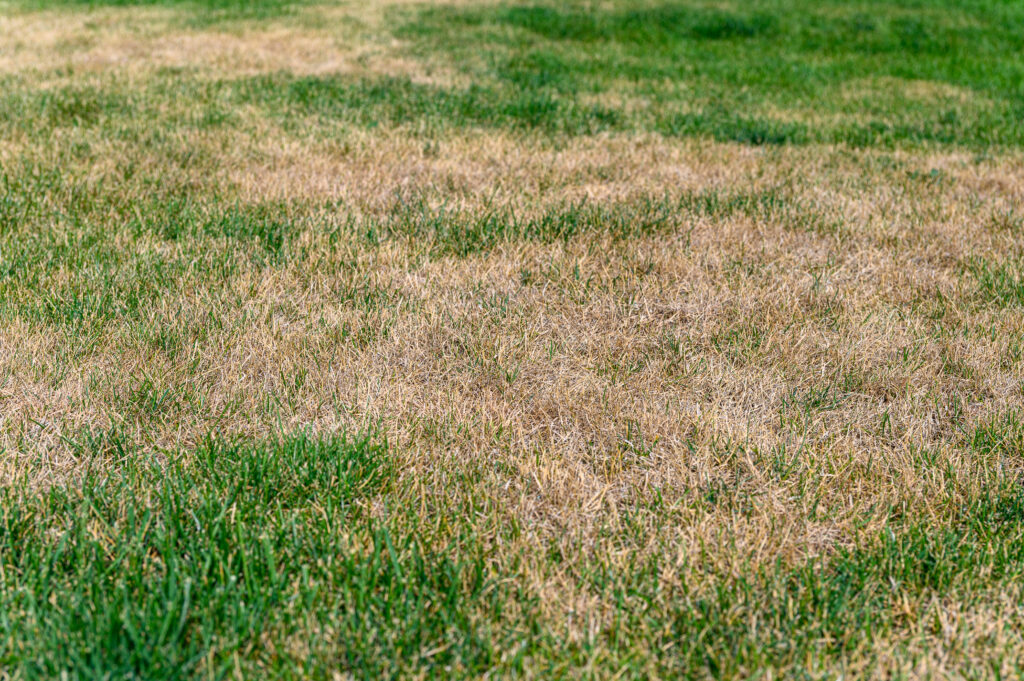
Irregular patches that follow the slope of the lawn, the path of the sun, or the property line where the sprinkler does not reach: drought stress. Drought stress is rarely a perfect circle. It follows the geography of the lot.
Whole-lawn pale color with no patches at all, particularly on fescue: heat dormancy. Cool-season grass goes off color across the entire area when soil temperatures exceed roughly 85 degrees. It is not sick, it is hibernating.
Step Three: Check the Time of Day
Walk the same problem area at 7 a.m. and again at 4 p.m. The difference is informative.
If the lawn looks wilted, blue-gray, and footprints stay visible in the afternoon but rebounds and looks normal in the early morning, that is heat stress on a lawn that still has access to soil moisture. The lawn is fine. It is just expressing thermal stress during peak heat. Resist the urge to add water.
If the lawn looks the same at 7 a.m. as it does at 4 p.m., dry and folded blades both times, the soil is actually out of moisture and the lawn cannot recover overnight. That is true drought, and it needs irrigation.
If the lawn looks worse at 7 a.m. than it did the night before (specifically, more patches, larger patches, or fresh tan halos on previously green areas) you have active disease spreading overnight. The mycelium from brown patch and large patch is most visible right at dawn when dew is still on the grass. Get out with a flashlight at 5:30 a.m. and look for white cobwebby growth at the patch edges. If it is there, you have your answer.
Step Four: Soil Probe at 3 Inches
A long screwdriver is the cheapest diagnostic tool in lawn care. Push it into the soil in the affected area, in an unaffected area, and in a third spot in between. If it goes in easily to 4 inches, you have moisture. If it stops at 1 inch and will not go further, the soil is dry and compacted, which is a drought signal even if the top of the grass still looks reasonable.
Red clay on most Chattanooga and North Georgia properties holds water longer than sandy soil, but when it does dry out, it dries hard. The transition from “still has moisture” to “concrete” can happen in a 48-hour window of high heat and no rain. Probing weekly through July is how we catch a drought problem two days before it expresses as discolored grass.
Step Five: Match Symptom to Grass Type
Fescue in July is almost always one of three things: heat dormant, brown patch, or both at the same time. Fescue does not actually drought stress in July in the way most homeowners think. By the time soil is dry enough to drought stress fescue, the grass is also so heat stressed that the two symptoms blur together. The fix is the same either way: deep early morning water and patience.
Bermuda almost never gets disease in July in a healthy lawn. Bermuda problems in July are almost always drought, soil compaction, or armyworms. Armyworms tend to appear in late July across North Georgia and southeast Tennessee, and they can take a bermuda lawn down to dirt in 72 hours. Look for ragged blade edges and small caterpillars at the soil line in the early morning. We talk about armyworm management below.
Zoysia in July is most often dealing with large patch from overwatering, occasional grub damage that shows up as soft spongy turf, or pure heat stress that resolves on its own. Zoysia rarely needs more water in July, and adding water when zoysia looks off is the most common mistake we see homeowners make.
Step Six: Watch for Armyworms and Fire Ants
Two pests deserve their own section because they show up reliably in late July across Chattanooga and North Georgia, and both can be mistaken for disease or drought.
Armyworms move through bermuda and fescue in waves, usually starting in late July in the warmer parts of North Georgia (Dalton, Ringgold, Tunnel Hill) and working north through Chattanooga over a few weeks. They feed at night and hide in the thatch during the day. If your lawn went from green to ragged in 48 hours, get out at dawn with a flashlight and check the thatch. Treatment is straightforward once you confirm the diagnosis, but it has to happen fast.
Fire ants are a year-round issue across most of our North Georgia service area, and they get more active in July. Mounds in the open sun, particularly in newer subdivisions in Cohutta, Ringgold, and parts of Dalton GA, signal the need for a targeted bait program. We treat them as a regular service item rather than a one-time fix, because reinfestation from neighboring properties is constant.
Frequently Asked Questions
My fescue lawn turned brown in just one week. Is it dead? Probably not. Fescue in July either goes dormant, gets brown patch, or both. Pull a tuft. If the crowns are firm and pale green, the lawn will recover when nighttime temperatures drop below 68. Keep mowing high, water deep in the early morning twice a week, and stop fertilizing nitrogen until September.
I watered my lawn at night and now it looks worse. Why? Evening watering leaves the canopy wet overnight, which is the perfect condition for brown patch on fescue and large patch on zoysia and bermuda. Switch to early morning watering between 4 a.m. and 8 a.m. and the disease pressure drops significantly.
Should I apply fungicide preventively in July? On fescue in shaded valley properties, yes, a preventive brown patch program in late June through August is good practice. On bermuda, almost never. On zoysia, only if you have a history of large patch on the property. Talk to us about a targeted plan rather than blanket-spraying.
Can I aerate or seed in July? No. Aeration in July damages a stressed lawn. Seeding fescue in July fails because soil temperatures are too high for germination and the seedlings cannot survive heat. Wait until September. Our other July blog walks through the planning side of fall aeration.
What to Do Next
If you have walked through these steps and you still are not sure what is going on, send us a photo and a short description of the lawn and we will help you sort it out. Diagnosis at a distance is imperfect, but with grass type, location, recent watering, and a clear photo, we can usually narrow it to one or two possibilities.
Lawn Squad of Chattanooga and North Georgia serves Apison, Chattanooga, Chickamauga, Cleveland TN, Cohutta, Collegedale, East Brainerd, Flintstone, Fort Oglethorpe, Graysville, Harrison, Hixson, Lakesite, Lookout Mountain, Lupton City, McDonald, Ooltewah, Red Bank, Ringgold, Rossville, Signal Mountain, Soddy-Daisy, Tunnel Hill, and Wildwood. We also work properties across Dalton GA and the surrounding Whitfield County area.
Call us at 423-287-4871 or request a free quote at lawnsquad.com. Our VitaminLawn program is built for transition zone realities: fescue on Signal Mountain shade, bermuda in the East Brainerd sun, zoysia on Collegedale clay, all of them fighting different battles in the same July week. We will help you read the lawn and treat what is actually wrong, not what it looks like from the deck.