Short Answer: Southern chinch bugs are the number one cause of St. Augustine lawn damage in South Miami, and June is when populations explode as temperatures stay above 80 day and night. Damage looks like irregular yellowing patches in the hottest sunniest parts of the yard (south- and west-facing exposures) that progress to straw brown over 2 to 3 weeks. The classic diagnostic is the 5-minute float test: push a coffee can with both ends cut out into the soil at the edge of a yellow patch, fill it with water, and watch for tiny black bugs with white wing patches floating to the surface within 5 minutes. Five or more chinch bugs in the can means treatable infestation. Targeted insecticide applied at the damage edge stops the spread, but the lawn needs supplemental watering for 3 to 4 weeks to recover the surviving grass.
You walk out the front door in Pinecrest, Palmetto Bay, Coral Gables, or Kendall on a humid June morning, coffee in hand, and the strip of St. Augustine between the driveway and the sidewalk that looked fine last week has a yellow patch the size of a beach towel. The grass within the patch looks dry. Your first thought is that the irrigation must be missing that zone. You bump up the watering. A week later the patch is bigger and turning straw brown.
What you are almost certainly looking at, given the timing, the location, and the South Florida climate, is southern chinch bug damage. Chinch bugs (Blissus insularis) are the single biggest pest threat to St. Augustine lawns in South Miami, and June through September is their peak. We see this play out on Floratam, Palmetto, ProVista, and Bitterblue lawns across South Miami every summer, and the ones that recover are the ones whose owners spotted the damage in the first ten days. The ones that lose half the yard are the ones who treated it as a watering problem for three weeks before calling.
Why South Miami Is the Chinch Bug Capital
Southern chinch bugs are tropical and subtropical insects. They reproduce year-round in South Florida, with three to five generations stacked into a single season. The math gets ugly fast. A single female chinch bug lays 200 to 300 eggs over a few weeks. Eggs hatch in 7 to 10 days at our summer soil temperatures. New nymphs reach reproductive age in another 4 to 6 weeks. By late June, a yard that started May with a handful of chinch bugs in one corner can have tens of thousands distributed across half the lawn.
Floratam, the most planted St. Augustine cultivar in South Florida for decades, was originally bred for chinch bug resistance. That resistance broke down in many parts of the state by the 1990s as chinch bug populations adapted. Today, Floratam in South Miami is just as vulnerable as Palmetto or Bitterblue. The promised resistance is gone. Plan accordingly.
South Miami’s specific conditions push chinch bug activity higher than most of the state. Long summer days. Sustained high humidity. Sandy or limestone-influenced soils that drain quickly and warm fast. South- and west-facing exposures that hit 95 degree blade temperatures in midafternoon. Chinch bugs thrive in heat-stressed turf, and our lawns provide it.
What Chinch Bug Damage Actually Looks Like
The visual pattern is consistent enough that you can spot it from the porch once you know what you are looking for.
- Damage starts as an irregular yellow patch, usually 12 to 36 inches across, in the sunniest part of the lawn. South- and west-facing strips near driveways, sidewalks, and stone borders are the first places to look.
- The patch expands outward over 1 to 3 weeks. The center turns from yellow to straw brown. The leading edge is yellow with healthy green grass just beyond.
- The blades within the patch are not flat. Chinch bug damage produces upright dry brown blades, not the flattened tan look of fungal disease.
- Patches tend to coalesce. By the time you have three or four separate patches, they will start merging into ribbons and irregular blob shapes covering 20 to 40 percent of the front lawn.
- Recovery does not happen from the brown areas. The dead grass stays dead. Recovery only happens by spreading stolons from undamaged grass.
The 5-Minute Float Test
This is the diagnostic every South Miami homeowner with St. Augustine should know how to do. It takes five minutes, costs nothing, and is more accurate than what most people can see by eye.
You need an empty 39-ounce coffee can or large vegetable can with both ends cut out (so it is a metal tube). Pick a spot at the leading edge of a suspect patch where the yellow blends into healthy green. Push the can into the soil 1 to 2 inches deep, twisting as you push so it cuts through the thatch and into the soil. Fill the can with water from a hose. Wait 5 minutes.
What you should see if chinch bugs are present. Within 3 to 5 minutes, tiny black insects start floating to the water surface inside the can. Adult chinch bugs are about an eighth of an inch long with black bodies and white wing patches. Nymphs are smaller and reddish to dark gray with a pale band across the back. If you see 5 or more chinch bugs in the can, you have a treatable infestation. If you see 25 or more, you have an active outbreak that needs immediate treatment to save what is left of the lawn.
Repeat the test in 2 or 3 other places along the damage edge to confirm. Chinch bug populations are patchy. One can pulled in the wrong spot can show zero bugs even when the lawn has thousands a few feet away.
Chinch Bug Damage vs Drought Stress vs Disease
The three things South Miami St. Augustine lawns can look like in June, and the float test is one of the few reliable ways to tell them apart in the first week of damage.
Drought stress on St. Augustine shows up as blade folding lengthwise, a blue-gray cast across the lawn, and persistent footprints. The patches tend to be in the sunniest spots but the damage is uniform within those spots, not patchy. Water deeply and you see recovery within 4 to 7 days. Chinch bug damage does not recover with water alone.
Take-all root rot (which we have written about for our North San Antonio sister market and which also appears here) shows up as patches with yellow blades and rotted roots, but the lawn pulls up easy because the roots are gone. Chinch bug damaged grass has intact roots in the early stages because chinch bugs feed on the lower stems and crowns, not the roots themselves.
Gray leaf spot disease shows up as oval brown lesions on individual leaf blades, often with gray centers and dark borders. The blades look damaged when you examine them up close. Chinch bug damaged blades look uniformly dry and bleached.
The float test is the tiebreaker. If chinch bugs float in the can, that is your answer.
Treatment That Actually Works
If your float test confirms chinch bugs, treatment is straightforward but timing-sensitive. The longer you wait, the more dead lawn you have to recover.
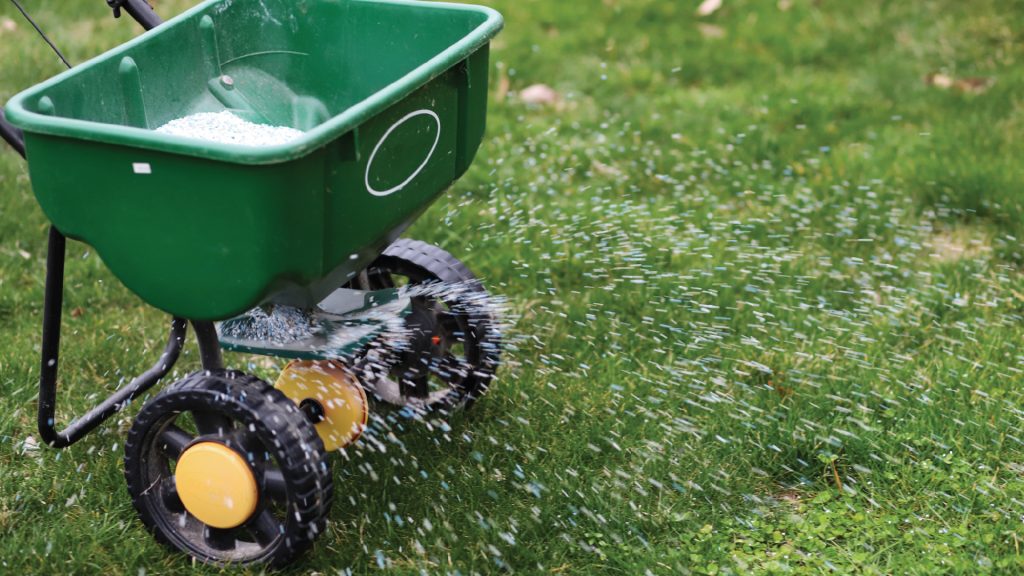
A targeted granular or liquid insecticide labeled for chinch bug control (bifenthrin, lambda-cyhalothrin, or imidacloprid are the most common active ingredients) applied at the leading edge of the damage and 5 to 10 feet beyond into the surrounding healthy lawn stops the spread. The product needs to be watered in within 24 hours so the active ingredient reaches the thatch layer where chinch bugs feed. Repeat application in 4 to 6 weeks during peak season because reinfestation from neighboring properties is common in South Miami.
Once chinch bugs are knocked down, recovery is about getting the surviving grass to spread back into the dead zones. That requires increased watering (three quarters of an inch twice a week through July and August), light fertility to support stolon growth, and patience. A patch the size of a kitchen table takes 6 to 10 weeks to fill in from the edges. Patches larger than 4 by 4 feet often need sod replacement in the dead area.
Prevention for the Rest of the Season
Once you have had one chinch bug outbreak in a South Miami lawn, you are on a treatment cycle for the rest of summer. Eggs that were laid before the first treatment hatch later. Adults migrate in from neighbors. The honest pattern for a treated lawn is preventive treatment every 4 to 6 weeks from June through September.
Cultural fixes that reduce pressure. Avoid heavy nitrogen fertilizer in summer, which produces lush growth that chinch bugs prefer. Mow at 3.5 to 4 inches (chinch bugs prefer hotter, drier turf). Water deeply rather than frequently. Address any thatch buildup with annual core aeration. Keep an eye on the sunniest sections of the lawn weekly. Damage that gets caught at the size of a dinner plate is fully recoverable. Damage that grows to the size of a car hood often needs sod.
What to Do Next
If you have a yellow patch in your South Miami St. Augustine and you have already done the float test (or you want us to do it), call us before the damage spreads. The cost of treating a 12-foot patch is a fraction of the cost of resodding 200 square feet of dead lawn.
Lawn Squad of South Miami serves homeowners across the South Miami area, including the Pinecrest, Palmetto Bay, Coral Gables, Cutler Bay, Kendall, and surrounding neighborhoods.
Call us at 786-310-1011 or request a free quote at lawnsquad.com. Our VitaminLawn program is built specifically for South Miami’s St. Augustine, Bermuda, and Zoysia lawns growing in our sandy and rocky South Florida soils, with chinch bug, sod webworm, and tropical disease monitoring built into every visit during the warm months.