Short Answer: Bermuda lawns in the North Atlanta area typically begin visible green-up in mid to late April, with full green-up usually complete by mid May. Timing varies year to year based on soil temperatures, lingering cold nights, fall fertilization quality from the previous year, and shade exposure. Lawns that received strong fall feeding and have full sun exposure green up first. Lawns under tree canopy, with fertility deficits, or with significant winter damage lag behind. Patience matters in April; most differences between neighboring lawns even out by early June. Here is the practical guide for properties across Alpharetta, Roswell, Marietta, Cumming, and the surrounding North Atlanta area.
You drive through North Atlanta neighborhoods in mid April and one Bermuda lawn looks ready for summer while the lawn next door is still mostly brown. The houses are similar, the lots are similar, and yet there is a visible gap. The answer is rarely random.
Across Alpharetta, Roswell, Marietta, Cumming, Sandy Springs, Dunwoody, and our broader service area, here is what drives Bermuda green-up.
The Soil Temperature Trigger
Bermuda starts active growth when soil temperatures hit 65 degrees consistently at 4-inch depth. Air temperature does not directly drive green-up; soil temperature does.
North Atlanta soil temperatures typically reach 65 degrees between mid and late April. Warm springs push the timing earlier; cold springs delay it.
Within a property, soil temperatures vary. Southern-facing exposures warm faster than northern sides. Open lawn warms ahead of areas under tree canopy. The first parts to green up are the sunniest, warmest areas.
What Strong Fall Feeding Does
One of the biggest predictors of green-up speed is the late-fall fertilization done the previous year. Lawns that received quality fall winterizer typically green up faster and more uniformly.
Fall feeding builds carbohydrate reserves in roots and stolons that the grass uses to wake faster in spring. Without those reserves, the lawn builds green tissue from stored sugars alone, which is a slower process.
If your lawn is greening slower than neighbors, the answer often traces to last fall.
What Shade Does
Bermuda needs at least 6 hours of direct sun for healthy growth. Areas under significant tree canopy receive less sun and stay cooler longer.
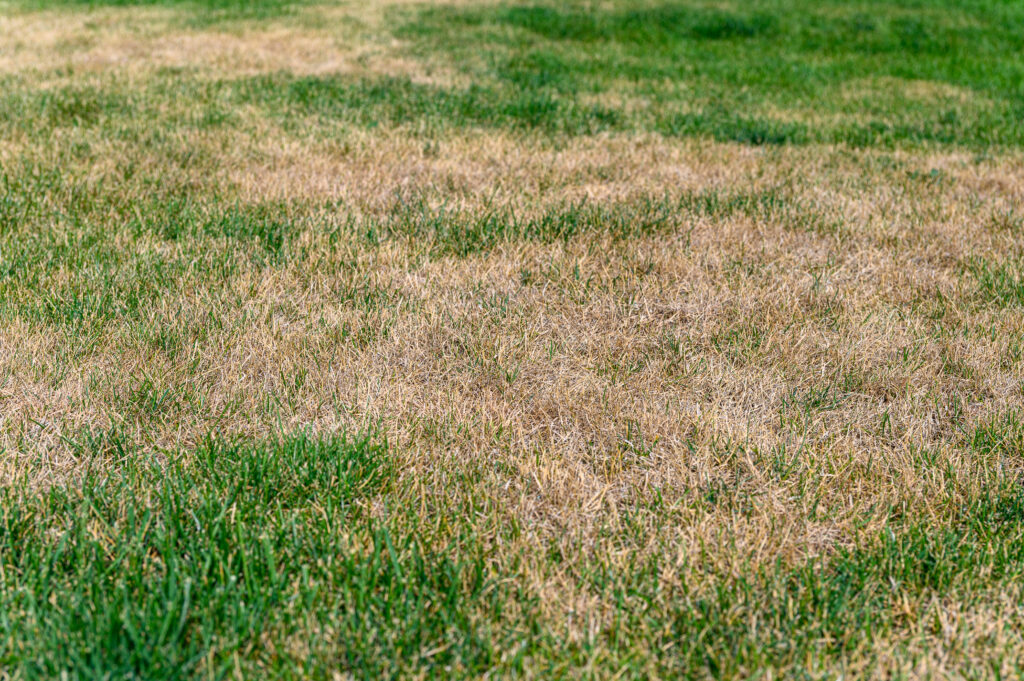
Result on shaded properties: patchy green-up. Open lawn greens up first; shaded areas under trees green weeks later or thin out instead of greening.
Properties with mature shade trees often have year-over-year worsening Bermuda performance under the canopy. The honest answer is often that Bermuda is the wrong grass for chronically shaded areas. Zoysia tolerates more shade. Tall fescue may be even better for heavily shaded zones.
What Winter Damage Does
North Atlanta winters are typically mild but occasionally include cold snaps. Severe cold can damage Bermuda crowns in exposed areas, particularly on northern exposures or wind-exposed properties.
Winter damage shows as patchy green-up in specific areas year over year. Areas slow to green and still thin by late May are usually winter damage rather than slow timing.
Soil Conditions and Compaction
Compacted soils hold cold longer and have less root function. Areas with foot traffic, parking, or play equipment show slower green-up.
Annual aeration during active growing season relieves compaction. Properties on regular aeration programs show faster more uniform green-up.
Soil chemistry matters. Lawns with off pH or significant nutrient deficiencies wake slower.
What to Do During the Wait
Productive things while waiting:
Soil test if you have not in 2 years.
Spring debris cleanup.
Light raking on any matted damage areas.
Pre-emergent crabgrass control at the soil-temperature window (February to early March).
Equipment service before the first mow.
What Not to Do
Heavy fertilization before full green-up. Bermuda cannot use nitrogen efficiently until fully active.
Aggressive raking or scalping before crowns are fully active.
Heavy traffic on still-dormant or barely-greening areas.
Panicking about slow green-up before mid-May.
How Pre-Emergent Affects Green-Up
Pre-emergent applied at the right time has almost no effect on green-up. The chemistry targets germinating annual grass seeds without affecting established Bermuda runners and crowns.
Standard rates produce no meaningful effect on Bermuda waking up.
Iron Application for Color
Iron applied to actively-greening Bermuda produces visible deeper green within 5 to 7 days. Bermuda often shows mild iron deficiency in our Georgia soils, and chelated iron corrects it quickly.
Iron does not actually speed biological green-up; it makes already-occurring green more visible. Properties looking for color boost in mid to late April benefit from chelated iron.
The Patience Factor
Most North Atlanta Bermuda lawns that look slow in mid-April look fine by mid-May. Spring green-up is a 6 to 10 week process, and judging against early-greening neighbors at week 2 produces unfair comparisons.
Wait until late April or early May to assess. Lawns not greened up by then are signaling actual issues. Lawns still catching up at that point are usually fine.
Reading Visible Cues
Several cues help track green-up progress. First green tinge in stolons typically appears as soil hits 60 degrees. Light green color follows by 65 degrees consistently. Deep emerald green arrives at 70 degree soil temperatures.
Inspect closely along the soil line. Stolons green from the base up. Visible canopy color lags behind what is happening at the soil. Lawns that look mostly brown but have green-tinged stolons are about to surge into full green-up.
Elevation and Microclimate
North Atlanta has significant elevation variation across the metro. Properties at higher elevations (Cumming, parts of Roswell, ridge tops in Sandy Springs) typically run a week or two behind valley properties in spring warm-up.
Within a single neighborhood, micro-elevations and exposures produce timing differences. A property at the top of a hill may green up later than a property at the bottom of the same hill, even though they share neighborhood characteristics.
Mature neighborhoods with significant tree canopy in areas like Vinings, Brookhaven, and parts of Sandy Springs face more shade-related green-up issues than newer subdivisions in Cumming or Alpharetta with less mature trees.
Setting Up the Year
Properties that handle green-up correctly produce stronger summer lawns. Key practices: proper fall fertilization the previous year, soil testing every 3 years, correctly-timed pre-emergent, patience through transition, light fertility once active growth established, and proper mowing height matching the grass type.
The transition from dormant to fully active is the most visible lawn care window of the year. Getting it right matters for the rest of the season.
What If Your Lawn Is Behind Neighbors
Several questions guide diagnosis:
What does fall feeding history look like? Strong fall feeding is the biggest predictor of fast spring green-up.
Sun exposure? Significant tree canopy will affect timing regardless of other care.
Compaction? Annual aeration produces visible improvements over 2 to 3 years.
Disease history? Take-all root rot or other ongoing issues weaken spring recovery.
Variety differences? Common Bermuda varieties green up slightly faster than some hybrids. Different sod sources produce different timing.
What to Expect From a Slow Lawn
Slow lawns that are not signaling underlying issues typically follow the same trajectory as fast lawns, just 1 to 3 weeks behind. By June, most differences have evened out.
Slow lawns with underlying issues need investigation. Specific damage types, soil chemistry problems, drainage issues, or wrong grass type for the conditions all produce different trajectories than just slow timing.
Diagnosis is the first step. The fix depends on what is actually driving the slow performance.
Coordinating Green-Up Timing With Other Spring Tasks
Bermuda green-up timing affects when other spring tasks happen. Equipment service before the first mow (which waits for full green-up). Fertilization after active growth is established. Scalping after full green-up plus 2 weeks. Aeration in late spring through early summer.
Properties that coordinate these tasks around green-up timing produce better results than properties that approach each separately on calendar dates.
What to Do Next
If you would rather have someone else handle the timing decisions, product selection, and application for your North Atlanta lawn, we are here for that.
Visit lawnsquad.com to find Lawn Squad of North Atlanta and request a free quote. Our VitaminLawn program is built specifically for the grass types, soils, and weather patterns in our service area. Most homeowners see noticeable improvement within the first two applications.