
Short Answer: Soil temperature drives spring lawn timing in the Chattanooga area more than any calendar date. Cool-season grasses begin active growth as soil hits 50 to 55 degrees Fahrenheit at 4-inch depth. Warm-season grasses (Bermuda, Zoysia, Centipede) begin green-up at 65 degrees and reach full activity at 70 degrees. In our transition zone climate, both grass types are common, sometimes on the same property. Soil temperatures in our area typically cross the cool-season threshold in mid-March and the warm-season threshold in mid to late April. Pre-emergent timing, fertilization, and first-mow decisions all hinge on these readings. Here is the practical guide for properties across Chattanooga, Cleveland TN, Dalton GA, and the surrounding area.
Across our service area, late winter into early spring is the highest-leverage window for lawn care decisions. Soil temperatures drive when grass wakes up, when crabgrass germinates, and when fertilizer can actually be used. Tracking those temperatures produces better decisions than guessing from air temperature or calendar dates.
For properties across Chattanooga, Cleveland TN, Dalton GA, Ringgold, East Ridge, and our broader transition zone service area, here is the practical guide.
Why Soil Temperature, Not Air
Grass roots respond to soil temperature, not air temperature. The two diverge significantly in spring. Air can hit 70 degrees on a sunny March day while soil is still in the upper 40s. The grass and weeds respond to what is happening at the root level.
Soil also has thermal lag. Several days of warm air are needed to raise soil temperature meaningfully. Several days of cold air can cool soil back down. Calendar dates that worked in a warm spring miss badly in a cold one and vice versa.
The Two Key Thresholds in Our Area
For the Chattanooga area, two soil temperature thresholds matter most:
50 to 55 degrees Fahrenheit at 4-inch depth. This is when cool-season grass (tall fescue, Kentucky bluegrass) begins active growth and when crabgrass seeds start germinating. Pre-emergent crabgrass control timing hinges on this number.
65 degrees at 4-inch depth. This is when warm-season grass (Bermuda, Zoysia, Centipede) begins active green-up. Significantly above this is when warm-season fertilization becomes effective.
In our area, the cool-season threshold typically arrives mid-March, the warm-season threshold mid to late April. Year-over-year variation is 2 to 4 weeks.
How to Track Soil Temperature
Several methods work for tracking soil temperature in our area:
Direct measurement with a soil thermometer is the most accurate. A stem thermometer pushed 4 inches into the soil tells you exactly where your specific lawn is. Cost is $10 to $20 and the tool lasts indefinitely.
University of Tennessee Extension and University of Georgia Extension publish regional soil temperature data through spring. Cross-reference with local readings.
Weather service products provide soil temperature data from monitoring stations.
Visible indicators help. Forsythia blooming, redbud opening, and tulip magnolia in flower all correlate with cool-season germination temperatures. Bermuda showing first green tinge correlates with warm-season threshold approach.
What the Mixed Grass Reality Looks Like
Many Chattanooga area properties have both cool-season and warm-season grass on the lawn. Bermuda dominates sunny areas. Fescue persists in shaded zones. The two grasses wake up at different times.
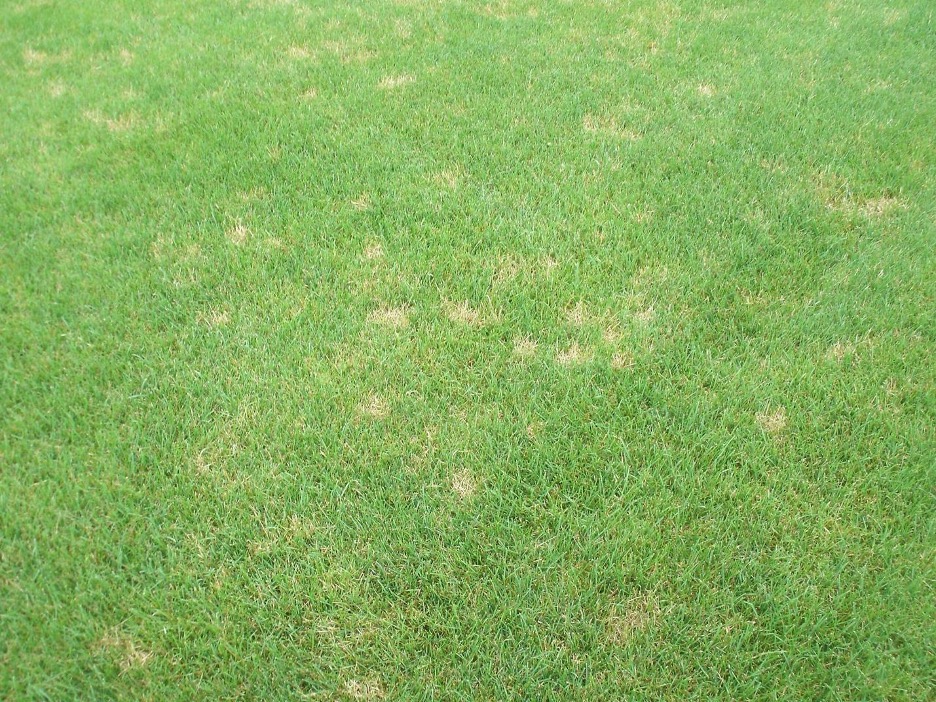
This produces a visible pattern most homeowners notice: shaded fescue greens up in March while sunny Bermuda areas stay tan into April. The lawn looks patchy through spring transition. By May, both grasses are active and the lawn looks more uniform.
For lawn care decisions, this means different timing on different areas of the same lawn. Cool-season fertility timing serves the fescue. Warm-season fertility timing serves the Bermuda. Trying to apply one schedule across both grasses misses the right window for at least one.
Pre-Emergent Timing
Pre-emergent crabgrass control needs the chemical barrier in place before crabgrass seeds germinate. In our area, that means application when soil temperatures approach 50 to 55 degrees consistently, typically late February to mid-March.
Apply too early and the barrier degrades before late-summer crabgrass germination flushes. Apply too late and crabgrass has already sprouted.
The window is roughly 3 to 4 weeks of correct timing. Properties on calendar-based schedules hit the window perfectly in some years and miss badly in others.
Fertilization Timing
Fertilizer timing follows active growth, not soil temperature directly. Apply nitrogen to grass that is actively growing, not to grass that is barely waking up.
For cool-season grass: light fertilization once active growth is visible, typically late March to early April in our area.
For warm-season grass: wait until full green-up is complete plus 2 weeks, typically early to mid May.
Premature fertilization on either grass type wastes product and can damage barely-active grass.
First-Mow Decisions
Cool-season grass typically needs its first mow when growth is actively producing height gain. For Chattanooga fescue, this is usually mid to late March depending on the year.
Warm-season grass first mow waits until full green-up. For Chattanooga Bermuda, this is typically late April to early May.
Properties with mixed grass face the decision of when to start mowing. The general approach is to begin mowing when the actively-growing grass type needs it, even if other grass types are not yet active. Set the mower at the height appropriate for the dominant grass type.
Aeration and Renovation Timing
For cool-season grass, fall is the preferred aeration window. Spring aeration is possible but produces less benefit.
For warm-season grass, late spring (after full green-up plus 2 weeks) through early summer is the preferred aeration window. Aerating before active growth wastes the opportunity for grass response.
Renovation timing follows the same logic. Cool-season renovation in fall, warm-season renovation in late spring.
Chattanooga Climate Realities
Several factors specific to our area affect spring timing:
Elevation variation across the metro produces real timing differences. Properties on Signal Mountain or Lookout Mountain run cooler than valley properties. Same neighborhood differences are smaller but still present.
Northern exposure properties run cooler than southern exposure. Same property can have areas that warm at different rates.
Heavy clay soils common across the area warm slower than sandy soils.
Mature tree canopy in established neighborhoods produces shade that slows soil warming significantly.
Late frosts in March or April can reset soil temperature progress. After a hard frost, soil cools back down and any actively-growing grass faces stress.
Building a Tracking Habit
The simplest setup is a soil thermometer kept in a representative part of your lawn from late February on. Check it once or twice a week initially. Note the readings on a calendar. When you see 45 degrees rising, check daily.
When soil crosses 50 to 55 degrees consistently for 3 to 4 days, that triggers cool-season germination and pre-emergent timing.
When soil crosses 65 degrees consistently for 3 to 4 days, that triggers warm-season green-up and the start of warm-season management.
Most homeowners who try this for a season find they time their applications better than calendar-based approaches.
Common Mistakes in Spring Timing
Using last year’s date for this year’s applications. Year-over-year variation is significant.
Reading air temperature instead of soil. Air temperature swings dramatically and is not what the grass responds to.
Treating mixed-grass lawns with single-grass timing. Different grasses need different schedules.
Fertilizing dormant or barely-active grass. Wastes product and produces no benefit.
Applying pre-emergent too early to be safe. Burns out before late-summer pressure peaks.
Aerating in the wrong season for the grass type. Cool-season aeration in fall, warm-season aeration in late spring.
What Tracking Produces Over Time
Properties on data-driven timing typically see better results year over year than properties on calendar-based schedules. The benefits compound: better pre-emergent control reduces summer weed pressure, better fertilization timing produces stronger lawn response, and better mowing timing supports density rather than stressing barely-active grass.
The investment in tracking is minimal. A soil thermometer and 5 minutes a week through spring produce a measurable improvement in lawn outcomes.
What to Do Next
If you would rather have someone else handle the timing decisions, product selection, and application for your Chattanooga and North Georgia lawn, we are here for that.
Lawn Squad of Chattanooga & North Georgia serves Apison, Chattanooga, Chickamauga, Cleveland TN, Cohutta, Collegedale, East Brainerd, Flintstone, Fort Oglethorpe, Graysville, Harrison, Hixson, and surrounding areas.
Call us at 423-287-4871 or request a free quote at lawnsquad.com. Our VitaminLawn program is built specifically for the grass types, soils, and weather patterns in our service area. Most homeowners see noticeable improvement within the first two applications.