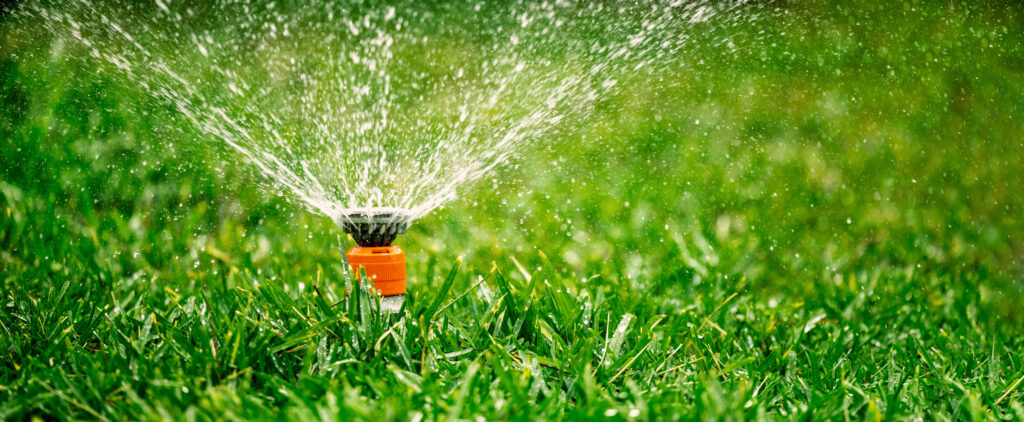
Short Answer: Most established Cincinnati lawns need 1 to 1.5 inches of water per week during peak growing season, delivered in 2 deep cycles rather than daily light watering. Watering should happen in early morning between 4 AM and 9 AM, never at night. Cincinnati clay soils hold water longer than sandy soils, so frequency matters less than depth. The biggest watering mistake we see is daily shallow watering that produces shallow roots that cannot survive July and August. Deep infrequent watering trains roots to grow down into the soil where moisture is more reliable. Here is the practical schedule.
Watering is one of the most consequential lawn care practices, and one of the most commonly done wrong. Across Cincinnati, Mason, West Chester, Loveland, Hyde Park, and our broader service area, we see the same watering mistakes repeatedly. The single biggest one is daily shallow watering, which produces shallow roots that cannot survive the heat we get in July and August.
Here is the practical guide to watering Cincinnati lawns through the growing season.
The Core Principle: Deep and Infrequent
Most established Cincinnati lawns need about 1 to 1.5 inches of water per week during active growing season, combining rainfall and irrigation. The key is how that water is delivered.
Deep, infrequent watering (2 cycles per week of about half an inch each, applied in early morning) trains roots to grow down into the soil where moisture is more reliable. The grass develops a 4 to 8 inch root system that handles drought and heat far better than shallow-rooted turf.
Daily light watering does the opposite. It keeps moisture only in the top inch or two of soil, and roots stay there because that is where the water is. When summer heat dries out the surface, those shallow roots have nothing to fall back on. The lawn browns out fast.
Cincinnati Clay Soil Considerations
Most Cincinnati area lawns sit on clay or clay-loam soils. The Ohio River Valley clay holds water longer than the sandy soils common further south. This affects watering practices in three ways:
Frequency can be lower. Where a sandy lawn might need watering every 3 days, a clay lawn often needs it every 4 to 5 days because the soil retains moisture longer.
Runoff is more likely. Clay absorbs water slowly, especially when dry. Heavy watering produces runoff before the water has time to soak in. Cycle and soak (split the irrigation into 2 shorter runs with 30 minutes of soak time between) helps.
Depth matters more. Clay holds water in the top few inches, but pushing roots deeper requires the water to actually reach those depths. Shorter run times that produce only surface wetting do not get water where it needs to be for deep roots.
Morning Watering: The Single Biggest Improvement
Watering between 4 AM and 9 AM is the right time of day for Cincinnati lawns. The reasons:
Less wind drift. Morning is calmer than afternoon, so spray patterns reach where they should.
Less evaporation. Cool morning soil absorbs water more efficiently than hot afternoon soil. Daytime watering can lose 20 to 30 percent to evaporation.
Less disease pressure. Wet grass overnight feeds many fungal diseases (brown patch, dollar spot, pythium). Morning watering lets the lawn dry through the day.
Better absorption. Clay soils accept water better when temperatures are cool and the surface is not crusted from heat.
Evening watering is the worst time and produces the most disease pressure across our service area. If you have only a manual hose available, water as early in the day as you can manage.
Measuring Your Sprinkler Output
Generic time recommendations do not work because sprinkler outputs vary dramatically. The simple test takes 20 minutes:
Place 5 to 6 empty straight-sided containers (tuna cans work) around one zone.
Run the zone for 15 minutes.
Measure the depth of water in each can.
Average them. Multiply by 4 to get the inches per hour rate.
Now you can calculate run time. If a zone delivers half an inch per hour, you need an hour twice a week to hit 1 inch. If it delivers a quarter inch per hour, you need 2 hours twice a week. Different zones often have different output rates, so test each one.
Spring Watering: Less Than You Think
April and most of May in Cincinnati typically does not require irrigation. Spring rainfall and cool temperatures mean cool-season grasses get most of what they need from natural conditions.
Many homeowners turn on irrigation systems in April and run them on full schedules. The result is over-watered spring lawns that develop fungal disease and shallow roots before summer even arrives.
If you have an irrigation system, leave it off through April and into early May. Watch the lawn. When it starts to need water (footprints staying visible after walking, slight color shift toward bluish-gray), that is when to turn on the system.
Late Spring and Summer: 1 to 1.5 Inches Per Week
From mid-May through August, most Cincinnati lawns need 1 to 1.5 inches of water per week, split across 2 cycles. During July heat waves with no rainfall, the upper end (1.5 inches) is appropriate.
Track rainfall. After significant rain, skip the next scheduled cycle or two. Smart controllers and rain sensors automate this if you have them.
Watch for signs of over-watering: persistent wet soil, mushrooms appearing, soft spongy turf, fungal disease outbreaks. Any of these means cut back.
Watch for signs of under-watering: footprints staying visible, bluish-gray color shift, dry crispy soil. Any of these means increase watering.
Heat Wave Adjustments
During Cincinnati heat waves (multiple days in the 90s), most lawns benefit from a slight increase in water. Up to 1.75 to 2 inches per week, still split across 2 cycles, may be appropriate during extreme heat.
However, more is not always better. Watering excessively during heat can produce as much disease pressure as drought stress. The goal is to keep the lawn just adequately watered rather than constantly wet.
Late Summer to Fall Transition
As temperatures cool in September, water needs decrease. Many Cincinnati lawns can drop back to once-a-week watering through September and October, then off entirely as cool weather and rainfall take over.
Fall fertilization and overseeding both benefit from consistent moisture, so do not stop watering entirely if you have just seeded or aerated. Adjust schedules to match the specific situation.
Smart Controllers
Modern smart irrigation controllers adjust automatically based on weather data, soil moisture sensors, and historical patterns. Quality smart controllers reduce water use by 20 to 50 percent compared to fixed schedules while producing equivalent or better results.
Rain sensors are the highest-value upgrade for any system without one. They override the controller during and after rainfall, preventing the system from running through storms. Most are inexpensive and pay for themselves through water savings within a year.
Common Cincinnati Mistakes
Daily watering for 10 to 15 minutes. Produces shallow roots that fail in July.
Set-it-and-forget-it programming. Spring schedules running at summer rates waste water. Update controller seasonally.
Watering at night. Single biggest disease driver in our climate.
Trusting a rain sensor that has stopped working. Many sensors fail silently. Test yours every spring.
Ignoring zone differences. Sun and shade zones, sloped and flat areas all need different run times.
What to Do Next
If you want help dialing in your watering schedule for your Cincinnati area lawn, we walk properties to do coverage and timing audits, calculate proper run times for each zone, and program controllers for optimal performance. If you would rather have someone else handle the timing decisions, product selection, and application for your Cincinnati lawn, we are here for that.
Visit lawnsquad.com to find Lawn Squad of Cincinnati and request a free quote. Our VitaminLawn program is built specifically for the grass types, soils, and weather patterns in our service area. Most homeowners see noticeable improvement within the first two applications.