Short Answer: Fire ants are a year-round reality in Birmingham, with peak mound activity from March through October. The most effective control approach is a two-step method: a broadcast bait application across the whole yard to take out the colonies you cannot see, followed by direct mound treatment for the colonies that are visible. Bait wins over contact insecticide because it kills the queen, not just the workers. A whole-yard professional treatment for a typical Birmingham residential lot runs $80 to $200 per application and typically reduces mound activity by 80 to 95 percent within three to four weeks. Below is the complete guide for keeping your Birmingham yard usable.
You walk out to the mailbox on a Saturday morning in Hoover and there it is. A new fire ant mound the size of a salad plate, right in the middle of where the kids play. Two days ago there was nothing. Now there is a colony of thousands, and within a week there will probably be three more.
If you have lived in Birmingham for more than one summer, you have lived through some version of this. Fire ants are not an “if” question in our area. They are a “when” and “how bad” question, and the answer to both depends almost entirely on what you do about them.
This is the deep dive we wish every Birmingham homeowner had before peak season hits.
How to Tell What You Are Actually Looking At
Not every ant in your yard is a fire ant, and that distinction matters because the treatment approach differs. Imported fire ants (Solenopsis invicta), the species that causes nearly all the damage in our area, have specific identifiers.
- Mound shape. Fire ant mounds are dome-shaped piles of loose, fluffy soil with no visible entry holes from the top. The ants enter and exit through tunnels underneath. Native ant mounds typically have a single visible entry hole at the top.
- Size and number. Fire ant mounds reach 12 to 18 inches across at maturity, and a typical untreated yard supports dozens of them. If you are counting mounds in the double digits, you are dealing with imported fire ants.
- Aggression. Disturb a fire ant mound and within seconds, hundreds of workers stream out in every direction looking for what hit them. Most native ants are far less aggressive.
- The sting. Fire ants both bite (to grip) and sting (to inject venom). The pain is sharp and burning, and the resulting white pustule is unique to this species.
If you can confirm two or more of those signs, you have imported fire ants. The rest of this guide assumes that is what you are dealing with.
Why Birmingham Is a Year-Round Fire Ant Market
Several things stack on top of each other to make our region one of the most active fire ant markets in the country.
Our climate keeps colonies active most of the year. Imported fire ants slow down in genuine cold but rarely freeze out completely in our part of Alabama. Mild winters mean colonies survive, expand, and hit spring with reproductive momentum.
Our soils support easy mound construction. The clay-heavy soils across most of Birmingham give fire ants the structure they need to build deep, weatherproof colonies that can house 200,000+ workers. Sandier southern Alabama soils support fewer mounds per acre.
Our rainfall pattern triggers visible mound activity. Heavy rain forces colonies to the surface to repair damage, which is why you suddenly see five new mounds the day after a thunderstorm. They were there. They just were not visible.
Our long warm season means colonies have months to mature. A new colony established in March can be at full size and producing reproductives by July.
The Lifecycle (and Why Spring Mounds Explode)
Understanding the colony lifecycle changes how you think about treatment.
A new colony starts when a winged reproductive female (a future queen) lands on bare soil after a mating flight. Mating flights happen most often in spring and after heavy rain events. The queen sheds her wings, digs into the soil, and lays her first batch of eggs.
For the first month or two, the new colony is small and vulnerable. By month three, it has produced enough workers to be self-sustaining. By the end of the first year, a healthy colony has 50,000+ workers and is starting to produce its own reproductives.
This is why spring is the make-or-break window. The colonies you see in March are last year’s mature colonies. The mounds that explode in May and June are new colonies established by spring mating flights. If you treat in early spring before those new colonies establish, you are working with the smaller existing population. If you wait until July, you are fighting many more colonies.
Health and Safety Considerations
Fire ant stings are not just painful. For some Birmingham residents, they are a real medical concern.
For most people, a fire ant sting causes a sharp burning pain followed by a white pustule that takes 5 to 7 days to clear. Itchy, annoying, but not dangerous on its own.
For about 1 percent of the population, fire ant venom triggers a severe allergic reaction. Symptoms can range from widespread hives and swelling to anaphylactic shock requiring epinephrine and emergency care. If anyone in your household has experienced a strong reaction to insect stings before, fire ants in your yard are a genuine safety concern, not just a nuisance.
Children are higher risk because they are more likely to disturb a mound without realizing it, more likely to receive multiple stings before getting away, and have less body mass relative to the venom dose. Pets, especially dogs that sniff and dig, can receive face and mouth stings that trigger swelling around the airway.
If you have small children, elderly family members, anyone with insect allergies, or pets that use the yard, the case for active fire ant control goes from “nice to have” to “actively important.”
The Single Most Important Concept: Bait Beats Contact
Most homeowners reach for whatever spray or granular insecticide is at the hardware store and pour it directly on the mound they can see. This kills the workers on contact. It feels satisfying. It does almost nothing about the actual problem.
Here is why. A fire ant colony has one queen who lays all the eggs. The workers you see are expendable. As long as the queen survives, the colony rebuilds the worker population in days. Killing 5,000 workers feels productive but barely dents a colony of 100,000.
Bait products work differently. Workers find the bait, carry it back into the colony, and feed it to the queen and the brood. The active ingredient takes effect over 1 to 4 weeks, killing the queen and collapsing the entire colony from the inside.
The trade-off: bait is slower than contact. You will not see immediate results. But the colony is genuinely gone in 3 to 4 weeks, versus the contact-only approach where the same mound is back in 7 to 10 days.
The Two-Step Method (What Actually Works)
The most effective approach across Birmingham yards is a two-step method that combines the strengths of both bait and contact treatments.
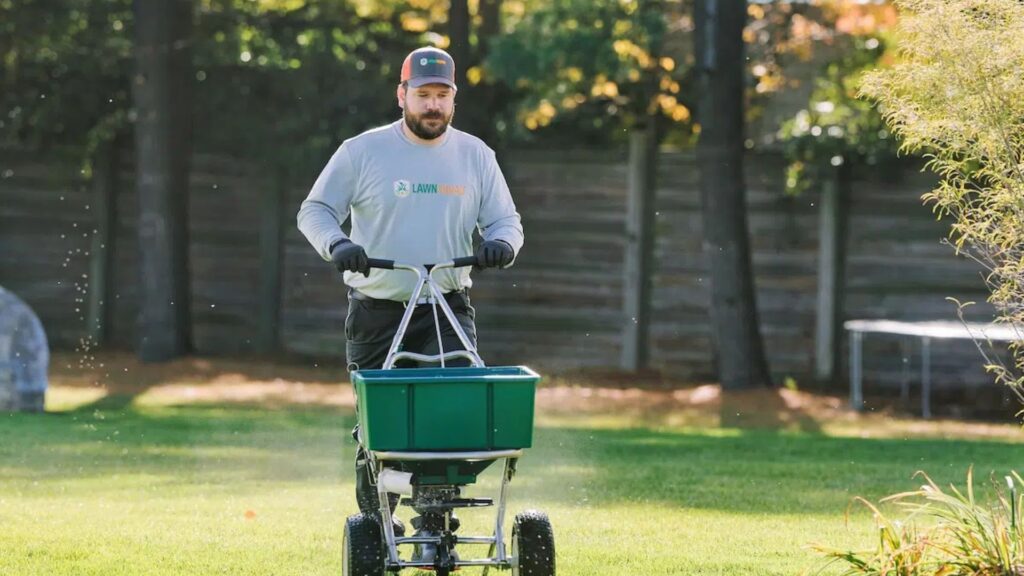
Step 1: Broadcast bait across the entire yard. Using a hand-crank spreader or a calibrated broadcast spreader, distribute a fire ant bait product evenly across the lawn at the rate specified on the label. The bait targets every colony in the yard, including the ones you cannot see (which is most of them). Time this for a dry period when no rain is forecast for at least 24 hours, since wet bait loses effectiveness.
Step 2: Direct mound treatment on visible colonies. Two to three weeks after the broadcast bait, treat any remaining visible mounds directly with a contact insecticide or a mound-specific bait. By this point, the broadcast bait has weakened or eliminated most colonies, and direct treatment finishes the survivors.
Done correctly, this two-step approach typically reduces mound activity in a yard by 80 to 95 percent. Maintenance broadcast applications every 3 to 4 months keep the population suppressed long-term.
What Works at the Hardware Store
For DIY homeowners, the bait products that consistently work in Birmingham conditions include hydramethylnon-based baits, indoxacarb-based baits, and methoprene-based growth regulators. Each has slightly different speed and persistence profiles. The label tells you what you are getting.
For contact mound treatment, products containing fipronil, bifenthrin, or acephate work well as direct kills. Read the label and follow the rate exactly. Doubling up does not help and can damage your turf.
Avoid pouring boiling water, gasoline, or various folk remedies on mounds. Boiling water kills only the workers on the surface. Gasoline contaminates the soil and is illegal in many cases. Most folk remedies do not address the queen and produce short-term satisfaction at best.
When Professional Treatment Is the Better Call
DIY can absolutely work for fire ant control. We are not telling you it cannot. But there are situations where professional treatment is consistently the better choice.
Larger lots benefit from professional broadcast equipment that distributes bait more evenly than handheld spreaders. On a half-acre or larger lot, the time savings alone often justify the cost.
Yards with heavy mound activity (20+ visible mounds) need a coordinated, sustained program more than a single application. Professional services follow up with second and third applications timed to the colony lifecycle.
Properties with sensitive members (children, elderly, allergic individuals, pets) benefit from the certainty that professional applicators bring to product selection and rate calibration.
Households that have already tried DIY and seen the mounds come back are usually dealing with a re-infestation pattern that needs sustained pressure rather than another DIY round.
For most Birmingham residential lots, a professional fire ant treatment runs $80 to $200 per application, with a season-long program of three to four applications running $300 to $600. Compared to the cost of an emergency room visit for an allergic sting reaction, the math is straightforward for at-risk households.
What to Do Next
If you are looking at fire ant mounds right now and trying to figure out whether to handle it yourself or call us, the order of operations is the same either way. Identify the species. Time the treatment for the front of the season. Use the two-step method. Plan for follow-up applications.
If you would rather hand it off, Lawn Squad of Birmingham serves Alabaster, Bessemer, Birmingham, Calera, Chelsea, Helena, Homewood, Hoover, Indian Springs, Inverness, Maylene, Montevallo, Mountain Brook, Pelham, Pinson, Trussville, and Vestavia Hills.
Call us at 205-573-1921 or visit lawnsquad.com. We can build a fire ant program into your VitaminLawn schedule or run it as a standalone service. Either way, the goal is the same: a Birmingham yard you can actually use without watching where every kid and every dog steps.