
Short Answer: In April, Murfreesboro lawns are in full spring transition. Warm-season Bermuda and Zoysia are greening up, Fescue is at peak spring vigor before summer stress hits, and pest and disease pressure is ramping up fast. The four biggest priorities this month: finish your second pre-emergent application, feed warm-season grass at green-up, treat for fire ants, and watch for early large patch on Zoysia. Below is the week-by-week plan we follow across Murfreesboro, Smyrna, Mt. Juliet, Nolensville, and Middle Tennessee.
You step out onto your Murfreesboro, Smyrna, or Nolensville lawn one April morning. The Bermuda is mostly green but a few sections are still waking up. The fescue in the shaded back looks great for now but you know it is on borrowed time once Tennessee summer heat arrives. Fire ant mounds have popped up near the driveway overnight. And you are trying to figure out what to do first.
Spring in Middle Tennessee is tightly packed. Here is the week-by-week plan we walk every Murfreesboro customer through.
Week 1 of April: Walk, Observe, Clean Up
Before doing anything active, walk the lawn. Look for:
- Circular yellow-orange patches starting in Zoysia (early large patch)
- Bermuda areas slow to green up while the rest of the lawn has greened (possible take-all root rot)
- Fire ant mounds emerging, particularly in sunny spots and near the driveway
- Winter weed holdovers: henbit, chickweed, Poa annua
- Compaction along walking paths and in newer Mt. Juliet or La Vergne construction
Clear fallen branches, leaves, and any landscape debris. Gently rake any matted areas in fescue. Do not power-rake or dethatch aggressively in April.
Fertilization before green-up is wasted effort on warm-season lawns. Hold off until the grass is actively growing.
Week 2 of April: Second Pre-Emergent and Green-Up Feeding
If you put down the first pre-emergent in late February or early March (standard for Middle Tennessee), this is the split-rate second application window. It extends coverage through May and catches later-germinating goosegrass.
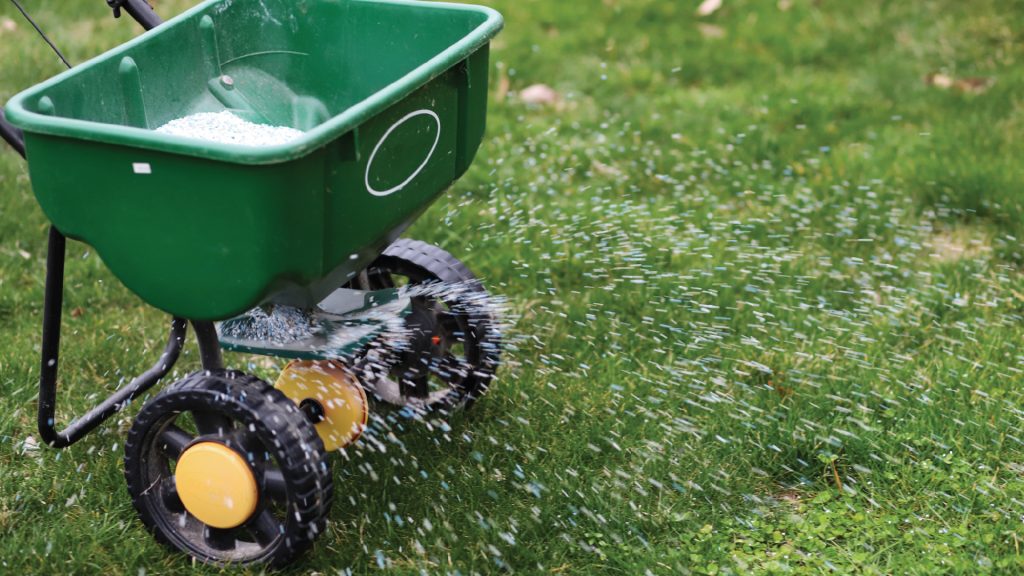
This is also the green-up feeding window for warm-season grasses. When Bermuda is 70+ percent green and actively growing, apply a balanced fertilizer. For fescue in shaded areas, apply only a light spring feeding. The real fescue fertility is in fall.
Grass type matters:
- Bermuda: responds to nitrogen at green-up, can handle higher rates
- Zoysia: moderate nitrogen, avoid heavy rates that fuel large patch
- Fescue: light feeding only in spring, heavy feeding in fall
- Centipede: very light nitrogen, centipede declines with heavy feeding
Week 3 of April: First Real Mow by Grass Type
Once the lawn is consistently growing, mow for the first time. Height depends on the grass:
- Bermuda (home lawn): 1 to 1.5 inches
- Zoysia: 2 to 3 inches
- Tall fescue: 3.5 to 4 inches
- Mixed lawn: mow each section at its appropriate height
Rules for the first mow: sharp blade, never remove more than one-third of the height in a single pass, mow when dry. Wet mowing on our heavy clay soil starts compaction.
This is also a good week to pull a soil sample. Middle Tennessee sits on limestone bedrock and often has slightly alkaline pH. UT Extension or your lawn care company can run the test for about $15.
Late April: Fire Ant Treatment and Disease Watch
Broadcast fire ant bait across the whole lawn in late April. This takes out existing colonies over 2 to 4 weeks and prevents new ones from establishing. Fire ant pressure in Middle Tennessee is constant, and one well-timed spring application dramatically reduces summer activity.
Also watch for early large patch on Zoysia. Circular yellow-orange patches in low-lying or shaded spots. If active, reduce spring nitrogen, improve drainage, and apply targeted fungicide.
End of April: Light Broadleaf Weed Control
Dandelion, clover, wild violet, and ground ivy all flush in Middle Tennessee in April and early May. Spot-treat rather than blanket-spray unless pressure is heavy. Active weed growth is the best time to treat for maximum effectiveness.
What Not to Do in April in Murfreesboro
- Do not apply pre-emergent and overseed at the same time. You will lose both.
- Do not dethatch warm-season grass aggressively. It is still building runners for the season.
- Do not fertilize warm-season grass before green-up. Nitrogen just feeds winter weeds.
- Do not scalp fescue. It stays at 3.5 to 4 inches year-round.
- Do not skip fire ant treatment. Spot-treating all summer is never as effective as one spring broadcast.
What This Month Sets Up
If you follow this plan, by early June your Murfreesboro lawn should have: crabgrass and summer annual weeds locked out, warm-season grasses fully green and growing, fire ants suppressed, early disease pressure under control, and broadleaf weeds reduced. From there, summer management is mostly watering, mowing, and spot treatments.
What to Do Next
If you would rather have someone else handle the timing and applications, we are here for that.
Lawn Squad of Murfreesboro serves Arrington, Christiana, Gladeville, La Vergne, Mt. Juliet, Murfreesboro, Nolensville, and Smyrna.
Call us at 615-622-6918 or request a free quote at lawnsquad.com. Our VitaminLawn program is built specifically for Middle Tennessee’s warm-season grasses, limestone-influenced soils, and humid summer disease pressure.