The short answer: Lawn aeration helps Cincinnati lawns thrive by relieving soil compaction that blocks water, air, and nutrients from reaching grass roots. The process removes small plugs of soil across your lawn, creating channels that allow roots to grow deeper and access the resources they need for healthy growth.
Cincinnati’s clay soils compact more severely than sandy soils found in other regions. This compaction worsens every year from foot traffic, mowing, and the natural settling that occurs during wet and dry cycles. Without aeration, even the best fertilizer and watering practices cannot overcome the barrier that compacted soil creates.
Quick overview:
- What aeration does: Removes thousands of small soil plugs to relieve compaction and improve soil structure
- When to aerate: Fall is optimal for Cincinnati lawns, with late August through October providing the best results
- How often: Most Cincinnati lawns benefit from annual aeration, with heavily used lawns needing twice yearly treatment
- Expected results: Deeper roots, better drought tolerance, improved fertilizer uptake, and thicker turf
Keep reading to learn exactly how aeration works, when to schedule it, and why Cincinnati’s unique soil conditions make this service essential for lawn health.e, what products work best, and how to avoid the mistakes that ruin Cincinnati lawns every year.
The Complete Aeration Approach: Our Seasonal Program
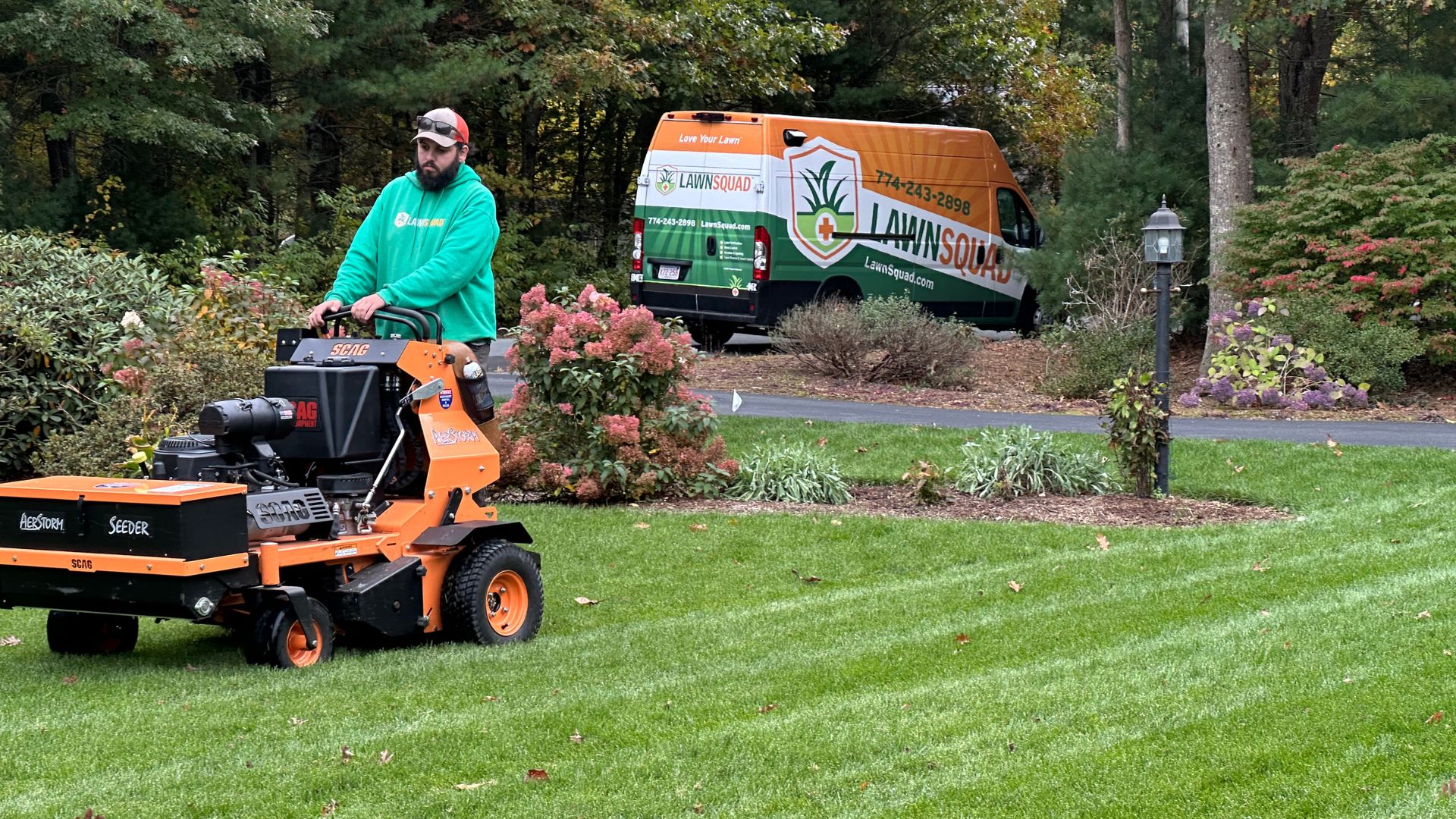
At Lawn Squad of Cincinnati and Northern Kentucky, we include core aeration in Rounds 5 and 6 of our ELITE program because we know how critical this service is for lawns throughout the tri-state area. The timing in mid August and late September targets the fall growth period when cool season grasses recover fastest from aeration.
Our approach addresses the specific challenges lawns face across Hamilton, Butler, Warren, Clermont, Kenton, Boone, Campbell, and Grant counties. The heavy clay soils throughout Greater Cincinnati and Northern Kentucky compact severely during summer drought, creating conditions that suffocate grass roots and limit growth.
Whether you aerate yourself or hire professionals, understanding why this service matters helps you appreciate its value. Aeration is not glamorous, but it may be the single most important cultural practice for maintaining a healthy Cincinnati lawn over time.
Why Aeration Matters More Than Most Cincinnati Homeowners Realize
Most homeowners focus on fertilizer, weed control, and watering when thinking about lawn care. These are all important, but they cannot overcome the fundamental problem of compacted soil.
Think of soil compaction like a sponge that has been squeezed and dried out. A fresh sponge absorbs water easily and holds air in its pores. A compressed, hardened sponge repels water and contains no air spaces. Your lawn’s soil works the same way.
Here is the key principle every Cincinnati homeowner needs to understand: grass roots need three things from soil: water, air, and nutrients. Compacted soil blocks all three. Water runs off the surface instead of soaking in. Air cannot penetrate the dense soil structure. Fertilizer sits on top where it washes away or volatilizes into the atmosphere instead of reaching roots.
Cincinnati’s clay soils make this problem worse than in regions with sandy or loamy soils. Clay particles are microscopic and pack together tightly when compressed. Once compacted, clay soil resists penetration by water, roots, and air far more stubbornly than lighter soil types.
The Ohio Valley’s weather patterns contribute to compaction as well. Our cycle of wet springs, dry summers, and freeze thaw winters causes soil to expand and contract repeatedly. Each cycle compresses soil particles closer together. Without intervention, compaction worsens every year.
How Core Aeration Works
Core aeration uses a machine with hollow tines that punch into the soil and remove small plugs. A typical residential aerator removes plugs about three quarters of an inch in diameter and two to three inches deep, spaced three to four inches apart across the entire lawn.
The Mechanical Process
The aerator rolls across your lawn with rotating drums that drive hollow tines into the ground. As each tine penetrates, it captures a core of soil inside the hollow tube. When the tine withdraws, the soil plug drops onto the lawn surface.
A single pass with a professional aerator creates thousands of holes across an average lawn. Two passes in different directions doubles the hole density, which most Cincinnati lawns need given our severe compaction issues.
The soil plugs left on the surface look messy at first, but they serve an important purpose. As they break down over one to two weeks, they return organic matter and beneficial microorganisms to the lawn. The thatch layer that builds up on many lawns begins decomposing faster when mixed with the soil from these cores.
What Happens Underground
The immediate effect of aeration is the creation of channels through compacted soil. These channels allow water to penetrate rather than running off. They allow air to reach the root zone. They create paths for roots to grow deeper into soil that was previously impenetrable.
Over the following weeks, the soil around each aeration hole gradually loosens as roots grow into the space and organic matter accumulates. The holes themselves fill in with new root growth and healthy soil, but the improvement in soil structure persists.
Grass responds to aeration by producing new roots that grow both outward and downward. A lawn with deep roots accesses water during drought that shallow rooted lawns cannot reach. Deep roots also anchor grass against traffic damage and help turf survive the stresses of Cincinnati’s hot summers and cold winters.
Core Aeration vs. Liquid Aeration
Lawn Squad offers both core aeration and liquid aeration services. Understanding the difference helps you choose the right option.
Core aeration physically removes soil plugs, providing immediate relief from compaction. The results are visible and measurable. Core aeration is the gold standard for severely compacted lawns and the best choice when combining aeration with overseeding.
Liquid aeration applies soil conditioning products that help break up compaction chemically over time. It does not create immediate channels like core aeration, but it can improve soil structure gradually with repeated applications. Liquid aeration works well for lawns where the physical process of core aeration is difficult, such as properties with extensive landscaping or underground utilities.
For most Cincinnati lawns, core aeration provides superior results. We recommend liquid aeration as a supplement to core aeration or as an alternative when physical aeration is impractical.
When to Aerate Cincinnati Lawns
Timing affects aeration results significantly. Aerating at the wrong time can stress your lawn rather than helping it.
Fall Aeration: The Best Choice
Fall is the optimal time to aerate lawns throughout Greater Cincinnati and Northern Kentucky. The ELITE program includes aeration in Round 5 starting mid August and Round 6 starting late September for this reason.
Cool season grasses enter their strongest growth period in fall when temperatures moderate and rainfall becomes more reliable. Aerating during this period allows grass to recover quickly and fill in aeration holes with new root growth before winter dormancy.
Fall aeration pairs perfectly with overseeding. Seeds that fall into aeration holes have direct soil contact and protection from birds, resulting in germination rates three to four times higher than surface seeding. If your lawn needs thickening, fall aeration plus overseeding delivers the best results.
The soil conditions in fall also favor aeration. Summer drought hardens Cincinnati’s clay soils, making them difficult to penetrate. Fall rains soften the soil enough for aerator tines to penetrate effectively while still providing the compaction relief your lawn needs.
Spring Aeration: Proceed with Caution
Spring aeration is possible but requires careful consideration. Lawn Squad advises customers about the pre-emergent conflict before scheduling spring aeration.
Pre-emergent herbicides work by creating a chemical barrier in the top inch of soil that prevents crabgrass and other weed seeds from germinating. Aeration punches holes through this barrier, creating gaps where weeds can establish.
If you aerate in spring, you may need to skip pre-emergent treatment or accept reduced crabgrass control. For lawns with serious crabgrass history, this trade off often is not worthwhile.
Spring aeration also coincides with root growth that is shallower and more vulnerable to stress. Fall aeration allows roots to recover during ideal growing conditions, while spring aeration precedes the stresses of summer heat.
If your lawn’s compaction is severe enough to require spring aeration, consider it an addition to fall aeration rather than a replacement. Some heavily trafficked lawns benefit from twice yearly aeration.
When to Avoid Aeration
Do not aerate during summer heat or drought stress. Aerating when grass is already struggling adds stress that can cause serious damage. Wait until temperatures cool and moisture returns.
Do not aerate when soil is saturated or muddy. The aerator tines smear wet clay rather than removing clean plugs, and the machine can damage soft soil structure. Wait a day or two after heavy rain before aerating.
Do not aerate newly seeded or sodded lawns. Young grass needs time to establish roots before the disruption of aeration. Wait at least one full growing season before aerating new turf.
Professional Aeration for Cincinnati Lawns
Professional aeration services provide advantages that DIY efforts often cannot match.
Equipment Quality
Commercial aerators are heavier and more powerful than rental units. They penetrate deeper into compacted clay soil and remove more cores per square foot. The difference in results between professional and consumer grade equipment is substantial, especially in severely compacted Cincinnati lawns.
Professional aerators also maintain sharp, properly sized tines. Rental units often have worn tines from heavy use that create smaller, shallower cores. The effectiveness of aeration depends directly on core size and depth.
Proper Technique
Lawn Squad technicians make multiple passes in different directions to maximize core density. We identify areas with heavier compaction, such as paths where foot traffic concentrates, and give them extra attention.
We also flag irrigation heads, invisible fence wires, and other underground obstacles before aerating. Hitting these items damages both the obstacle and the aerator. Professional experience helps avoid costly mistakes.
Program Integration
Aeration works best as part of a complete lawn care program. The ELITE program’s fertilizer applications following aeration take advantage of the improved nutrient penetration. Weed control treatments are timed to avoid conflicts with aeration and overseeding.
When you schedule standalone aeration, it may conflict with other treatments or miss the optimal timing window. Integrated programs ensure all services work together for maximum benefit.
Pricing for Professional Aeration
Aeration pricing is based on lawn square footage. For Cincinnati area lawns, pricing ranges from $50 to $70 for small lawns up to 5,000 square feet, $80 to $120 for lawns from 6,000 to 10,000 square feet, $130 to $170 for lawns from 11,000 to 15,000 square feet, $180 to $220 for lawns from 16,000 to 20,000 square feet, and $230 to $270 for lawns from 21,000 to 25,000 square feet.
The ELITE program includes aeration in Rounds 5 and 6 as part of the comprehensive service, providing twice yearly aeration along with fertilization, weed control, insect management, disease control, and other treatments.
DIY Aeration for Cincinnati Lawns
If you prefer aerating yourself, here is how to get good results.
Step 1: Rent the Right Equipment
Rent a core aerator, not a spike aerator. Spike aerators poke holes without removing soil, which actually increases compaction around each hole rather than relieving it. Core aerators with hollow tines are essential for true compaction relief.
Choose a drum style aerator rather than a tow behind unit if possible. Drum aerators are heavier and penetrate better in clay soil. Tow behind units work adequately for sandy soils but often struggle with Cincinnati’s heavy clay.
Expect to pay $75 to $100 for a full day rental. Reserve the aerator in advance during fall when demand is highest.
Step 2: Prepare Your Lawn
Water your lawn the day before aeration if rain has not fallen recently. Moist soil allows tines to penetrate effectively. Dry, hard soil limits penetration depth and wears out aerator tines faster.
Do not aerate muddy soil. If you can squeeze water from a handful of soil, wait another day.
Mark all irrigation heads, invisible fence wires, cable lines, and other underground obstacles with flags. Aerator tines will damage anything in their path.
Mow your lawn to normal height before aerating. Tall grass tangles in the aerator and makes it difficult to see where you have been.
Step 3: Aerate Thoroughly
Make at least two passes over your entire lawn in different directions. More passes create more holes and better results. For severely compacted areas, three or four passes may be worthwhile.
Overlap each pass slightly to avoid missed strips. The goal is uniform coverage with holes spaced no more than four inches apart across the entire lawn.
Pay extra attention to high traffic areas where compaction is worst. Paths between the driveway and front door, play areas, and dog runs often need additional passes.
Step 4: Leave the Plugs
Resist the urge to rake up the soil plugs. They look messy but break down within one to two weeks, returning valuable organic matter to your lawn.
If appearance concerns you, run your lawn mower over the plugs a day or two after aeration. The mower breaks them up and speeds decomposition without removing the material.
Step 5: Follow Up Properly
Water your lawn after aeration to help soil settle and begin the recovery process. This is especially important if you plan to overseed.
Apply fertilizer within a few days of aeration to take advantage of improved nutrient penetration. The channels created by aeration allow fertilizer to reach roots directly rather than sitting on the surface.
If overseeding, apply seed immediately after aeration while holes are open and receptive. Follow with starter fertilizer and begin the light, frequent watering schedule that new seed requires.
How to Know If Your Cincinnati Lawn Needs Aeration
Several signs indicate that compaction is limiting your lawn’s health.
Water pooling or runoff: If water puddles on your lawn after rain or runs off slopes without soaking in, compacted soil is preventing absorption. Healthy soil acts like a sponge, while compacted soil acts like concrete.
Thin or patchy grass: Compaction prevents roots from growing deep and accessing nutrients. Grass becomes thin and weak even with proper fertilization and watering.
Hard soil: Push a screwdriver into your lawn. If you cannot penetrate at least four inches without significant force, your soil is compacted.
Heavy thatch layer: Thatch accumulates when soil organisms cannot break down dead grass material. Compaction limits oxygen and microbial activity, slowing decomposition and allowing thatch to build up.
Drought stress despite watering: If your lawn shows drought symptoms even with adequate irrigation, water may not be penetrating compacted soil to reach roots.
High traffic areas look worse: Paths, play areas, and other heavily used zones show obvious decline compared to less trafficked areas.
Most Cincinnati lawns exhibit at least some of these signs after a few years without aeration. The clay soils throughout our region virtually guarantee compaction problems without regular aeration.
Common Aeration Mistakes Cincinnati Homeowners Make
After serving thousands of customers across Greater Cincinnati and Northern Kentucky since 2001, we see the same aeration errors repeatedly.
Mistake 1: Using a Spike Aerator
Spike aerators poke holes without removing soil. This actually compacts soil around each hole rather than relieving compaction. Always use a core aerator with hollow tines that extract plugs.
Mistake 2: Aerating at the Wrong Time
Aerating during summer heat stress or winter dormancy harms rather than helps your lawn. Fall is optimal for Cincinnati lawns. Spring aeration is acceptable but conflicts with pre-emergent crabgrass control.
Mistake 3: Not Aerating Deeply Enough
Consumer grade aerators and worn rental equipment often penetrate only one to two inches into soil. Effective aeration requires three inch penetration or deeper. If your aerator is not removing full size plugs, the tines may be worn or soil may be too dry.
Mistake 4: Single Pass Aeration
One pass with an aerator leaves holes too far apart for optimal results. Two or more passes in different directions doubles or triples core density, providing much better compaction relief.
Mistake 5: Raking Up the Plugs
Soil plugs return organic matter and microorganisms to your lawn as they decompose. Raking them up removes this benefit and creates unnecessary work. Leave the plugs or mow over them to speed breakdown.
Core Aeration vs. Liquid Aeration: Which Should You Choose?
Core aeration physically removes soil plugs, creating immediate channels for water, air, and nutrients. Results are visible and dramatic, especially in severely compacted lawns. Core aeration is essential for lawns that will be overseeded.
Best for: Severely compacted lawns, lawns being overseeded, heavy clay soils like those found throughout Cincinnati and Northern Kentucky, and any lawn that has not been aerated in two or more years.
Liquid aeration applies soil conditioning products that improve structure over time through biological and chemical processes. It does not create immediate channels but can maintain soil quality between core aeration treatments. Application is easier and does not leave soil plugs on the surface.
Best for: Lawns with extensive landscaping or underground obstacles, maintenance between core aeration treatments, lawns with mild compaction, and situations where the physical process of core aeration is impractical.
Your Cincinnati Lawn Aeration Calendar at a Glance
Spring Option (If Needed)
| When | What to Do | Important Notes |
|---|---|---|
| Late March to early April | Aerate if compaction is severe | Conflicts with pre-emergent timing |
| After aeration | Apply fertilizer | Takes advantage of improved penetration |
| 2 weeks after aeration | Apply pre-emergent if possible | Reduced effectiveness in aerated areas |
Fall Aeration (Recommended)
| When | What to Do | Important Notes |
|---|---|---|
| Mid August to late September | Schedule core aeration | Optimal timing for Cincinnati lawns |
| Day before aeration | Water lawn if soil is dry | Ensures proper tine penetration |
| During aeration | Make 2 or more passes | Maximizes compaction relief |
| Immediately after aeration | Overseed if desired | Seeds germinate best in aeration holes |
| 1 to 2 days after aeration | Apply fertilizer | Improved nutrient penetration |
| 1 to 2 weeks after aeration | Plugs break down naturally | No raking needed |
Ongoing Maintenance
| Lawn Condition | Recommended Frequency | Notes |
|---|---|---|
| Normal residential use | Once per year in fall | Standard recommendation for Cincinnati |
| Heavy traffic or clay soil | Twice per year (spring and fall) | Addresses severe compaction |
| New construction or renovation | Annually for first 3 years | Addresses construction compaction |
| Athletic fields or commercial | Twice per year minimum | High traffic requires frequent treatment |
The Bottom Line
Lawn aeration helps Cincinnati lawns thrive by solving the compaction problem that our clay soils and weather patterns create. Without regular aeration, water cannot penetrate, roots cannot grow deep, and fertilizer cannot reach where grass needs it most.
Key principles to remember:
- Core aeration removes soil plugs to relieve compaction, while spike aeration makes compaction worse
- Fall is the optimal time to aerate Cincinnati lawns, with mid August through late September providing the best results
- Two or more passes in different directions doubles the benefit of aeration
- Leave soil plugs on the surface to decompose and return organic matter to your lawn
- Most Cincinnati lawns need annual aeration due to clay soil and compaction prone conditions
- Aeration paired with overseeding dramatically improves seeding success rates
Following these principles maintains the soil health your lawn needs to thrive through Cincinnati’s challenging seasons.
Let Lawn Squad Handle It For You
Every lawn in Cincinnati and Northern Kentucky faces different compaction challenges. Traffic patterns vary by property. Soil composition differs across neighborhoods. Previous construction or grading affects soil structure for years.
Our lawn care programs account for all these variables. We assess compaction levels and adjust aeration intensity accordingly. We coordinate aeration timing with fertilization, weed control, and overseeding for maximum benefit.
The ELITE Program includes:
- Core aeration in Round 5 (mid August) and Round 6 (late September)
- Fertilizer applications timed to maximize penetration after aeration
- Weed control adjusted to avoid conflicts with aeration and overseeding
- Root stimulant to support new growth into aeration holes
- Disease control during the humid recovery period
- Unlimited service calls throughout the season
Standalone aeration services include:
- Professional grade equipment that penetrates deeper than rental units
- Multiple passes for thorough compaction relief
- Coordination with your existing lawn care program
- Optional overseeding and starter fertilizer application
Tired of thin grass that never improves despite fertilizing and watering? Frustrated with water that runs off your lawn instead of soaking in? Ready for the deep root system that creates a truly healthy lawn?
Contact Lawn Squad of Cincinnati and Northern Kentucky today at 513-817-4887 or visit lawnsquad.com/locations/cincinnati-northern-ky to schedule fall aeration and give your lawn the foundation it needs to thrive.