Why Do Armyworms Strip Middle Tennessee Lawns So Fast in August?
Short Answer: Fall armyworms do not survive our winters. They arrive as moths riding north on summer weather systems, so pressure varies a great deal from one year to the next. When a heavy flight lands in Rutherford County, larvae hatch small and eat almost nothing for the first week, then consume most of their total food in the final few days, which is why a lawn can look fine on Friday and stripped by Monday. Watch for a ragged advancing edge, heavy bird activity, and turf that browns like drought while the soil stays damp. A soapy water flush confirms it in minutes.
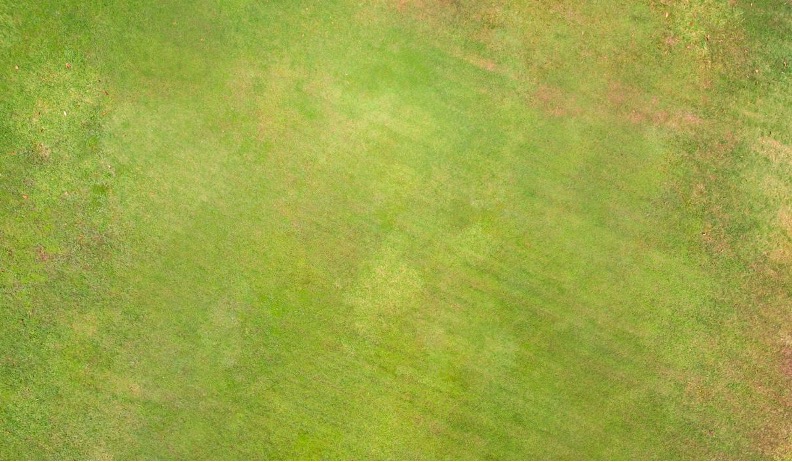
The call usually comes on a Monday morning. Somebody in a newer subdivision off Veterans Parkway mowed on Saturday, everything looked normal, and by Sunday evening a third of the back yard had gone the color of wheat straw. What makes it strange is that the edge of the brown area is not soft or blotchy the way drought damage is. It is a line. On one side there is grass, on the other side there are stems with the green eaten off them, and over the course of an afternoon that line moves. If there is a hayfield or a pasture on the far side of the fence, which is still common out toward Christiana and around Gladeville, the line is usually moving away from it.
People find this genuinely unsettling, and not because of the money. It is the speed. Lawn problems in Middle Tennessee normally develop over weeks, and this one happens while you are at church.
Where They Come From and Why Some Years Are Quiet
The fall armyworm is a caterpillar, the larval stage of a nondescript gray brown moth. The important fact about it is that it cannot overwinter here. Freezing temperatures end the population every year, and the survivors that repopulate the country each summer live far to our south, along the Gulf and into the subtropics.
Every year the moths work their way north in successive generations, carried along by wind and storm systems. How far they get, how many arrive, and when they show up depends on weather patterns we cannot predict months ahead. That is why armyworm severity swings so wildly. Some seasons Rutherford County barely notices them. Other seasons the moth flights are heavy, the timing lines up with a wet late summer, and hayfields, pastures, and lawns get hit hard at once. Anyone who tells you in advance exactly how bad a given year will be is guessing. The useful response is not prediction. It is scouting.
Why Agricultural Ground Around Rutherford County Matters
Murfreesboro has grown fast, and a lot of our newer neighborhoods sit directly against ground that was hayfield a few years ago. That matters here more than it would in a fully built out suburb. Female moths lay egg masses on tall grass, fence posts, gutters, siding, and light fixtures, and pasture and hay ground is prime habitat. Those fields are often where the population builds first.
When a field gets cut or grazed down, or when the caterpillars simply exhaust it, they move. That is where the name comes from. They travel as a front, and a maintained lawn on the other side of a fence line looks like an improvement. This is why we see the pattern most consistently in Christiana, out around Arrington, and along the edges of Gladeville where subdivisions meet working land, while an interior lot in an older established neighborhood may go untouched in the same week.
What the Damage Actually Looks Like Up Close
From the patio it reads as drought. Get down on your knees and it does not. Small larvae feed on the surface of the blade rather than eating through it, scraping off the green tissue and leaving a thin transparent window, so the turf takes on a frosted or silvery cast in early morning light before it browns. Larger larvae chew blades off entirely and leave ragged, blunt ends, nothing like the clean cut of a sharp mower blade.
Look for other tells. Small dark specks of frass sit down in the canopy at the soil line. Birds work the area hard, and a yard full of grackles or starlings walking a lawn in August is worth investigating. On our limestone soils, where much of Rutherford County has shallow topsoil over rock and cedar glade ground, homeowners often assume the thin spots are the usual summer heat stress. The distinguishing question is simple: is the soil dry? If the ground is still moist and the grass is browning anyway, insects are a strong suspect.
The Overnight Illusion, Explained
Nothing about armyworm feeding is truly overnight, but the perception is understandable. A caterpillar passes through several growth stages, and each one is dramatically larger than the last. Through the early stages the entire population combined removes a trivial amount of leaf tissue, invisible from a standing height. The final stages consume the overwhelming majority of everything those insects will ever eat.
So the population is present and feeding for a week or more before anyone notices, then it hits its largest size and clears the yard in two or three days. Add the fact that they feed most actively in the cool of early morning and evening and hide down in the canopy during the hottest hours, and it is easy to walk the lawn at noon and see nothing at all.
How We Scout: The Soap Flush
The confirmation test costs almost nothing and takes about five minutes. Mix a couple of tablespoons of lemon scented dish soap into a gallon of water and pour it slowly over a square yard of turf right at the edge of the damaged area, not in the middle of the dead part where the food is already gone. The soap irritates the insects and drives them to the surface. Within a few minutes you will see caterpillars climbing up the blades if they are present.
What you are looking for is a smooth bodied caterpillar, generally an inch or so long at full size, with lengthwise stripes and a pale inverted Y marking on the dark head capsule. Do this at several spots. Finding a handful in a square yard is meaningful, and finding a dozen or more means the lawn is under real pressure. This is exactly the test our technicians run before recommending anything, and we are happy to walk a homeowner through it over the phone.
Recovery Depends Entirely on Your Grass
Here is the part that determines whether this is an inconvenience or an expense. Armyworms eat leaf tissue. They do not eat roots, rhizomes, or stolons. Bermuda, which dominates full sun lawns across Smyrna, La Vergne, and much of Murfreesboro, keeps its growing points at and below the surface and spreads laterally. A healthy bermuda lawn stripped in August typically greens back up in two to three weeks with adequate moisture and a modest feeding. It looks catastrophic and usually is not. Zoysia recovers similarly, though more slowly because it simply grows slower.
Tall fescue is the harder case. Fescue is a bunch type cool season grass with no runners, so it cannot spread sideways into a bare area. If armyworms strip it in the middle of a hot Middle Tennessee August, when the plants are already stressed and feeding down close to the crown, some of those plants do not come back. Fescue lawns that take a hit this month frequently need fall overseeding to be whole again, which is a conversation worth having early since our seeding window runs from about the beginning of September into early October.
What to Do Next
If you suspect armyworms, act the same day rather than waiting to see what happens, because waiting is how the last few feeding days play out. Call Lawn Squad of Murfreesboro at 615-622-6918 or reach us at lawnsquad.com. Treatments work fastest and at the lowest rate on small larvae, and get harder as the caterpillars mature, so timing matters more than product selection. On a first visit we confirm the identification with a flush, check whether the population is still actively feeding or has already pupated and moved on, and look for a second wave, since a heavy flight year can bring more than one generation before frost.
After treatment, expect feeding to stop quickly. Green up is a slower story: keep the lawn watered, hold off on scalping it, and on bermuda a light feeding helps it push new growth. Most warm season lawns look substantially better within two to three weeks and normal by roughly thirty days. At ninety days, heading into fall, the goal is a stand thick enough that you would never know. Fescue areas get evaluated for overseeding rather than waiting on recovery that may not come.
Our VitaminLawn program is built around Middle Tennessee grass types, our thin limestone influenced soils, and our specific pest calendar, and surface insect control can be added where pressure justifies it. We serve Murfreesboro, Smyrna, La Vergne, Christiana, Arrington, Gladeville, Nolensville, and Mount Juliet, with free quotes and a satisfaction guarantee. If we flush your lawn and find nothing, we will tell you so and look for the real cause instead.