Which Late-Summer Fungus Is Attacking My Coastal Carolina Lawn: Brown Patch, Gray Leaf Spot, or Take-All?
Short Answer: Look at where the damage lives. Brown patch and its warm-season cousin large patch make roughly circular areas with rotted leaf sheaths that slip loose when you tug a blade. Gray leaf spot puts oblong tan lesions with dark borders directly on St. Augustine leaf blades and thins turf quickly. Take-all root rot shows nothing on the blade at all: the grass yellows in irregular patches, stolons lift with almost no resistance, and the roots underneath are short, dark, and rotted. Blade symptoms point to a leaf disease. Clean blades over failing roots point to take-all.
Step outside at nine in the morning anywhere from Little River down to Georgetown right now and the grass is still soaking wet. Not from the sprinklers. That is dew that has been sitting since two in the morning and has no intention of burning off until the sun clears the roofline. Walk across it and your shoes are wet through. That single fact, more than heat or rain totals, is why our lawns get the disease pressure they do.
Most homeowners we talk to this time of year have already tried something. A bag from the hardware store, an extra feeding to green things up, more water because it looked like drought. When the spot keeps spreading anyway, the natural conclusion is that the lawn is beyond saving. Usually it is not. It is just being treated for the wrong thing.
Why the Grand Strand Runs Hot for Fungus
Every turf disease needs three things at once: the pathogen present in the soil, a grass that can host it, and weather that lets it work. The first two are permanent here. The fungi behind all three of these problems live in the thatch and soil of essentially every lawn in Horry and Georgetown County, all the time, doing nothing. Weather is the switch.
Ours stays flipped on for months. Ocean humidity keeps the air saturated overnight, so leaf surfaces stay wet ten or twelve hours at a stretch. Night temperatures hold in the seventies through August rather than dropping the way they do an hour inland past Aynor and Loris. Add an afternoon thunderstorm and a lawn watered at six in the evening, and the leaf never dries. Fungal spores need continuous leaf wetness to germinate and penetrate, and we hand it to them.
Brown Patch and Large Patch: One Fungus, Two Names
This causes more confusion than any other topic we discuss at the front door. Brown patch and large patch are caused by strains of the same organism, Rhizoctonia. On the tall fescue you occasionally see on shadier inland lots, it is called brown patch and it strikes during hot, humid summer nights. On warm-season grass, the same fungus is called large patch, and it behaves in the opposite way: it goes to work in spring and fall when soil temperatures pass through the sixties and low seventies, not in the peak of summer.
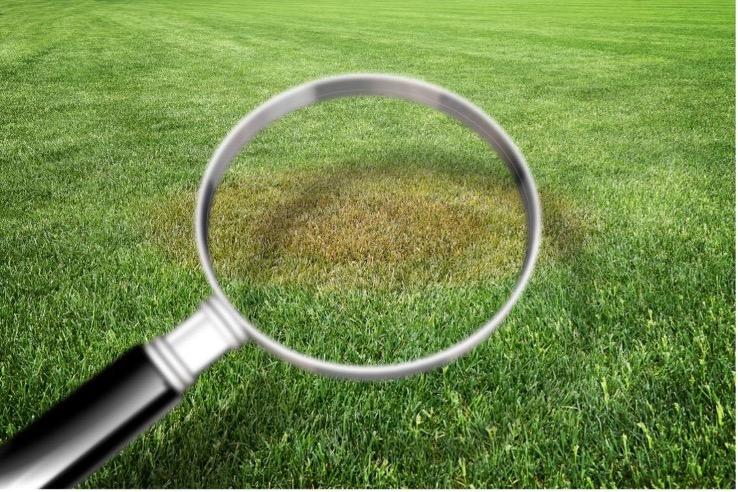
The practical takeaway for a centipede or zoysia lawn is that August is not when you see large patch. August is when you decide about it. Rings appear as roughly circular tan or orange-tinged areas, sometimes with a darker outer edge, and the giveaway is at the base: pull a blade from the margin and the sheath comes away easily and smells sour, with a rotted brown collar right where it meets the runner. Zoysia and centipede are the most affected here, and a lawn that had it last October will almost certainly have it again.
Gray Leaf Spot: The Fastest Mover on St. Augustine
Gray leaf spot is the one that genuinely belongs to this month, and it targets St. Augustine hard. Get down close and look at individual blades. You are looking for small oblong lesions, tan or ash gray in the center, ringed by a distinctly darker brown or purple border, often with a faint yellow halo around that. Under a hand lens they look like tiny eyes running along the blade.
From ten feet back the lawn simply looks off color and thin, and it can go from a few blades to a noticeable area within a week of humid weather. What accelerates it more than anything is nitrogen. Lush, fast-growing St. Augustine tissue is exactly what this fungus prefers, which is why lawns that got a heavy summer feeding in the shady side yard tend to break out first. Shade and poor air movement, common in the older neighborhoods around Conway with mature live oaks, finish the setup.
Take-All Root Rot: The Most Misread Problem We See
Take-all is the one that gets treated as drought, as nutrient deficiency, as insects, and as a dozen other things before anyone tests for it. It attacks the roots and stolons rather than the leaves, which is why the blades look clean while the plant slowly starves. Patches turn yellow in irregular shapes, thinning out over weeks rather than days, and the grass will not respond to water or fertilizer the way healthy turf does.
The confirmation is physical. Take hold of a runner in the affected area and pull gently. Healthy stolons resist and tear. Take-all stolons lift off the soil like a piece of loose string, because the roots holding them down have rotted to short dark stubs instead of a white fibrous mat. Centipede and St. Augustine are the usual hosts, and it favors soils on the higher pH side, which is common on lots where builder fill or crushed shell was worked into sandy ground.
The Corrections That Matter More Than Any Spray
Watering time is the single biggest lever. Irrigate between four and eight in the morning so dew and irrigation water dry off together, rather than in the evening, which doubles the hours of leaf wetness. Water deeply and infrequently. Two longer cycles a week beats a light daily run for both root depth and disease.
Then look at nitrogen. Centipede in particular is a low-appetite grass, and the well-intentioned habit of feeding it every time it looks pale is one of the most common ways a Grand Strand lawn ends up sick. Mow at the right height with a sharp blade, since torn leaf tips are open doors, and thin out low limbs where you can to move air across chronically damp corners. For take-all specifically, topdressing with sphagnum peat moss and correcting soil pH downward gives real, measurable improvement in a way that no fungicide alone achieves.
Thatch and drainage round it out. A spongy layer that your shoe sinks into holds moisture against the crowns and shelters the fungus between outbreaks, and the low back corner that stays soft three days after a storm will keep producing the same patch every year until the water has somewhere to go. Neither is a same-week fix, but both are worth putting on the list while you are thinking about it.
When a Fungicide Earns Its Place
Fungicides work best before symptoms, not after. For large patch on zoysia and centipede, the meaningful application goes down in early fall as soil temperatures at a four inch depth drop through the low seventies, which protects the crowns going into the cool season and prevents the ugly spring reappearance. Gray leaf spot on St. Augustine can be treated actively during an outbreak, though it needs the nitrogen and watering corrections alongside it or the fungus returns. Take-all is the hardest of the three, needs early fall applications watered in to reach the root zone, and improves over seasons rather than weeks. We would rather tell you that up front than sell you a quick fix that does not exist.
What to Do Next
Call us at 843-702-6210 or request a free quote through lawnsquad.com and we will come look at it. A first visit means walking the lawn with you, examining blades and pulling runners in the affected areas, checking your irrigation timing and mowing height, and identifying which of the three you actually have. Knowing that is most of the battle, and we will tell you honestly if the answer is a schedule change rather than a service.
Expect the spread to stop before the damage looks better. At thirty days a treated lawn generally holds steady with fresh green appearing at patch edges. At ninety days, with runners filling in, most properties read as recovered from the street, though take-all cases take longer and we say so. Our VitaminLawn program is built around your specific grass, our sandy coastal soil, and this humidity, and Lawn Disease Control fits alongside it for properties with a history of these problems. We serve Myrtle Beach, North Myrtle Beach, Conway, Murrells Inlet, Pawleys Island, Little River, Longs, Loris, Aynor, Georgetown, Andrews, and Hemingway, and this location is independently owned and operated.