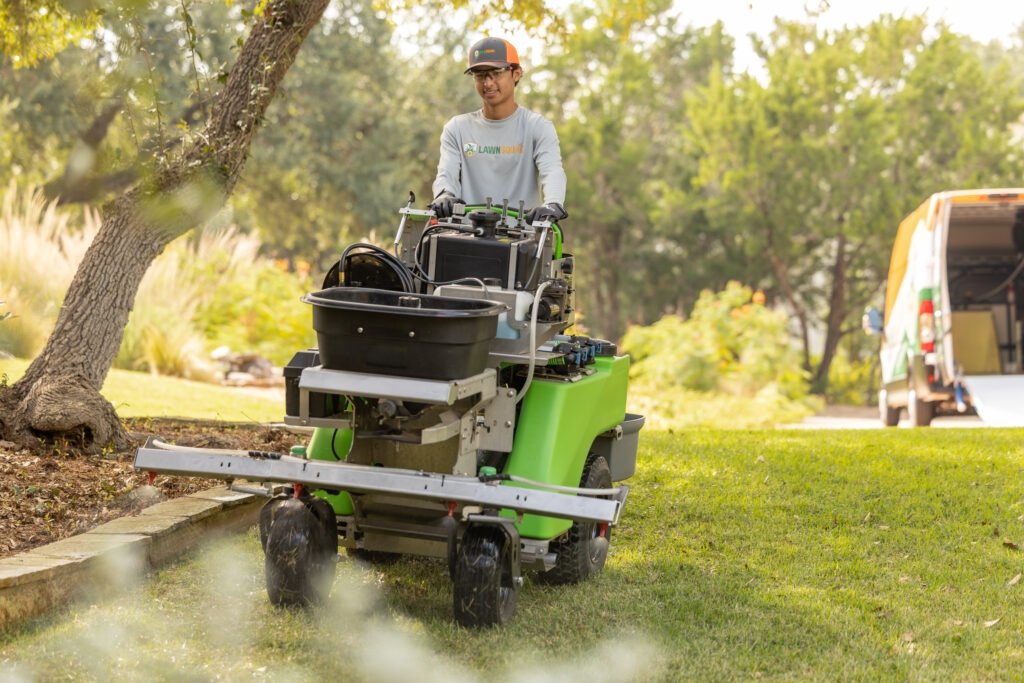
The short answer: Growing a thick lawn in Columbus requires a year-round approach that accounts for our cold winters, humid summers, and unpredictable weather patterns in between.
The most important factors are proper fertilization timing, consistent weed control, and addressing soil health before problems become visible. Columbus lawns need cool season grass care, which means the growing seasons in spring and fall matter most.
Quick overview:
- Spring: Apply pre-emergent crabgrass control and slow-release fertilizer before weeds take hold
- Summer: Focus on grub prevention, disease control, and maintaining root health during heat stress
- Fall: Fertilize heavily, aerate, and prepare roots for winter with a winterizer application
Whether you tackle lawn care yourself or hire a professional, understanding what Columbus grass needs throughout the year will help you make smarter decisions. Let’s break down exactly what it takes to grow the thick, healthy lawn you want.

The Complete Lawn Care Approach: Our Six Round Program
At Lawn Squad of Columbus, we’ve developed a comprehensive six-round treatment program specifically designed for Central Ohio lawns. This approach addresses every challenge your grass faces throughout the year, from early spring weed prevention to late fall winterization.
What makes this program effective is the timing. Columbus weather doesn’t follow a predictable schedule, so treatments need to happen at the right biological moments, not just calendar dates. Pre-emergent applications must go down before soil temperatures trigger weed germination. Grub prevention needs to be in place before beetles lay eggs. Disease control has to start before fungal spores spread.
Whether you choose to manage your lawn yourself or work with professionals, understanding these fundamentals will help you get better results. A thick lawn doesn’t happen by accident. It comes from consistent, well-timed care that addresses problems before they become visible.
Why Lawn Thickness Matters More Than Most Columbus Homeowners Realize
A thin lawn isn’t just an eyesore. It’s an invitation for weeds, pests, and disease to take over your yard.
Here’s what happens when grass gets thin: bare spots and sparse areas create openings where weed seeds can germinate. Crabgrass, dandelions, and clover don’t need much space. Just a few inches of weak turf gives them the foothold they need. Once weeds establish themselves, they compete with your grass for water, nutrients, and sunlight, making the problem worse.
Thin lawns also suffer more from grub damage. When beetle larvae feed on grass roots, a thick lawn can often recover on its own. A thin lawn can’t. You end up with dead patches that require reseeding or sodding to fix.
The key principle is this: thick grass crowds out problems naturally. Dense turf shades the soil, preventing weed seeds from getting the light they need to germinate. Strong root systems can survive pest feeding and drought stress. Healthy grass fights off fungal diseases that would devastate weakened turf.
Columbus presents unique challenges that generic lawn advice doesn’t address. Our variable weather means grass can face freezing temperatures, drought conditions, and humid disease pressure all within the same season. That’s why local expertise matters when planning your lawn care approach.
Spring Lawn Care Guide for Columbus Homeowners
Spring is when you set the foundation for the entire year. Get this season right, and the rest becomes much easier.
Round 1: Pre-Emergent and Fertilizer (Early March)
The first treatment of the year combines pre-emergent crabgrass control with slow-release fertilizer. This timing is critical because pre-emergent herbicides work by creating a barrier in the soil that prevents weed seeds from sprouting. Once crabgrass breaks through the soil surface, pre-emergent is useless.
In Columbus, soil temperatures typically reach the crabgrass germination threshold (55 degrees) in late March or early April. That means your pre-emergent needs to be down by early March to give it time to activate. The slow-release fertilizer provides steady nutrition as your grass comes out of winter dormancy.
If you’re testing your soil, this is the time to do it. A soil test reveals pH levels and nutrient deficiencies that affect how well your grass absorbs fertilizer. The ELITE program from Lawn Squad includes soil testing in the first round for this reason.
Round 2: Second Pre-Emergent and Weed Control (Mid-April)
The second spring treatment adds another layer of pre-emergent protection and introduces broadleaf weed control. By mid-April, dandelions and other broadleaf weeds are actively growing, making them vulnerable to targeted herbicides.
This round also includes surface insect control in the PRO and ELITE programs. Spring is when many turf-damaging insects become active, and early treatment prevents populations from exploding later in the summer.
Critical warning: If you plan to aerate or overseed in spring, you need to know that pre-emergent herbicides will prevent new grass seed from germinating just like they prevent weed seeds. This is why fall aeration and overseeding is generally recommended for Columbus lawns. If you must seed in spring, discuss timing conflicts with your lawn care provider.
Lawn Squad’s programs account for these timing considerations automatically, adjusting treatment schedules based on what services you need.
Summer Lawn Care Guide for Columbus Homeowners
Summer in Central Ohio brings heat stress, humidity, and the peak of insect and disease pressure. This is when many lawns struggle, but proper care keeps yours thriving.
Round 3: Grub Prevention and Disease Control (Late May)
Late May is grub prevention time in Columbus. Japanese beetles, European chafers, and other grub-producing beetles lay eggs in lawns throughout June and July. Preventative grub control needs to be in place before egg-laying begins to protect your lawn through the summer.
This round continues fertilization and weed control while adding disease control for ELITE program customers. As humidity rises, fungal diseases like brown patch and dollar spot become more common in Central Ohio. Preventative fungicide applications stop these diseases before they damage your turf.
Round 4: Continued Protection (Early July)
The fourth round maintains grub prevention coverage and continues disease control through the hottest part of summer. Fertilizer applications during this period use formulations designed for summer stress, providing nutrition without pushing excessive top growth that weakens grass.
Broadleaf weed control continues, targeting any weeds that escaped earlier treatments or germinated from seed.
Summer Watering: Critical Guidance
Watering is where many Columbus homeowners make mistakes that undo all their other lawn care efforts. Here’s what you need to know:
- Water deeply and infrequently, not lightly every day. Grass needs about one inch of water per week, including rainfall.
- Water in the early morning, never in the evening. Wet grass overnight promotes fungal disease.
- During drought conditions, it’s better to let grass go dormant than to water inconsistently. Grass can survive several weeks of dormancy, but alternating between dormancy and active growth exhausts the plant.
Round 5: Root Stimulant and Aeration Prep (Mid-August)
As summer winds down, attention shifts to root development. The ELITE program includes root stimulant in this round, encouraging deeper root growth before fall. Strong roots help grass survive winter and emerge vigorously the following spring.
This round also includes aeration for ELITE customers. Core aeration removes small plugs of soil, reducing compaction and allowing air, water, and nutrients to reach grass roots more effectively. Late summer through early fall is the ideal aeration window for Columbus lawns because grass is actively growing and can quickly fill in the holes.
How to Calculate Your Lawn’s Square Footage
Understanding your lawn’s size helps you buy the right amount of products and get accurate service quotes. Here’s how to measure it.
Step-by-step process:
- Sketch your lawn on paper, breaking it into rectangles, squares, and triangles
- Measure each section using a tape measure or by counting paces (one adult pace is approximately three feet)
- Calculate area for each section: rectangles use length times width, triangles use base times height divided by two
- Add all sections together for total square footage
- Subtract the footprint of your house, driveway, patio, and other non-lawn areas
Practical example: A typical Columbus lot might have a front yard measuring 60 feet wide by 40 feet deep (2,400 square feet) and a backyard measuring 60 feet wide by 80 feet deep (4,800 square feet), minus a 400-square-foot patio. Total lawn area: 6,800 square feet.
This puts you in the 6,000 to 10,000 square foot pricing tier for most lawn services. At Lawn Squad of Columbus, this size lawn would have fertilizer applications ranging from $57 to $73 and weed control from $42 to $54 per treatment, depending on the exact measurement and program selected.
What About Aeration and Overseeding?
Aeration and overseeding are the secret weapons for transforming a thin, struggling lawn into thick, carpet-like turf.
Core aeration addresses soil compaction, one of the most overlooked lawn problems in Columbus. Clay soils, foot traffic, and even regular mowing gradually compress the soil, making it harder for roots to grow and water to penetrate. Aeration breaks up this compaction, giving your grass room to develop a deeper, stronger root system.
Overseeding introduces new grass plants to your lawn, filling in thin areas and introducing improved grass varieties that may be more disease-resistant or drought-tolerant than your existing turf.
Lawn Squad recommends fall aeration and overseeding for the best results. Fall provides ideal growing conditions for cool season grasses: warm soil, cooler air temperatures, and reduced weed competition. Seedlings have time to establish before winter and emerge strong the following spring.
For lawns between 1,000 and 5,000 square feet, aeration typically costs $50 to $70. Overseeding adds $37 to $185 depending on lawn size and seed rates. Combination aeration and overseeding packages offer the best value.
Common Lawn Care Mistakes Columbus Homeowners Make
After years of caring for lawns throughout Greater Columbus, Dublin, Westerville, and New Albany, we’ve seen the same mistakes repeatedly. Here’s what to avoid.
Mistake #1: Cutting grass too short Homeowners think shorter cuts mean less frequent mowing. In reality, cutting more than one-third of the grass blade at once stresses the plant and weakens the root system. Keep your mower at three to three and a half inches for the healthiest turf.
Mistake #2: Ignoring soil pH Columbus soils tend to be acidite, which prevents grass from absorbing nutrients effectively. Even expensive fertilizer won’t help if your soil pH is off. A soil test identifies this problem so you can correct it with lime applications.
Mistake #3: Waiting to treat weeds until they’re visible By the time you see crabgrass or dandelions, prevention has failed. Pre-emergent herbicides need to be applied before weed seeds germinate, which happens earlier than most people expect in our climate.
Mistake #4: Skipping grub prevention Grub damage often doesn’t show up until late summer or fall, when it’s too late for preventative treatment. Curative grub control costs three times as much as prevention and may not save a severely damaged lawn.
Mistake #5: Inconsistent care Lawns respond to consistent attention over time. Fertilizing once in spring and hoping for the best doesn’t work. The lawns that look best in Columbus neighborhoods receive regular care throughout the entire growing season.
DIY Lawn Care vs. Professional Service: Which Should You Choose?
DIY lawn care gives you complete control over products and timing. You can save money on labor costs and learn a lot about how turf grass works. However, it requires significant time investment, proper equipment, storage space for products, and knowledge of application timing and rates. Getting any of these wrong can result in weed problems, fertilizer burn, or wasted money on products applied at the wrong time.
Best for: Homeowners who enjoy yard work, have flexible schedules, and want to learn the science behind lawn care.
Professional lawn care provides expert timing, commercial-grade products, and accountability for results. Professionals track weather conditions and soil temperatures to optimize application timing. They carry liability insurance in case something goes wrong. The tradeoff is higher cost and less personal control over what goes on your lawn.
Best for: Busy homeowners who want reliable results without the time investment, and anyone who has struggled with DIY approaches in the past.
Your Columbus Lawn Care Calendar at a Glance
ELITE Program Schedule
| Round | Timing | Services Included |
|---|---|---|
| 1 | March 2 | Pre-emergent, slow-release fertilizer, soil test |
| 2 | April 13 | Pre-emergent, fertilizer, broadleaf weed control, surface insect control |
| 3 | May 25 | Fertilizer, weed control, surface insect, grub prevention, disease control |
| 4 | July 6 | Fertilizer, weed control, insect control, disease control, grub prevention |
| 5 | August 17 | Fertilizer, root stimulant, weed control, insect control, disease control, aeration |
| 6 | September 28 | Fertilizer, weed control, insect control, winterizer, aeration |
PRO Program Schedule
| Round | Timing | Services Included |
|---|---|---|
| 1 | March 2 | Pre-emergent, slow-release fertilizer |
| 2 | April 13 | Pre-emergent, fertilizer, broadleaf weed control, surface insect control |
| 3 | May 25 | Fertilizer, weed control, grub prevention, surface insect control |
| 4 | July 6 | Fertilizer, weed control, surface insect control, grub prevention |
| 5 | August 17 | Fertilizer, weed control, root stimulant, surface insect control |
| 6 | September 28 | Fertilizer, weed control, surface insect control, winterizer |
The Bottom Line
Growing a thick lawn in Columbus isn’t about finding one magic product or technique. It’s about consistent, properly timed care that addresses weeds, pests, disease, and soil health throughout the entire year.
Key principles to remember:
- Pre-emergent timing in early spring determines your crabgrass situation for the entire year
- Grub prevention in late May protects your lawn from devastating root damage
- Fall is the most important season for building lawn thickness through fertilization, aeration, and overseeding
- Soil health determines how effectively your grass uses the nutrients you provide
- Consistency beats intensity, as regular care outperforms occasional heavy treatments
Columbus homeowners who follow these principles end up with the thick, green lawns that make their neighbors ask for advice.
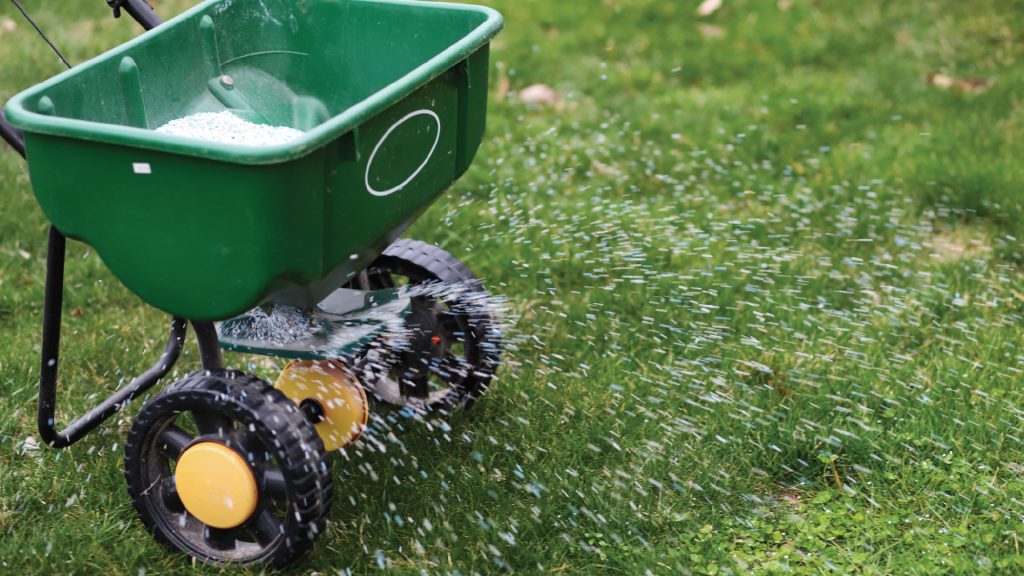
Let Lawn Squad Handle It For You
Every Columbus lawn is different. Soil composition varies across Franklin, Licking, and Fairfield counties. Shade levels, drainage patterns, and existing weed pressure all affect what your specific lawn needs.
Lawn Squad of Columbus has served homeowners and businesses throughout Greater Columbus, Dublin, Westerville, New Albany, and surrounding Central Ohio communities since 2001. Our programs are designed specifically for the challenges Ohio lawns face, from cold winters to humid summers and the variable weather patterns that define life in Central Ohio.
The ELITE Program includes:
- 12 billable treatments across 10 visits
- Two pre-emergent applications for complete crabgrass prevention
- Six fertilizer applications timed for maximum effectiveness
- Five broadleaf weed control treatments
- Surface insect control throughout the growing season
- Grub prevention before beetle egg-laying begins
- Three disease control applications
- Root stimulant for stronger fall growth
- Core aeration for improved soil health
- Winterizer for spring green-up
- Soil testing to identify hidden problems
- Unlimited service calls if issues arise between treatments
Stop fighting weeds, dealing with brown patches, and wondering why your lawn doesn’t look like the pictures online. Let the local experts who understand Columbus conditions handle it for you.
Contact Lawn Squad of Columbus today at 740-549-9991 to get a free quote and start building the thick, healthy lawn you deserve.