The short answer: Effective weed control in New Haven and Fairfield Counties requires a seasonal strategy built around pre-emergent herbicides in early spring and late summer, post-emergent treatments for weeds already growing, and lawn care practices that build thick, dense turf capable of crowding weeds out naturally.
Connecticut homeowners have one significant advantage over their counterparts in warmer climates: winter actually works in your favor. Hard freezes kill off many annual weeds and knock back overall weed pressure each year. But that advantage disappears quickly in spring. As soon as soil temperatures climb above 50 degrees in late March and April, weed seeds that have been dormant all winter snap to life — and they move fast.
The lawns that stay cleanest in New Haven and Fairfield Counties are not the ones that react to weeds after they appear. They are the ones with a plan in place before the growing season begins.
Quick overview:
- Pre-emergent control: Apply in early spring before soil temperatures hit 50°F to block crabgrass and other summer annuals
- Post-emergent control: Treat broadleaf weeds actively throughout spring and fall when temperatures favor both weed growth and herbicide effectiveness
- Turf health: Thick, well-fed cool-season grass is your most powerful long-term defense against weed invasion
Keep reading to learn exactly which weeds threaten Connecticut lawns and how to eliminate them for good.
Why Weed Control in New Haven and Fairfield Counties Requires a Seasonal Mindset
Weed management in Connecticut is fundamentally different from warm-climate states — and that difference works both for and against you.
The freeze-thaw cycle of a Connecticut winter kills off most annual weeds and temporarily reduces the seed bank in your soil. But that same cycle also stresses your turf. Grass damaged by winter desiccation, snow mold, or ice cover emerges in spring thin and weakened — exactly the condition weeds need to get a foothold before your lawn fully recovers.
Spring in New Haven and Fairfield Counties is a race. Weed seeds germinate quickly as soil warms. Crabgrass, one of the most aggressive summer annual weeds, begins germinating when soil temperatures reach 50 to 55 degrees — which in coastal Connecticut typically happens in mid to late April. Miss that window with a pre-emergent application and you are managing crabgrass all summer instead of preventing it entirely.
Fall brings a second wave of weed pressure. Cool-season broadleaf weeds like chickweed, henbit, and hairy bittercress germinate in September and October, overwinter as small plants, and surge with growth the following spring. Treating these weeds in fall — when they are small and actively growing — is far more effective than trying to eliminate their mature spring forms.
Understanding these seasonal windows is the foundation of effective weed control in Connecticut.
Common Weeds in New Haven and Fairfield County Lawns
Knowing what you are dealing with helps you choose the right treatment at the right time.
Broadleaf Weeds
These weeds have wide, flat leaves that look distinctly different from grass blades and are generally the most responsive to standard selective herbicides.
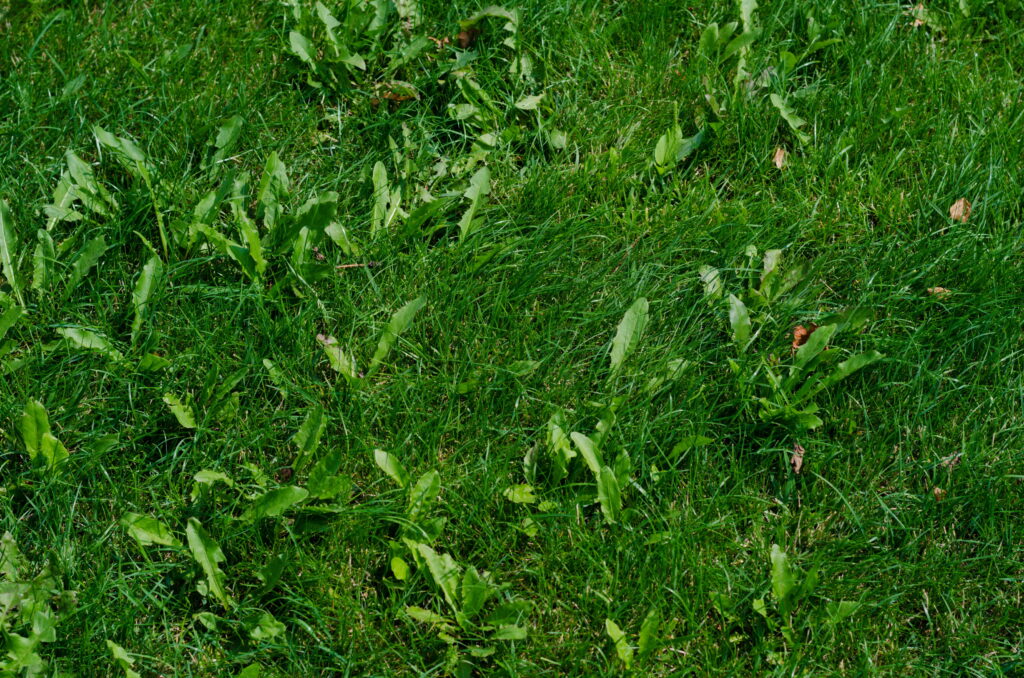
Dandelion is the most recognized lawn weed in Connecticut. Its deep taproot makes hand-pulling unreliable — any root fragment left behind regenerates a new plant. Each dandelion can produce up to 15,000 seeds per year, carried by wind across your lawn and your neighbors’. Post-emergent broadleaf herbicides are highly effective on dandelions when applied during active growth in spring and fall.
White clover forms low-growing patches of three-leaflet foliage with small white flowers. It fixes nitrogen from the atmosphere, meaning it thrives in lawns that are underfertilized while outcompeting grass in those thin, nutrient-poor areas. A well-fed, properly fertilized lawn naturally discourages clover over time.
Chickweed is one of the most common cool-season weeds in New Haven and Fairfield Counties. It germinates in fall, grows slowly through winter, and then explodes with growth in early spring — often flowering and setting seed before homeowners even notice it. Fall post-emergent treatment is the most effective approach.
Ground ivy (also called creeping Charlie) spreads aggressively through both seeds and creeping stems that root at each node. It favors shaded, moist areas and is notoriously persistent. Effective control requires multiple treatments and often takes more than one season to fully eliminate.
Plantain (both broadleaf and narrow-leaf varieties) forms low rosettes with distinctly ribbed leaves. It tolerates compacted soil and foot traffic better than most weeds, frequently appearing in high-traffic areas and along lawn edges. Core aeration combined with herbicide treatment produces the best long-term results.
Oxalis produces heart-shaped leaflets and small yellow flowers. It spreads through seeds and underground bulbs and can become persistent once established in a lawn.
Wild violet is a particularly stubborn perennial broadleaf weed in Connecticut. Its waxy leaf coating makes it resistant to many standard herbicides, often requiring specialized formulations or repeat applications for effective control.
Grassy Weeds
These weeds resemble turf grass and are harder to identify until they are well established. They also require different treatment approaches than broadleaf weeds.
Crabgrass is the dominant grassy weed problem across New Haven and Fairfield Counties. A summer annual, it germinates in spring, grows aggressively through summer, produces thousands of seeds, and dies with the first hard frost — leaving behind next year’s problem. Pre-emergent herbicide is the cornerstone of crabgrass management. Post-emergent options are limited and most effective only on young plants.
Goosegrass resembles crabgrass but grows in a flattened starburst pattern from a central point. It germinates slightly later than crabgrass and is more tolerant of compacted soil. Aeration helps reduce goosegrass pressure over time.
Quackgrass is a perennial grassy weed that spreads through both seeds and underground rhizomes, making it significantly harder to eliminate than annual grassy weeds. It has wider blades and a coarser texture than most lawn grasses and is visible as clumps that grow faster than surrounding turf. There are no selective post-emergent options for quackgrass in cool-season lawns — control typically involves spot treatment with non-selective herbicides followed by reseeding.
Annual bluegrass (Poa annua) germinates in fall, grows through mild stretches of winter, and produces seed heads prolifically in spring before dying as temperatures rise. It appears as bright green, fine-textured patches in an otherwise uniform lawn. Pre-emergent applications timed for late summer and early fall target Poa annua before it germinates.
Sedges
Yellow nutsedge appears in Connecticut lawns from late spring through summer, growing faster than surrounding turf and standing noticeably taller within days of mowing. It has a distinctive yellow-green color and triangular stems — remember, sedges have edges. Nutsedge spreads through underground tubers that persist in soil for years, making it stubborn once established.
Standard broadleaf herbicides will not control nutsedge. It requires specialized sedge-specific products applied during active growth. Nutsedge also thrives in wet, poorly drained areas — addressing drainage or irrigation issues alongside chemical treatment produces the best long-term results.
Pre-Emergent Weed Control in New Haven and Fairfield Counties
Pre-emergent herbicides stop weeds before you ever see them by forming a chemical barrier in the soil that kills germinating seedlings before they emerge. Properly timed, they are the single most effective and cost-efficient weed control tool available to Connecticut homeowners.
When to Apply
Early Spring (late March – mid April): This is the most critical application of the year. The target is crabgrass, goosegrass, and other summer annual weeds. The trigger is soil temperature — applications need to be in place before soil temps reach 50 to 55°F at a 2-inch depth. In New Haven and Fairfield Counties, this window typically falls between late March and mid-April depending on the year.
A useful local indicator: forsythia bloom. When forsythia begins flowering in your area, it is time to get pre-emergent down. Crabgrass germination typically follows forsythia bloom by two to three weeks.
Late Summer (mid August – September): This application targets cool-season annual weeds, particularly annual bluegrass (Poa annua) and winter annuals like chickweed that germinate in fall. This window is frequently missed by homeowners focused on summer lawn care, and missing it leads to significant broadleaf weed pressure the following spring.
Pre-Emergent Rules to Follow
- Water pre-emergent herbicides in with a quarter inch of irrigation within 48 hours if rain is not expected
- Avoid heavy irrigation, aerating, or dethatching for at least two weeks after application — disturbing the soil disrupts the chemical barrier
- Do not apply pre-emergent if you plan to overseed. Pre-emergent prevents all seeds from germinating, including grass seed. Fall overseeding is extremely common in Connecticut — plan your pre-emergent and overseeding schedules so they do not conflict. If you need to overseed, skip or delay pre-emergent in those areas.
Post-Emergent Weed Control in New Haven and Fairfield Counties
When weeds are already visible and growing, post-emergent herbicides are your tool. Choosing the right product and applying it at the right time determines whether treatment succeeds or fails.
Selective vs. Non-Selective Herbicides
Selective herbicides target specific plant types without harming others. Broadleaf selective herbicides eliminate dandelions, clover, and ground ivy without damaging your lawn grass. These are the standard tools for in-lawn weed control.
Non-selective herbicides kill any plant they contact and are best reserved for spot-treating areas you intend to clear and reseed entirely. Apply with extreme care around desirable plants and lawn areas.
Treating Different Weed Types
Broadleaf weeds respond well to three-way herbicides containing 2,4-D, dicamba, and mecoprop. These products work best when weeds are actively growing and temperatures are between 60 and 80°F — making spring and fall the ideal treatment windows in Connecticut. Avoid applying during summer heat above 85°F or when rain is expected within 24 hours.
Grassy weeds require different chemistry. Post-emergent crabgrass killers work best on young, two to four-leaf stage plants. Once crabgrass matures, post-emergent options become much less effective — reinforcing why pre-emergent timing is so important.
Sedges require specialized products containing sulfentrazone or halosulfuron. Standard weed killers have no effect on nutsedge. Apply sedge-specific products during active growth in late spring and summer for best results.
Wild violet and ground ivy are among the most herbicide-resistant broadleaf weeds in Connecticut. They respond best to products containing triclopyr, either alone or in combination with standard three-way herbicides. Multiple applications in fall typically produce better results than spring treatments for these persistent species.
Application Tips for Connecticut Conditions
- Apply when no rain is expected for at least 24 hours
- Do not mow two to three days before or after treatment — you want maximum leaf surface for herbicide contact
- Avoid applying in temperatures above 85°F or below 50°F
- Cool-season grasses like tall fescue and Kentucky bluegrass can show temporary stress after herbicide application — this is normal and typically resolves within one to two weeks
Building Turf That Naturally Crowds Out Weeds
In New Haven and Fairfield Counties, cool-season grasses — primarily tall fescue, Kentucky bluegrass, and perennial ryegrass — form the backbone of healthy lawns. These grasses thrive in Connecticut’s climate and, when maintained properly, create the dense canopy that prevents weed seeds from receiving the sunlight they need to germinate.
Mow at the Right Height
Mowing height is one of the most powerful weed suppression tools available and one of the most consistently misused.
- Tall fescue: 3.5 to 4 inches
- Kentucky bluegrass: 2.5 to 3.5 inches
- Perennial ryegrass: 2.5 to 3.5 inches
Taller grass shades the soil surface, keeping it cooler and reducing crabgrass germination. Never remove more than one-third of the blade in a single mowing. Scalping cool-season grass opens the canopy to sunlight and stresses turf heading into summer heat — exactly when weeds are most aggressive.
Fertilize on a Connecticut Schedule
Cool-season grasses have a growth cycle opposite to warm-season turf. Their peak growth periods are spring and fall — not summer. Fertilization should align with this cycle.
- Late spring (May): Moderate nitrogen application to sustain spring growth without pushing excessive lush growth heading into summer stress
- Early fall (September): The most important fertilization of the year. Fall feeding drives root development and thickens turf density heading into the growing season
- Late fall (November): A final application feeds roots and improves winter hardiness and spring green-up
Avoid heavy nitrogen applications in summer. Pushing aggressive top growth during heat stress weakens turf and actually increases susceptibility to disease and weed pressure.
Overseed Thin Areas Every Fall
Fall is the best time to overseed cool-season lawns in Connecticut — soil is warm enough for germination, air temperatures are cooling, and rainfall is generally more reliable than summer. Thin, bare areas are prime real estate for weed colonization. Filling them with grass is one of the most effective long-term weed prevention strategies available.
Coordinate overseeding with your pre-emergent schedule. Pre-emergent applications and overseeding cannot happen simultaneously — the same barrier that stops weed seeds stops grass seed. Plan accordingly each season.
Core Aeration for Dense, Healthy Turf
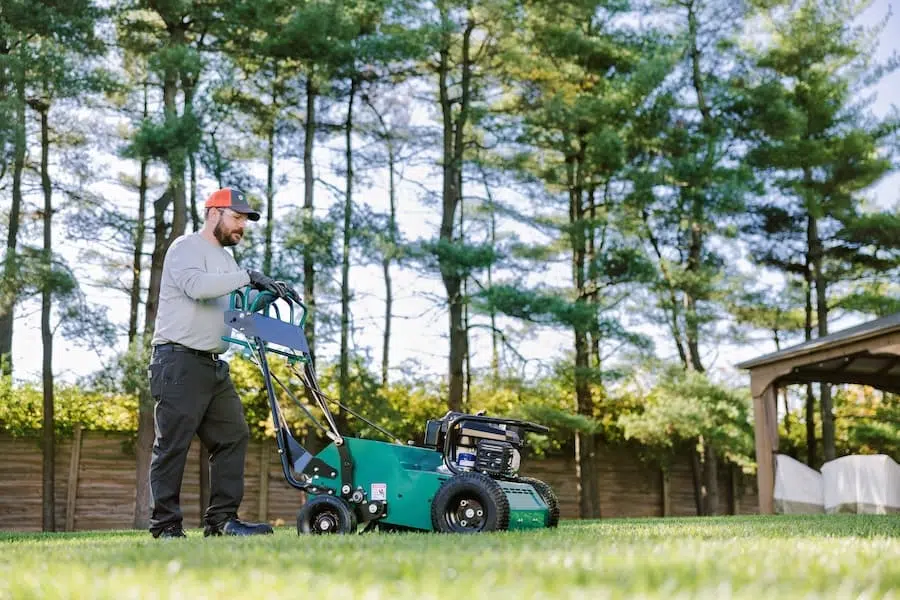
Connecticut’s soils, particularly in areas with heavy clay content, compact over time and restrict the root development grass needs to stay thick and competitive. Annual core aeration in fall relieves compaction, improves water and nutrient penetration, and creates ideal conditions for overseeding.
Aeration also directly reduces pressure from weeds like goosegrass and plantain that thrive in compacted soil. Addressing the underlying soil condition reduces weed germination naturally over time.
Your New Haven and Fairfield County Weed Control Calendar
| Timing | Treatment | Target Weeds |
|---|---|---|
| Late March – mid April | Pre-emergent application | Crabgrass, goosegrass, summer annuals |
| April – June | Broadleaf post-emergent | Dandelion, clover, ground ivy, chickweed |
| May – August | Sedge control | Yellow nutsedge |
| August – September | Pre-emergent application | Annual bluegrass, winter annuals, chickweed |
| September – October | Broadleaf post-emergent | Wild violet, ground ivy, fall broadleaf weeds |
| September – October | Core aeration + overseeding | Fill thin areas to prevent weed colonization |
| September, November | Fertilization | Build turf density for weed competition |
Common Weed Control Mistakes Connecticut Homeowners Make
Missing the Pre-Emergent Window
Once you see crabgrass in your lawn, it has already germinated — pre-emergent season is over. The forsythia bloom is your reminder. If the forsythia is flowering and your pre-emergent is not down, prioritize it immediately.
Skipping the Fall Pre-Emergent Application
Most homeowners focus on spring pre-emergent and forget about the August-September application entirely. This leads to chickweed, Poa annua, and other winter annuals establishing in fall and surging the following spring.
Trying to Overseed and Use Pre-Emergent at the Same Time
These two practices are incompatible in the same area at the same time. Pre-emergent stops grass seed from germinating just as effectively as it stops weed seed. Plan your calendar carefully each fall so these two important practices do not undermine each other.
Applying Herbicides in Summer Heat
Temperatures above 85°F reduce herbicide effectiveness against weeds while increasing the risk of damage to your cool-season lawn grass. Spring and fall are the optimal treatment windows in Connecticut for almost all broadleaf herbicides.
Giving Up Too Quickly on Tough Weeds
Wild violet and ground ivy are among the most persistent weeds in New England. A single treatment rarely eliminates them. Consistent fall applications over two or three seasons, using the right herbicide chemistry, produce lasting results. Homeowners who apply once, see partial results, and conclude the treatment failed miss out on the cumulative progress that consistent treatment delivers.
Professional vs. DIY Weed Control: Which Is Right for You?
DIY weed control is a reasonable approach for attentive homeowners comfortable with seasonal timing, product selection, and proper application. The Connecticut weed calendar is manageable once you understand the spring and fall windows.
Best for: Homeowners who enjoy hands-on lawn care, have time to monitor conditions and apply treatments at the right time, and are willing to learn the differences between weed types and herbicide categories.
Professional weed control provides expert identification, commercial-grade products, and treatment timing calibrated specifically to conditions in New Haven and Fairfield Counties — handling the timing, product selection, and application so you do not have to.
Best for: Busy homeowners who want reliable, consistent results; lawns with persistent problem weeds like wild violet, ground ivy, or quackgrass; and anyone who has struggled to get ahead of weed pressure with DIY efforts.
The Bottom Line
Weed control in New Haven and Fairfield Counties is a seasonal discipline — not a one-time fix. Connecticut’s climate gives you a winter reset that warmer states do not get, but spring arrives fast and weeds move faster than most homeowners expect.
Key principles to carry with you:
- Pre-emergent in late March or early April is your single most important weed control action of the year
- Do not skip the late summer pre-emergent — it prevents the fall germinating weeds that explode in spring
- Cool-season grass mowed tall, fertilized in fall, and overseeded in thin areas is your best long-term weed barrier
- Wild violet, ground ivy, and nutsedge require specialized products — standard weed killers will not get the job done
- Fall is the best season for both overseeding and broadleaf weed control — plan carefully so the two do not conflict
When you combine well-timed chemical control with strong cultural practices, a clean, healthy, weed-resistant lawn in New Haven and Fairfield Counties is absolutely achievable through every season.
Let Lawn Squad Protect Your Connecticut Lawn
Every lawn in New Haven and Fairfield Counties faces its own combination of weed pressure, soil conditions, and turf history. A treatment plan built for one property may completely miss the specific weeds invading yours.
Lawn Squad technicians identify exactly what is growing in your lawn and apply targeted treatments at the right time for maximum effectiveness — so you are not guessing at timing or products while weeds get ahead of you.
Lawn Squad programs include:
- Broadleaf weed control throughout the growing season
- Pre-emergent applications timed specifically for Connecticut’s germination windows
- Sedge suppression during active nutsedge growth
- Fertilization timed to build competitive cool-season turf density
- Unlimited service calls when breakthrough weeds appear between scheduled visits
Tired of fighting the same weeds every spring? Ready to finally get ahead of the problem instead of chasing it?
Contact Lawn Squad today at 203-759-8991 or visit https://lawnsquad.com/contact-us/ to get your free quote and take control of weeds in your New Haven or Fairfield County lawn.