The short answer: Murfreesboro lawns face brutal summer stress from heat, humidity, and drought. The best way to beat it is through proper fertilization, disease prevention, and smart watering practices starting in late spring.
Most Murfreesboro homeowners notice summer stress between June and August when temperatures stay above 90 degrees for weeks at a time. The good news is that with the right approach, your lawn can survive and even thrive during these tough months.
Quick overview:
- Prevention approach: Start treatments in spring before stress hits
- Rescue approach: Address problems as they appear with targeted treatments
- Professional approach: Follow a complete program that handles prevention and treatment together
Whether you tackle summer lawn care yourself or hire help, understanding what your grass needs during Murfreesboro’s hottest months will make all the difference.

The Complete Summer Stress Approach: Our 8 Round Program
At Lawn Squad of Murfreesboro, we designed our lawn care programs specifically for the challenges that come with Middle Tennessee summers. Our ELITE program includes 14 billable treatments across 13 visits, with summer rounds focused on keeping your lawn healthy when heat stress peaks.
What makes this approach work for Murfreesboro lawns is the combination of disease control, surface insect protection, and proper fertilization timed to your grass’s needs. We also include sedge suppression during summer months because nutsedge thrives in our hot, humid conditions.
Even if you handle your own lawn care, understanding these fundamentals helps you make better decisions about what your grass needs and when it needs it.
Why Summer Stress Matters More Than Most Murfreesboro Homeowners Realize
Summer stress does more than make your lawn look bad for a few months. When grass gets too stressed, it becomes weak and vulnerable to disease, insects, and weed invasion. A lawn that struggles through summer often takes until the following spring to recover, if it recovers at all.
Here’s what happens when summer stress goes unchecked in Murfreesboro:
Brown patch fungus spreads quickly through stressed turf, leaving dead circles that can grow several feet wide. Surface insects like armyworms can destroy an entire lawn in just a few days when grass is already weakened. Nutsedge and other summer weeds move into thin areas and establish deep root systems that make them nearly impossible to remove.
The key principle Murfreesboro homeowners need to understand is that our transition zone climate pushes both cool season and warm season grasses to their limits during summer. What works in cooler states or warmer southern states doesn’t always apply here.
At Lawn Squad of Murfreesboro, we’ve been treating lawns in Rutherford, Williamson, and Wilson counties since 2001. We understand that Christiana, La Vergne, Smyrna, and Mt. Juliet all face these same summer challenges.
Prevention Guide for Murfreesboro Summer Lawn Stress
Prevention is always easier than rescue. Here’s how to protect your Murfreesboro lawn before summer stress takes hold.
Step 1: Spring Pre Emergent and Fertilization (January through March)
Your summer lawn health actually starts in late winter. Apply pre emergent herbicide to stop summer weeds like crabgrass before they sprout. Follow up with fertilizer to build strong root systems while temperatures are still cool.
In Murfreesboro, Round 1 treatments typically start around January 26 and Round 2 around March 9. This timing gives grass a chance to establish deep roots before heat arrives.
Why this matters: Grass with deep, healthy roots handles drought and heat far better than grass that enters summer already weak. Skipping spring treatments means your lawn starts summer at a disadvantage.
Step 2: Late Spring Disease Prevention (April through May)
As temperatures warm up in Murfreesboro, fungal diseases become a real threat. Apply preventative fungicide before you see disease symptoms. Once brown patch or dollar spot appears, it’s already spreading through your lawn.
Round 3 treatments around April 20 should include surface insect control along with broadleaf weed control to address any weeds that made it past pre emergent applications.
Why this matters: Treating disease after it appears costs more and takes longer. A lawn recovering from brown patch has thin areas where summer weeds will move in.
Step 3: Early Summer Grub Prevention (June)
Grub prevention must happen before grubs hatch and start feeding on your grass roots. In Murfreesboro, this means treating in late May or early June. Grub damage often doesn’t show up until late summer or fall, but by then the damage is done.
Round 4 around June 1 is also when sedge suppression becomes important. Nutsedge loves Murfreesboro’s summer heat and humidity.
Why this matters: Grubs feed on grass roots underground where you can’t see them. By the time your lawn shows stress from grub damage, the root system is already destroyed. Prevention is the only practical approach.
Step 4: Summer Maintenance (July through August)
During peak summer heat, your lawn needs continued support. Light fertilization, ongoing weed control, and disease monitoring keep your grass healthy through the worst of Murfreesboro’s summer.
Rounds 5 and 6 in July and August include root stimulant to help grass survive drought stress, along with continued surface insect control and sedge suppression.
Critical warning: Never apply heavy nitrogen fertilizer during extreme heat. This forces grass to grow when it should be conserving energy, making stress worse instead of better.
Our ELITE program at Lawn Squad of Murfreesboro accounts for all these timing considerations so your lawn gets exactly what it needs when it needs it.
Rescue Guide for Stressed Murfreesboro Lawns
Sometimes prevention isn’t possible. Maybe you just moved into a new home, or your lawn got hit with problems despite your best efforts. Here’s how to rescue a stressed Murfreesboro lawn.
Step 1: Identify the Problem
Before you treat anything, figure out what’s actually wrong. Summer lawn problems in Murfreesboro usually fall into these categories:
- Drought stress: Grass blades folded, footprints stay visible, grayish color
- Disease: Circular dead patches, visible fungal growth, rapid spreading
- Insect damage: Birds pecking at lawn, grass pulls up easily, visible grubs or worms
- Heat dormancy: Uniform browning, no other symptoms, grass still has some green at base
Why this matters: Treating drought stress like a disease wastes money and delays recovery. Treating disease like drought stress lets the fungus spread further. Accurate diagnosis is the first step to recovery.
Step 2: Address Immediate Threats First
If you have active disease, treat it immediately with curative fungicide. If you find insects, apply appropriate insect control. These problems spread quickly during Murfreesboro summers and will get worse every day you wait.
For disease control, curative fungicide costs more than preventative treatments but stops active infections. For insect problems like armyworms, surface treatment can save your lawn if applied quickly.
Step 3: Avoid Making Things Worse
When lawns are stressed, some common practices actually cause more harm.
- If your lawn is heat dormant, don’t fertilize heavily. The grass can’t use the nutrients and the forced growth depletes energy reserves.
- If you have disease, don’t water in the evening. Wet grass overnight creates perfect conditions for fungal spread.
- If your lawn is drought stressed, don’t mow short. Taller grass shades soil and retains moisture better.
Step 4: Plan for Recovery
Most seriously stressed Murfreesboro lawns won’t fully recover until fall when temperatures drop. Plan for fall aeration and overseeding to repair thin areas. Continue protecting the grass you have while planning to fill in damaged sections when conditions improve.
Lawn Squad of Murfreesboro includes fall aeration in Rounds 4 through 8 of our ELITE program specifically because summer stressed lawns need this recovery support.
How to Calculate Your Lawn’s Water Needs
One of the most common questions Murfreesboro homeowners ask is how much water their lawn actually needs during summer.
Step by step process:
- Murfreesboro lawns need about 1 to 1.5 inches of water per week during summer, including rainfall.
- Use a rain gauge or empty tuna can to measure both rainfall and irrigation output.
- Water deeply but infrequently. Two sessions of 0.5 to 0.75 inches is better than daily light watering.
Practical example: If Murfreesboro gets 0.5 inches of rain one week, you need to provide another 0.5 to 1 inch through irrigation. Run your sprinklers and measure the output, then calculate how long to run them to hit your target.
Deep watering encourages roots to grow down where soil stays cooler and moister. Shallow daily watering keeps roots near the surface where they’re vulnerable to heat stress.
What About Aeration During Summer?
Aeration is one of the most beneficial services for stressed Murfreesboro lawns, and summer is actually a good time for it when done correctly.
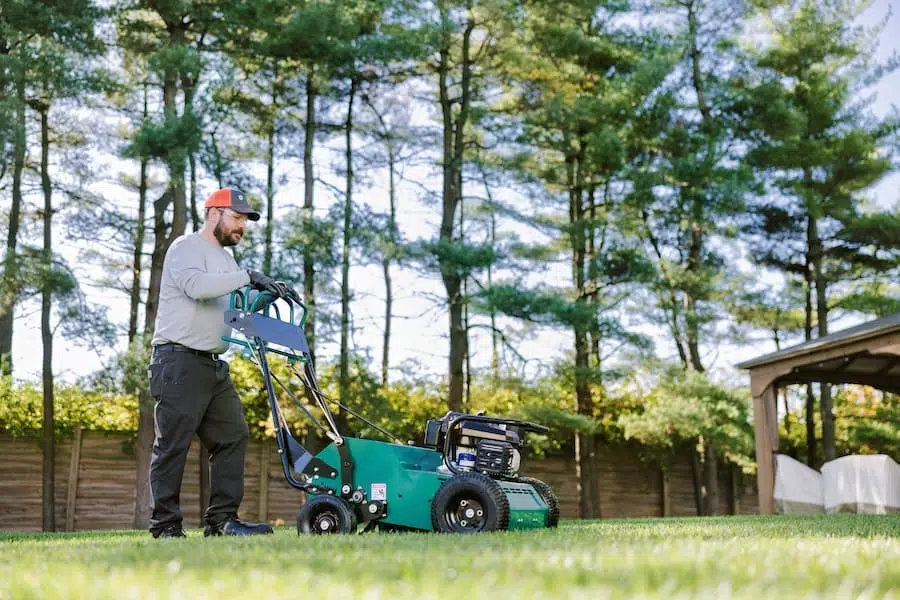
Core aeration pulls plugs of soil from your lawn, reducing compaction and allowing water, air, and nutrients to reach grass roots. For lawns struggling with summer stress, this can provide immediate relief by improving water penetration and root health.
At Lawn Squad of Murfreesboro, our ELITE program includes summer and fall aeration in Rounds 4 through 8. We recommend aeration during summer stress because it helps grass survive the heat and prepares the lawn for fall recovery.
One important note: if you had pre emergent herbicide applied in spring, check with your lawn care provider before aerating. Aeration can disrupt the pre emergent barrier that’s keeping crabgrass and other summer weeds out.
Common Summer Lawn Mistakes Murfreesboro Homeowners Make
After more than two decades serving Murfreesboro, Christiana, Smyrna, La Vergne, and surrounding areas, we’ve seen these mistakes cause lawn problems over and over.
Mistake #1: Waiting Until Problems Appear Many homeowners don’t think about summer lawn care until their grass turns brown or develops dead patches. By then, the damage is done and recovery is expensive. Prevention costs less and works better than rescue.
Mistake #2: Overwatering When grass looks stressed, the natural reaction is to water more. But overwatering creates shallow roots, encourages fungal disease, and can actually make drought stress worse in the long run. Stick to 1 to 1.5 inches per week, applied deeply.
Mistake #3: Mowing Too Short Cutting grass short during summer exposes soil to direct sun, increases water loss, and weakens grass plants. Keep Murfreesboro lawns at 3 to 4 inches during summer months.
Mistake #4: Fertilizing During Extreme Heat Heavy nitrogen forces grass to grow when it should be conserving energy. Summer fertilization should be light and timed carefully, not applied during heat waves.
Mistake #5: Ignoring Early Warning Signs A few yellow spots or a small patch of disease won’t fix itself. Early treatment prevents small problems from becoming lawn wide disasters.
DIY vs Professional Lawn Care: Which Should You Choose?
DIY lawn care gives you control over timing and products, and costs less upfront. However, it requires knowledge of what to apply and when, plus time to apply treatments every few weeks throughout the season. Mistakes can be costly, and most homeowners don’t have access to commercial grade products.
Best for: Homeowners who enjoy lawn work, have time during each treatment window, and are willing to learn about proper timing and products.
Professional lawn care handles all the timing, product selection, and application for you. Programs are designed by experts who understand Murfreesboro’s specific conditions. The cost is higher than DIY, but results are typically more consistent and problems are caught early.
Best for: Busy homeowners, those who want guaranteed results, or anyone dealing with ongoing lawn problems they can’t seem to solve.
Your Summer Lawn Care Calendar at a Glance
Prevention Approach
| When | What to Do | Details |
|---|---|---|
| January to February | Round 1 | Pre emergent, fertilizer, soil test |
| March | Round 2 | Pre emergent, fertilizer, broadleaf weed control, surface insect control |
| April | Round 3 | Fertilizer, weed control, surface insect control, grub prevention |
| June | Round 4 | Fertilizer, weed control, insect control, grub prevention, sedge suppression, aeration |
| July | Round 5 | Fertilizer, root stimulant, weed control, insect control, sedge suppression |
| August | Round 6 | Fertilizer, weed control, insect control, sedge suppression, disease control |
Rescue Approach
| When | What to Do | Details |
|---|---|---|
| Immediately | Identify problem | Determine if drought, disease, insect, or heat dormancy |
| Day 1 to 3 | Treat active threats | Curative fungicide or insect control as needed |
| Ongoing | Supportive care | Proper watering, mowing height, avoid heavy fertilizer |
| Fall | Recovery plan | Aeration and overseeding to repair damage |
The Bottom Line
Murfreesboro summers push lawns to their limits, but summer stress doesn’t have to ruin your yard. The key is starting early, treating problems before they spread, and understanding what your grass actually needs during the hottest months.
Key principles to remember:
- Prevention works better and costs less than rescue
- Water deeply but infrequently, about 1 to 1.5 inches per week total
- Keep mowing height at 3 to 4 inches during summer
- Don’t fertilize heavily during extreme heat
- Address disease and insect problems immediately before they spread
Following these guidelines will help your Murfreesboro lawn survive summer and come back strong in fall.
Let Lawn Squad of Murfreesboro Handle It For You
Every Murfreesboro lawn is different. Soil conditions, grass type, shade patterns, and irrigation all affect what your specific lawn needs. Our programs account for these variables and adjust treatments to your property.
ELITE Program includes:
- 14 billable treatments across 13 visits
- Disease control in summer rounds when fungal pressure peaks
- Surface insect control from spring through fall
- Grub prevention before damage occurs
- Sedge suppression during summer months
- Summer and fall aeration for stress relief and recovery
- Unlimited service calls if problems develop between visits
If you’re tired of watching your Murfreesboro lawn struggle through summer, or if you just want to spend your weekends doing something other than lawn work, we’re here to help.
Contact Lawn Squad of Murfreesboro today at 615-931-4478 or visit lawnsquad.com/contact-us to get a free quote and give your lawn the professional care it deserves.