Purdue’s Case for Late-Season Fertilization: What It Means for Central Indiana Lawns
Purdue’s Case for Late-Season Fertilization: What It Means for Central Indiana Lawns
Short Answer: Purdue University’s turfgrass program has long been one of the strongest advocates for late-season fertilization of cool-season lawns. For the Kentucky bluegrass and tall fescue lawns across Central Indiana, a feeding applied after the last regular mowing, while the grass is still green and the ground is unfrozen, gets stored in the roots and crowns rather than turned into leaves. The result is earlier, more even spring green-up, better root growth, and less need for heavy spring feeding. Around Indianapolis, that window usually falls in November.
If you are reading this, you may have heard that the most important lawn feeding of the year happens in November, and that probably sounded backward. Most of us were raised on the idea that spring is when you fertilize. The stores fill up in April, and the neighbors start spreading at the first warm weekend.
In Indiana, the push for late-season feeding has a home-state source. Purdue University’s turfgrass science program has studied and recommended late-season fertilization of cool-season lawns for decades. Here is what that research means for your lawn in Carmel, Fishers, Noblesville, Zionsville, Greenwood, or anywhere around Indianapolis this month.
What Most Central Indiana Lawns Are Made Of
Lawns across Central Indiana are mostly cool-season grasses: Kentucky bluegrass, tall fescue, and perennial ryegrass, often in blends. Shaded areas sometimes include fine fescues. A smaller number of lawns, especially in sunny spots, have zoysia, a warm-season grass.
Cool-season grasses grow best in the mild weather of spring and fall, slow down in summer heat, and go semi-dormant in winter. That pattern is the key to late-season feeding.
What Late-Season Fertilization Means
Late-season fertilization is not the same as fall fertilization in September. It is a feeding applied later, after the last regular mowing of the year, when top growth has nearly stopped but the grass is still green and the soil is not frozen.
At that point, the plant is not putting much energy into new leaves. Nitrogen taken up then goes largely into storage in the roots, crowns, and, in bluegrass, rhizomes. That stored energy carries the lawn through winter and fuels new growth in spring.
What the Research Has Shown
Turfgrass research, including work associated with Purdue, has pointed to several benefits of late-season nitrogen for cool-season lawns. Lawns tend to green up earlier in spring, often without needing an early spring feeding. Root growth improves, which helps the lawn handle summer stress. Turf density increases, leaving less room for weeds. And the lawn often holds its color longer into late fall and early winter.
One of the most practical takeaways is that late-season feeding can reduce the need for heavy spring fertilization, which tends to push top growth at the expense of roots.
Why Spring-Only Feeding Falls Short
When a lawn is fed mostly in spring, the grass puts that nitrogen into fast leaf growth. That means more mowing and a lawn that heads into summer with lots of top growth but relatively shallow roots. When July heat and dry spells arrive, those lawns are often the first to brown out.
Shifting more of the year’s feeding into fall, and especially into the late-season window, tends to build a lawn that is stronger below ground.
Timing Around Indianapolis
Here is what we have found works best for Central Indiana lawns. Plan the late-season feeding for November, after the last regular mowing, while the grass is still green and the ground is not frozen. In most years, that window runs from early to late November. A mild fall can stretch it toward early December. An early hard freeze can close it sooner.
Frost on the grass in the morning does not mean the ground is frozen. If a screwdriver pushes easily into the soil mid-morning, the window is open.
What to Apply
Nitrogen is the key nutrient. A quicker-release source is often preferred this late, since the grass needs to take it up before the soil cools further. Moderate rates are plenty, since the goal is storage rather than a surge of growth.
Many winterizer products are high in potassium. Potassium supports stress tolerance, but for cool-season lawns, research points to nitrogen as the nutrient that drives the late-season benefit. Unless a soil test shows a potassium shortage, a nitrogen-focused product is usually the better value.
Phosphorus is rarely needed on established lawns. Many Central Indiana soils have adequate phosphorus, and phosphorus runoff contributes to algae problems in reservoirs and streams. Choose a product with little or no phosphorus unless a soil test shows a need.
The Zoysia Exception
Zoysia is a warm-season grass that turns tan after the first hard frost and stays dormant until late spring. It should not get a late-season nitrogen feeding. It is already shutting down and will not use it. If part of your lawn went tan in October while the rest stayed green, skip that area.
Leaves Before Fertilizer
Central Indiana’s maples, oaks, and other shade trees drop a lot of leaves, and many come down in early to mid November. Fertilizer spread over a leaf layer never reaches the soil. Mulch light leaf cover with the mower or clear heavier layers before applying.
Keep It Out of the Storm Drains
Granules that land on driveways, sidewalks, and streets wash into storm drains with the next rain. Around Indianapolis, many of those drains lead to the White River, Fall Creek, and reservoirs like Geist and Morse that supply drinking water. Sweep or blow stray granules back onto the lawn, and avoid applying right before heavy rain or on frozen ground.
Spread It Evenly
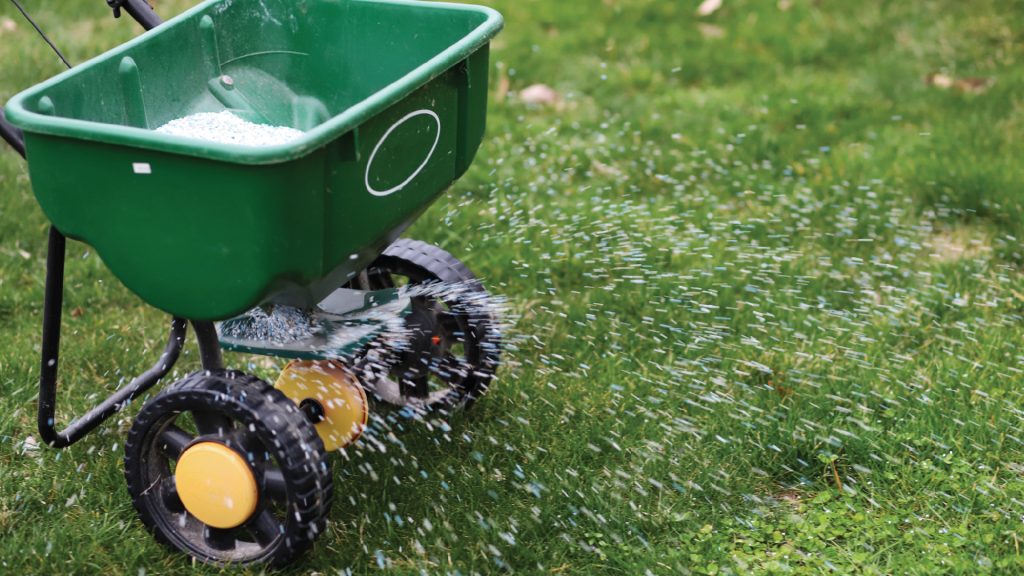
Spreader settings on the bag are a starting point, but every spreader and walking pace is different. Uneven application shows up next spring as stripes of dark and pale grass. Set the spreader at half the label rate, walk the lawn in one direction, then walk it again at a right angle, closing the spreader at the end of each pass before turning.
Final Mow
Keep mowing at about three inches until growth stops, then make a final cut slightly lower, around two and a half inches. That helps prevent long grass from matting under snow without scalping the crowns.
Common Mistakes
A few patterns come up often around Central Indiana. Applying a winterizer in early October, while the lawn is still growing hard, turns much of it into leaf growth. Applying in December or January on frozen ground mostly sends it toward the storm drains. And skipping it because the lawn looks fine in November means missing the application that does the most for spring.
A Soil Test Is Worth It
If you want to know exactly what your lawn needs, a soil test is the best starting point. It shows pH and nutrient levels and helps you avoid buying what your lawn does not need. Purdue Extension can point homeowners to testing options.
What a Research-Backed November Looks Like in Spring
Imagine this. It is early April. Lawns around your neighborhood are still mostly tan. Yours is greening up evenly across the whole yard, with deeper color and fewer weeds than last year, and you have not even pulled out the spreader yet. That head start came from following the research and feeding the lawn in November.
What to Do Next
If you are feeding your own lawn, plan for November, after the last regular mowing, while the grass is still green and the ground is not frozen. Clear leaves first, choose a nitrogen-focused product with little or no phosphorus, apply at half rate in two crossing passes, and sweep any granules off pavement. Skip zoysia areas.
If you would rather have someone else handle the timing decisions, product selection, and application for your Central Indiana lawn, we are here for that. Lawn Squad of Central Indiana serves homeowners across Central Indiana. Visit lawnsquad.com to request a free quote. Our VitaminLawn program is built for the grass types, soils, and weather patterns we deal with here.
Here is what to expect. We will look at your grass, talk through how your lawn handled this year, and explain what we would apply before winter and why. If your lawn does not need a late-season application, we will tell you that honestly.