

What Your Westchester Lawn Is Doing Under the Leaves in November, and Why It Still Needs a Feeding
What Your Westchester Lawn Is Doing Under the Leaves in November, and Why It Still Needs a Feeding
Short Answer: In November, a Westchester lawn looks like it is winding down, but underneath it is busy. Bluegrass, ryegrass, and fescue slow their top growth as days shorten, yet their roots keep growing and the plants keep moving carbohydrates into their crowns until the soil freezes. That is why a late-season feeding in early to mid November works so well: the grass stores the nitrogen instead of turning it into leaves, and it spends that reserve on an earlier, more even spring green-up. Clearing leaves and finishing before the December 1 cutoff are the keys.
If you are reading this, you are probably looking at a lawn that seems to be shutting down. The grass is growing slowly, if at all. Leaves are piling up from the oaks and maples. Mornings bring frost. It is natural to assume the lawn is done for the year and anything you put on it now would be wasted.
That is one of the most common assumptions we hear from Westchester homeowners in November, and it is understandable. The honest answer is that the lawn is not done at all. What you see on top is only half the story, and the other half is the reason November feeding matters so much.
The Part You See: Slowing Down
As days shorten and temperatures drop, cool-season grasses slow their leaf growth. In most of Westchester, that slowdown becomes noticeable in late October, and by mid November many lawns barely need mowing. The color may fade slightly during cold spells and recover on milder days.
That visible slowdown is what convinces many homeowners the season is over.
The Part You Do Not See: Roots at Work
Underneath, the story is different. Roots of Kentucky bluegrass, perennial ryegrass, tall fescue, and fine fescue keep growing as long as the soil stays above freezing. Soil cools much more slowly than air, so even after several frosty mornings, the root zone is often still warm enough for active growth.
At the same time, the plant is busy storing energy. Carbohydrates made in the leaves during sunny fall days are moved down into the crowns, roots, and, in bluegrass, the rhizomes. Those stored carbohydrates are what the grass lives on through winter and what it uses to push new growth in spring.
Imagine the lawn as a squirrel gathering acorns before winter. It looks quiet from a distance, but it is working hard to stock up.
Why Feeding Now Works So Well
When fertilizer goes down in spring, the grass uses most of the nitrogen to make new leaves. That gives a quick burst of green but more mowing and relatively little root development.
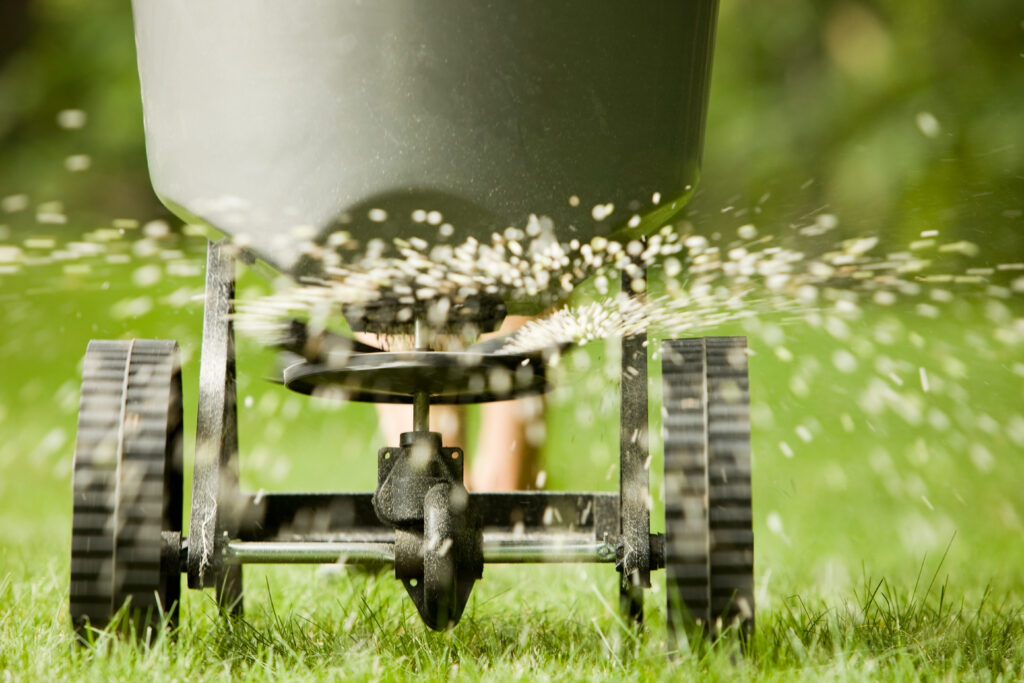
In November, the plant’s priorities are different. With top growth slowed, nitrogen taken up now goes largely into storage and root health. That is why a late-season feeding is so efficient. The grass uses it for exactly the things that matter most for next year.
The payoff shows up in spring. Lawns fed in late fall tend to green up earlier and more evenly, fill in thin spots faster, and start the season with more energy to crowd out weeds.
Leaves Interrupt the Process
Here is where many Westchester lawns run into trouble. The county’s mature trees drop a lot of leaves, and much of it comes down in November. A thick layer of leaves on the lawn blocks sunlight, which means the grass cannot make the carbohydrates it is trying to store. It also traps moisture against the turf, which encourages snow mold and other winter diseases.
So the leaves are not just a cosmetic issue. They directly interfere with the lawn’s late-season work. Mulching light leaf cover with the mower lets sunlight reach the grass while returning organic matter to the soil. Heavier layers should be raked or blown off.
Frost Is Not the Same as Frozen
A white frost on the lawn at 7 in the morning does not mean the ground is frozen. Frost forms on the grass blades when the air near the surface dips below freezing, but the soil a few inches down is usually much warmer.
That is why the late-season feeding window stays open well into November in most years. A simple check: after the frost melts mid-morning, push a screwdriver into the lawn. If it goes in easily, the roots are still active.
One caution: try to stay off frosted grass. Frozen blades are brittle and break under foot traffic, leaving brown footprints.
The December 1 Deadline
In Westchester, the window for feeding closes on a fixed date, not just when the ground freezes. Both New York State law and Westchester County law prohibit lawn fertilizer from December 1 to April 1. Even in a mild year when the roots are still working, the last day for a late-season feeding is November 30.
Here is what we have found works best. Aim for early to mid November, once mowing has slowed and the leaves are mostly under control, rather than waiting until the last week.
Choosing the Right Product
For a late-season feeding, nitrogen is the key nutrient. Under New York law, phosphorus can only be used on lawns when establishing a new lawn or when a soil test shows a need, and Westchester County restricts phosphorus fertilizer as well. A phosphorus-free, nitrogen-focused product is the right choice for most established lawns.
A quicker-release nitrogen source is often preferred this late in the season, since the grass needs to take it up before the soil cools further.
Mowing Through the Slowdown
Keep mowing at about three inches until the lawn stops growing. Taller grass has more leaf surface for making the carbohydrates the plant is storing. When growth has nearly stopped, a final cut slightly lower, around two and a half inches, helps reduce matting under snow. Avoid scalping, which removes the leaf tissue the plant still needs.
Watering in a Dry Fall
Most Novembers bring enough rain to keep the root zone moist. If the fall turns dry, a deep watering now and then helps roots keep growing and helps fertilizer move into the soil. Once the ground begins to freeze, there is no need to water.
Keep It Off the Pavement and Away From Water
Westchester’s hilly streets carry runoff downhill quickly toward the Hudson, the Sound, and the reservoirs. Both state and county law prohibit fertilizer on paved surfaces and restrict it within 20 feet of water. Sweep any stray granules back onto the lawn and mark a buffer along any brook or pond before you start spreading.
Signs the Lawn Is Truly Done
At some point, the lawn really does stop. Sustained cold drives soil temperatures down, roots slow to a crawl, and the grass goes semi-dormant, often taking on a dull, gray-green or tan color. In Westchester, that usually happens sometime in December, after the fertilizer window has already closed.
What That Underground Work Looks Like in Spring
Imagine this. It is mid April. The snow is long gone, and the soil is warming. Your lawn turns green evenly and quickly, the thin spot near the walkway fills in, and there are fewer weeds than last year. None of that was visible in November. It was happening underground, under the leaves, fueled by the late-season feeding.
What to Do Next
This month, keep mowing at about three inches until growth stops, clear or mulch leaves so sunlight can reach the grass, and apply a phosphorus-free, nitrogen-focused feeding in early to mid November. Stay off frosted grass, stay 20 feet from any water, sweep granules off the pavement, and finish before the December 1 cutoff.
If you would rather have someone else handle the timing decisions, product selection, and application for your Westchester lawn, we are here for that. Lawn Squad of Westchester serves homeowners across Westchester County. Visit lawnsquad.com to request a free quote. Our VitaminLawn program is built for the grass types, soils, and weather patterns we deal with here, and for the rules New York and Westchester County set on when and how lawns can be fed.
Here is what to expect. We will look at your grass, talk through how your lawn handled this year, and explain what we would apply before winter and why. If your lawn does not need a late-season application, we will tell you that honestly.
