Shade, Slopes, and Old Trees: Late-Season Feeding for Westchester’s Established Lawns

Shade, Slopes, and Old Trees: Late-Season Feeding for Westchester’s Established Lawns
Short Answer: Many Westchester lawns sit under mature oaks, maples, and beeches, on sloped lots that drain toward streams and reservoirs. Those conditions change how a late-season feeding should be handled. Shaded areas with fine fescue need less nitrogen than sunny bluegrass and ryegrass. Sloped yards need careful timing so fertilizer soaks in rather than running off. And heavy leaf drop means cleanup has to come first. A modest, phosphorus-free feeding in early to mid November, before the December 1 cutoff, gives each part of an established lawn what it can use.
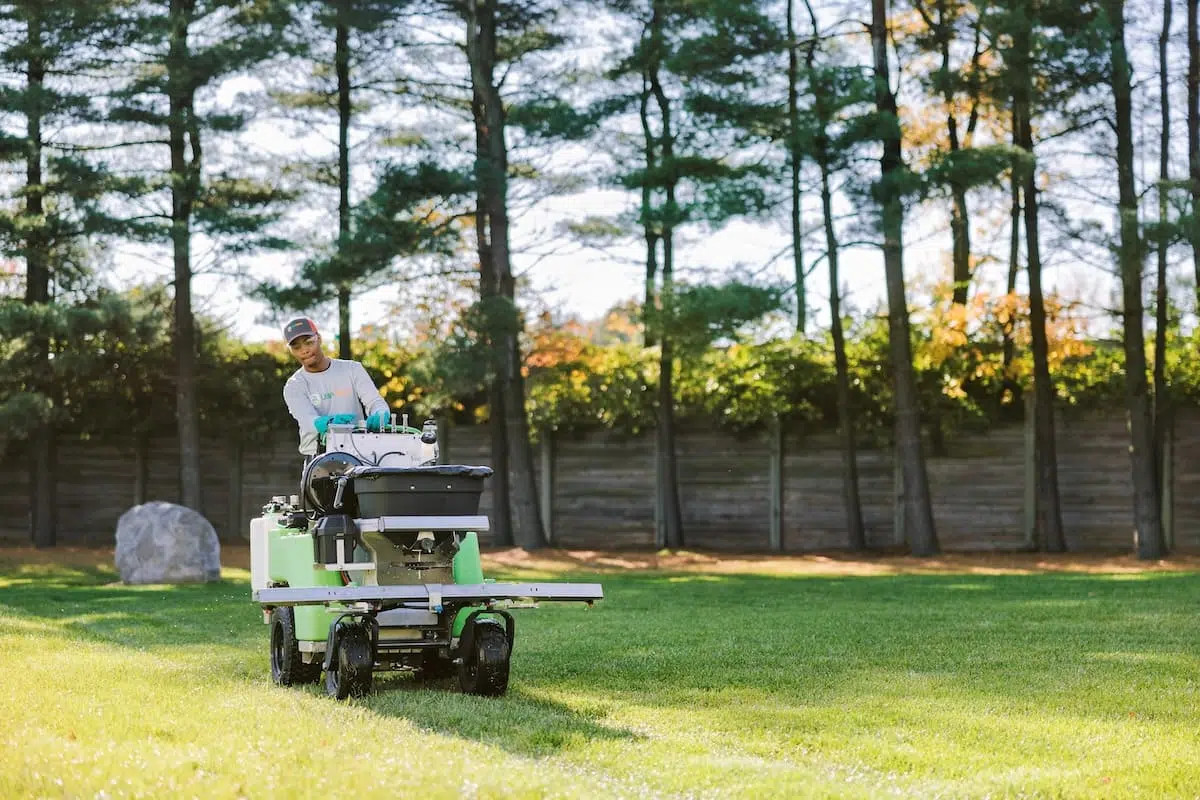
If you live in one of Westchester’s older neighborhoods, your lawn probably does not look like the ones in fertilizer commercials. It may sit under a canopy of hundred-year-old oaks, wrap around stone walls and rock outcrops, and run downhill toward a brook or a neighbor’s yard. Parts of it are deep green, parts are thin, and parts never seem to get enough sun.
That is completely normal here. Most homeowners we talk to in towns like Scarsdale, Bronxville, Chappaqua, Bedford, and Pound Ridge have some version of that lawn. The good news is that a late-season feeding can help, as long as it is matched to the conditions instead of applied the same way across the whole yard.
The Lawns Westchester Grows
The sunny parts of most Westchester lawns are Kentucky bluegrass, perennial ryegrass, or tall fescue, often in a blend. In the shade, fine fescues take over. Fine fescues, including creeping red fescue, chewings fescue, and hard fescue, handle shade, dry soil, and lower fertility better than the others.
All of these are cool-season grasses. In November, they slow down on top but keep building roots and storing energy until the ground freezes. A late-season feeding supports that process and helps the lawn green up earlier next spring.
Shade Changes the Math
Grass in the shade grows more slowly and uses less nitrogen than grass in full sun. Under a dense canopy, the lawn is also competing with tree roots for water and nutrients.
Fine fescues in particular can be harmed by too much nitrogen. They tend to perform best with light feeding, and heavy applications can make them more prone to disease. Here is what we have found works best. Give the shaded fine fescue areas a lighter late-season feeding than the sunny areas, or skip them entirely if they are healthy and dense. Focus the full rate on the sunny bluegrass, ryegrass, and fescue areas that can use it.
The Leaf Problem
Mature trees mean a lot of leaves, and in Westchester they come down late. Oaks, in particular, often hang on through much of November. A thick leaf layer on the lawn blocks the sunlight cool-season grass still needs in late fall and traps moisture that favors snow mold.
Clearing leaves before the late-season feeding is essential. Fertilizer spread over a leaf mat never reaches the soil. Mulch light leaf cover with the mower, and rake or blow heavier layers off so the granules land on the soil surface.
Slopes and Runoff
Many Westchester lawns are steep, or at least sloped, especially in the river towns and the northern part of the county. Rain runs off sloped lawns faster than flat ones, and anything sitting on the surface goes with it.
That makes timing especially important. Apply on a calm day ahead of a light rain rather than a heavy storm. Avoid applying on frozen or saturated ground. And use a lower rate on the steepest sections, where water moves fastest. A dense lawn on a slope is one of the best ways to slow runoff, so the goal is to feed it in a way the grass can absorb.
Stone Walls, Ledges, and Shallow Soil
Westchester’s rocky terrain means some lawns sit on shallow soil over ledge, especially near stone walls and rock outcrops. Shallow soil dries out quickly and holds fewer nutrients. Grass in those spots often looks thin regardless of how it is fed.
For those areas, a late-season feeding helps a bit, but the bigger issue is usually soil depth and moisture. Topdressing with compost in spring or fall can help over time.
Phosphorus and Westchester Lawns
New York State and Westchester County both restrict phosphorus in lawn fertilizer. Phosphorus can only be applied when establishing a new lawn or when a soil test shows it is needed. For established lawns, choose a product with no phosphorus.
Water Setbacks on Wooded Lots
Many established properties border brooks, wetlands, or ponds. New York law restricts fertilizer within 20 feet of any water body, with closer application allowed only with a spreader guard, deflector, or drop spreader. Westchester County law also prohibits fertilizer within 20 feet of surface water except where a vegetated buffer is in place. Marking the buffer before you start makes it easy to follow.
Timing Around December 1
Both state and county law prohibit lawn fertilizer from December 1 to April 1. For established lawns under big trees, that can make timing tricky, since the leaves come down late. Here is what we have found works best. Clear leaves in stages, and apply the late-season feeding in early to mid November in the areas that are clear, rather than waiting for every last leaf to fall.
Mowing Before Winter
Keep sunny bluegrass and fescue areas mowed at about three inches until growth stops, then make a final cut slightly lower. Fine fescue in the shade can stay a little taller. Avoid scalping any part of the lawn before winter.
Soil Testing Pays Off on Older Properties
Older properties often have soil that has been altered over decades by construction, tree roots, and past fertilization. A soil test shows pH and nutrient levels and helps you avoid buying what your lawn does not need. Many Westchester soils lean acidic, especially under oaks and pines, and lime may be more helpful than extra fertilizer in some areas. Cornell Cooperative Extension can point homeowners to soil testing options.
Moss in Shady Spots
Moss shows up in a lot of shaded Westchester lawns, especially on the north side of the house and under evergreens. It is usually a sign of conditions that favor moss over grass: dense shade, acidic soil, compaction, or poor drainage. Fertilizer alone rarely fixes moss. Addressing the underlying conditions, such as improving light, adjusting pH based on a soil test, and loosening compacted soil, gives the grass a better chance to compete.
Accepting What Shade Will Allow
One honest note. Under very dense shade, no amount of fertilizer will produce a thick lawn. Grass needs sunlight. In the shadiest spots, many homeowners have better luck with shade-tolerant ground covers or mulched beds than with turf. Thinning the tree canopy, done carefully by an arborist, can also help.
What a Well-Matched Plan Looks Like in Spring
Imagine your yard next April. The sunny front lawn is greening up early and evenly. The fine fescue under the oaks is holding its own without disease. The slope down to the brook is thick and green, and none of the fertilizer ended up in the water. Each part of the lawn got what it could actually use.
What to Do Next
For an established lawn under mature trees, clear leaves in stages and feed the clear areas in early to mid November, before the December 1 cutoff. Give shaded fine fescue a lighter rate or skip it, use the full rate on sunny areas, go lighter on steep slopes, use a phosphorus-free product, and stay 20 feet from any brook or pond.
If you would rather have someone else handle the timing decisions, product selection, and application for your Westchester lawn, we are here for that. Lawn Squad of Westchester serves homeowners across Westchester County. Visit lawnsquad.com to request a free quote. Our VitaminLawn program is built for the grass types, soils, and weather patterns we deal with here, and for the rules New York and Westchester County set on when and how lawns can be fed.
Here is what to expect. We will look at your grass, talk through how your lawn handled this year, and explain what we would apply before winter and why. If your lawn does not need a late-season application, we will tell you that honestly.