Why Do Fall Armyworms Appear Overnight, and What Actually Stops Them?
Short Answer: Fall armyworms hatch small and feed almost invisibly for their first week or so, then eat far more in their final days than in their entire life before, which is why a lawn seems to brown overnight. Confirm them with a soapy water flush: a couple tablespoons of lemon scented dish soap in a gallon or two of water poured over about a square yard at the edge of the damage, then watch for a few minutes as caterpillars crawl up. Curative insecticide applied while larvae are small works quickly. Preventive treatment has real but limited residual, because flights are unpredictable and vary year to year.
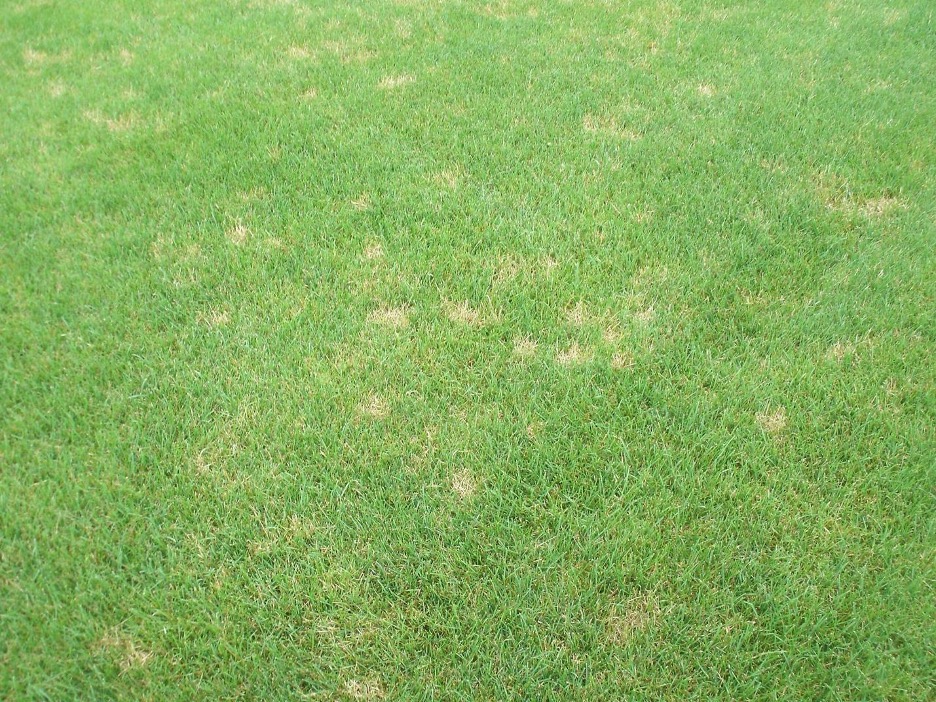
You mowed on Saturday and the lawn was fine. On Tuesday morning you walk out with coffee and half the back yard is the color of straw, with a ragged edge running across it like something dragged a rake sideways. There are more birds on the lawn than you have ever seen at once. If you crouch down, the grass in the brown area is not just discolored, it is shorter, and the blades that are left look chewed along the edges rather than dried out.
The first reaction is almost always that the irrigation failed or a chemical got spilled. It feels like something you did, or failed to do. In most cases it is neither, and the culprit walked in from a hundred miles away without asking anybody.
What You Are Actually Looking At
Fall armyworm caterpillars are the larvae of a night flying moth. Full grown ones reach roughly an inch and a half and range from pale green to brown to nearly black, with lengthwise stripes down the body. Two markings identify them reliably. The head capsule carries a light colored inverted Y. Near the rear of the body, on the second to last segment, there are four dark spots arranged in a square. If you find that combination, you have your answer.
The damage they cause is genuinely different from drought, and once you have seen it you will not confuse the two again. Drought stress dulls color across a whole area and the blades stay intact, folded and blue gray, and footprints linger. Armyworm damage removes tissue. Young larvae scrape one surface of the leaf and leave thin translucent windows. Larger ones eat the blade down, leaving notched, ragged edges and eventually just stems. The affected area often has a distinct advancing front, and the turf looks like it was mowed far too low in that spot only. Look closely and you will find small dark pellets of frass down at the soil line.
The Life Cycle That Explains the Overnight Part
A female moth lays eggs in a fuzzy mass, often on something flat and light colored near the lawn rather than on the grass itself. Fences, gutters, siding, mailbox posts, flags, and the undersides of leaves are all typical. Eggs hatch within a few days and the caterpillars drop or crawl into the turf.
For the first week and a half or so, they are tiny and eat very little. You can be standing on an infested lawn and see nothing at all. Then, in the last few days before pupating, they grow rapidly and consume the overwhelming majority of everything they will ever eat. That is the whole explanation for the overnight phenomenon. The infestation is not new. The appetite is. After feeding finishes, they burrow into the soil to pupate, and a new generation of moths emerges to start again, which is why a lawn can be hit more than once in a season.
Why the Timing Varies So Much by Region and by Year
Fall armyworms cannot survive freezing winters. They overwinter only in the warmest parts of the country and in the tropics, then move north on moth flights carried by weather systems through the summer. That single fact explains most of what homeowners find confusing about them.
In tropical Florida and along the Gulf Coast, populations are present through much of the year and pressure can be near constant during the wet season. In the warm-season South, from Texas through the Carolinas, late summer is the classic period and bermuda, zoysia, and bahia are common targets. In the transition zone, through Tennessee, Kentucky, Missouri, and the mid Atlantic, arrivals tend to come later in the summer and are more sporadic, and they hit newly seeded tall fescue hardest. The cool-season North and the arid West can get outbreaks when a strong flight pushes far enough, but they are less frequent and often go unrecognized because homeowners are not looking for them.
Severity swings widely from year to year depending on how populations build in the south and how weather patterns move them. Some years are quiet in a given region and some years are memorable. Anyone who tells you exactly what this season will bring is guessing, and we would rather tell you what to watch for than predict weather we cannot see.
The Soapy Water Flush Test
This is the most useful five minutes you can spend, and you already own the equipment. Mix a couple of tablespoons of lemon scented dish soap into a gallon or two of water. Pick a spot at the edge of the damage where green grass meets brown, because that is where active larvae are, not in the middle of the eaten area. Pour the mixture slowly over roughly a square yard so it soaks in.
Then stand still and watch for several minutes. The soap irritates the caterpillars and they climb to the surface. If armyworms are present, you will see them crawling up through the canopy, sometimes in numbers that surprise people. A few showing up per square foot is meaningful and worth acting on. Nothing after several minutes means you should look at drought, disease, or grubs instead. Rinse the test area with plain water afterward. Do the test in the early morning or at dusk if you can, since larvae move to the base of the plants in the heat of the day.
The Honest Limits of Preventive and Curative Treatment
Curative treatment works well and works fast. A properly labeled insecticide applied when larvae are small typically brings the population down within a day. Timing matters more than product choice. Large, late instar caterpillars are noticeably harder to kill, and by then most of the damage is already done anyway. Two application details are worth knowing, because they run opposite to grub control: armyworms feed on leaf tissue, so the material should stay on the foliage rather than be watered in, and mowing right after an application removes much of what you just applied. Late day treatment lines up with when they feed.
Preventive treatment is more complicated, and we would rather be straight with you. Longer residual products exist and can hold protection for a period of weeks, which is genuinely valuable on new sod, fresh seedings, and properties with a history of repeated hits. But no residual lasts all season, flights are unpredictable, and blanket preventive spraying in a quiet year is money spent on an insect that never arrives. On most established lawns, active scouting plus fast curative response is the better value. On a lawn you just paid to renovate, the calculus changes.
The recovery outlook is better than it looks. Armyworms eat leaf tissue and generally leave crowns and roots alone, so an established, well rooted lawn usually greens back up within a couple of weeks with water and appropriate nitrogen. What they can kill outright is new seedlings and new sod that have no reserves yet. That is the case where speed genuinely matters.
What to Do Next
If damage is spreading, run the flush test today rather than waiting for the weekend, and check egg masses on nearby fences and siding. If you would like a professional set of eyes on it, find your local Lawn Squad at lawnsquad.com or call 833-816-7508 for a free quote. Each location is independently owned and operated and builds its VitaminLawn fertilization and weed control program around local grass type, soil, and climate, including the insect pressure that actually shows up in your region.
A first visit means confirming the pest, checking whether the damage is caterpillars alone or caterpillars on top of drought or disease, and treating the same day when it is warranted. Expect feeding to stop quickly after a curative application. At 30 days, an established lawn should have filled back in noticeably, and at 90 days the episode should be invisible, with a plan in place for scouting the next flight.