
What Actually Happens During Fall Aeration and Overseeding, and What Results Should I Expect?
Short Answer: Core aeration pulls thousands of soil plugs out of the lawn, relieving compaction and opening channels for air, water, and roots. Seed dropped into those holes lands on bare soil instead of thatch, which is what makes it germinate. Expect the plugs to melt back into the lawn within two to three weeks, first seedlings in roughly one to three weeks depending on species and temperature, and visible thickening by 30 days. Real density arrives at 90 days and after. One overseeding improves a thin lawn substantially. It rarely finishes the job in a single season.
You booked the service, you wrote the check, and then a machine spent forty minutes in your yard and left behind what looks like a field covered in mud cigars. The lawn looks worse than it did that morning. Someone in the household is going to ask why the yard is covered in dirt. This is the moment more homeowners call us with questions than any other point in the year, and it is completely fair, because almost nobody explains the process before the truck pulls up.
The uncertainty is the hard part. You are spending money on something you cannot see working, on a schedule you did not set, and the visible evidence for the first two weeks runs in the wrong direction. So let us walk through exactly what is happening under there.
What Core Aeration Actually Does
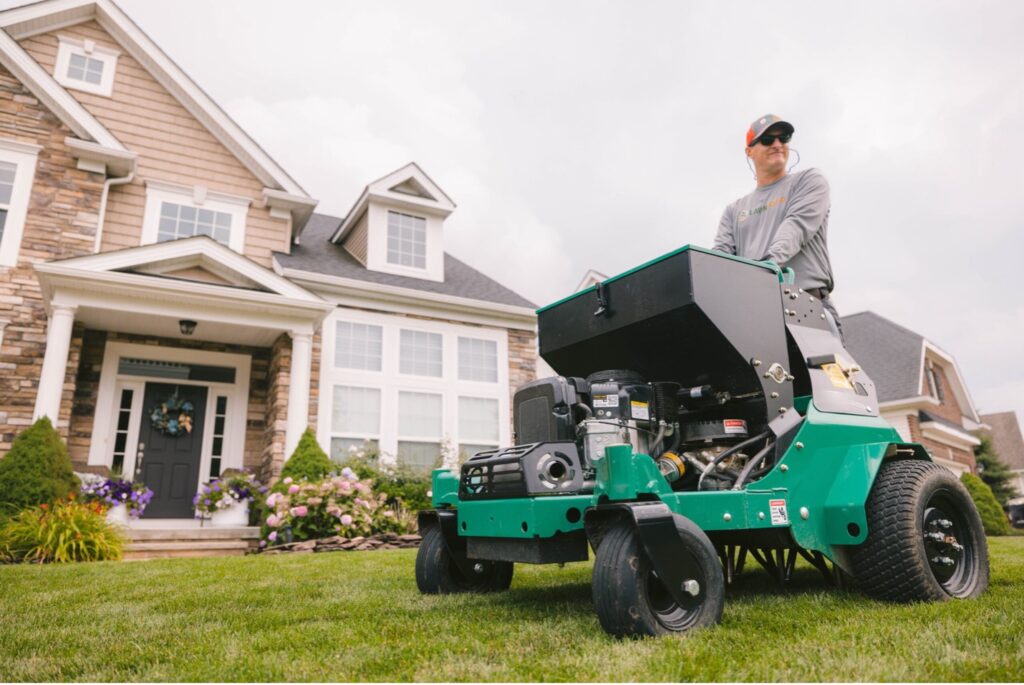
A core aerator is a drum fitted with hollow tines. As it rolls, those tines punch into the soil and pull out plugs, usually somewhere around two to three inches deep and a half inch across, spaced a few inches apart. That is the whole mechanism. It sounds crude because it is, and it works for three reasons at once.
First, it relieves compaction. Soil is not solid. A healthy root zone is roughly half pore space, filled with air and water, and roots grow into those pores. Foot traffic, mowers, clay, and construction squeeze those pores shut, and roots stop going down. Removing cores gives the surrounding soil somewhere to expand into.
Second, it breaks through thatch. Thatch is the spongy layer of stems and roots between the green blades and the soil. A thin layer is normal and useful. A thick layer sheds water sideways and keeps seed suspended above the soil where it will sprout, run out of moisture, and die. Aeration cuts channels straight through it.
Third, and most importantly for overseeding, it creates thousands of small protected pockets of bare soil. Grass seed needs firm contact with soil and steady moisture. A seed sitting on top of a lawn has neither. A seed that falls into an aeration hole has both, plus shade and a little shelter from birds.
What Actually Happens on Service Day
Before the machine runs, the lawn should be mowed shorter than usual and watered a day or two ahead, because tines will barely penetrate bone dry soil and make a mess of saturated soil. Irrigation heads, invisible fence lines, and shallow utilities get marked. Then the aerator makes multiple passes, often in more than one direction on compacted lawns, working around obstacles.
How many passes matters more than most people expect. A single pass on a compacted clay lawn removes a modest fraction of the surface, which is fine for annual maintenance but not enough when the goal is real seed establishment. On lawns we are renovating, more holes means more places for seed to land, and the difference in fill-in the following spring is easy to see. This is also why the machine wanders in what looks like an inefficient pattern. Straight uniform rows leave uniform gaps.
Seed goes down after aeration, not before, and is chosen for your grass type and light conditions. A starter fertilizer with phosphorus is typically applied at the same time, since phosphorus supports early root development and most established lawns do not otherwise need it. The plugs stay on the surface on purpose. Do not rake them up. Rain and mowing break them down in about two to three weeks, and as they crumble they work a thin layer of soil and microbes back over the seed, which is free topdressing.
Where You Live Changes the Calendar
Aeration and overseeding together is a cool-season practice, and the right week varies enormously by region. In the cool-season North, including New England, the upper Midwest, the Great Lakes, the Pacific Northwest, and the mountain West, late August into September is the window, and the northern edge of that zone needs to be at the early end so seedlings get six to eight weeks before hard frost. In the transition zone, from the mid Atlantic Piedmont through Kentucky, Tennessee, Missouri, and into Oklahoma, tall fescue lawns aerate and seed from late August through mid September, and this is genuinely the one high percentage window of the year.
In the warm-season South, running bermuda, zoysia, centipede, and St. Augustine, aeration is valuable but overseeding with cool-season grass is not a permanent fix, and core aeration belongs earlier in the season while the warm-season grass is actively growing and can heal. The arid West can seed cool-season lawns in late summer, but only where irrigation is reliable and secondary water is still running. In tropical Florida and along the Gulf Coast, lawns are grown from sod, plugs, or sprigs rather than seed, and the fall conversation is about drainage, disease, and thatch instead.
The Germination Timeline, Honestly
Germination speed depends on species and soil temperature. Perennial ryegrass is the sprinter and typically shows in about five to ten days. Tall fescue follows in roughly one to two weeks. Kentucky bluegrass is the slow one and can take two to three weeks or more, which is why a bluegrass overseeding looks like a failure right up until the moment it does not. Cooler soil slows all of it.
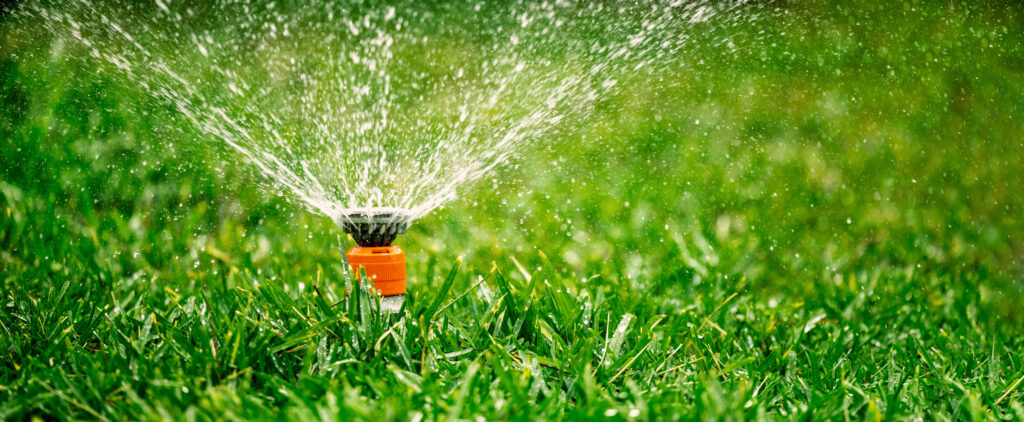
The critical variable is not the seed. It is moisture. Seedbeds need to stay consistently damp at the surface, which usually means short, light waterings once or twice a day for the first two to three weeks, then a gradual shift back toward deeper and less frequent watering as roots go down. This directly contradicts the summer watering rule, and it is the single most common reason homeowner overseeding fails.
Mowing is the other thing people get wrong during establishment. Keep mowing the existing lawn on schedule, because letting it grow tall shades out the seedlings underneath. Wait until new grass reaches roughly three inches before it gets cut, use a sharp blade, and try to mow when the surface is dry so young plants are not pulled out of soft soil. Expect a few weeks where the lawn looks uneven in texture. That is normal, and it evens out as the new plants mature.
What a Good Result Looks Like at 30 and 90 Days
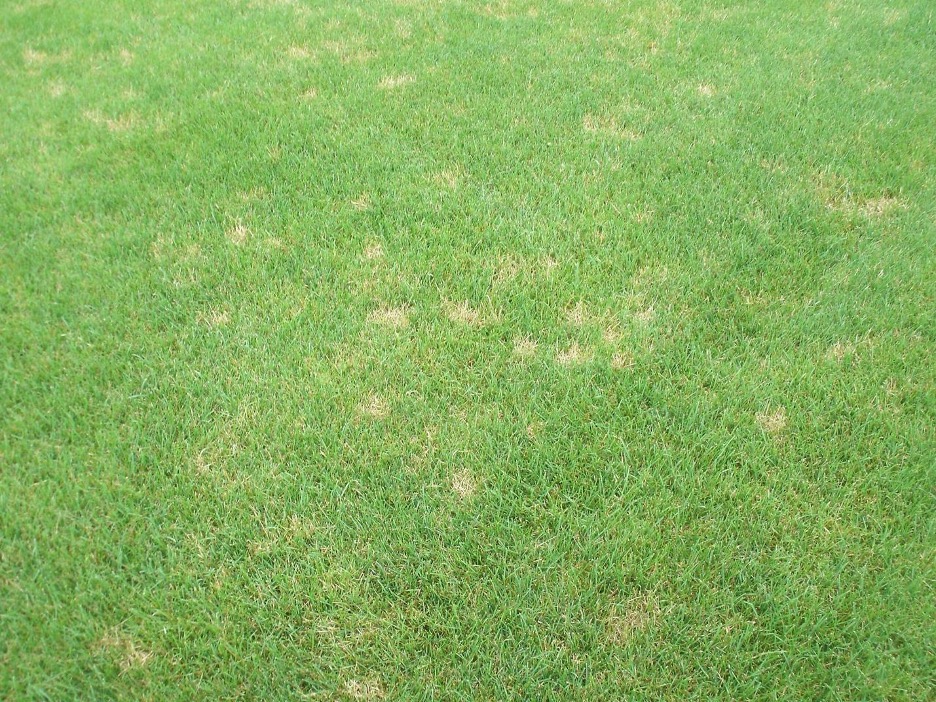
At 30 days, walk out in the morning and look down through the existing grass rather than across it. You should see fine, bright new blades standing up between the older plants, thickest where the aeration holes were, and thin areas should be visibly filling. The lawn will not look finished. New seedlings are thin, upright, and lighter in color than mature turf.
At 90 days, the difference should be obvious from the driveway. Density improves, the lawn feels springier underfoot, and weed pressure drops because there is less bare ground for weeds to claim. Underneath, the real work is happening: roots are extending while the top growth slows, which is what pays you back next summer.
Here is the honest part. A single aeration and overseeding on a badly thinned lawn typically gets you meaningful improvement, not perfection. Lawns that were 40 percent thin usually need two consecutive fall seasons to fully close. And aeration will not fix deep shade, root competition under mature trees, bad grading, a broken irrigation zone, or the wrong grass for the site. Those are separate conversations, and we would rather have them with you up front than let you spend money twice.
What to Do Next
Schedule earlier than feels necessary. Aeration calendars in most regions fill through late summer, and the window is defined by weather, not by availability. To find your local team, visit lawnsquad.com or call 833-816-7508 for a free quote. Each Lawn Squad location is independently owned and operated, and builds its VitaminLawn fertilization and weed control program around your local grass type, soil, and climate, which is exactly why the seed blend and timing recommended in Wisconsin should not match the one recommended in North Carolina.
A first visit means walking the property, checking thatch depth and compaction, identifying your grass, and talking through whether overseeding, a full renovation, or simply better cultural practices is the right spend this fall. Then plan on watering. The service creates the opportunity, and the three weeks that follow determine what you get from it.