
Why Does Tropical Sod Webworm Damage Move So Fast on South Miami Lawns in August?
Short Answer: Tropical sod webworm is the usual culprit. Small tan moths flutter up out of the turf at dusk, lay eggs, and the caterpillars feed only at night, chewing notches out of the leaf edges and skeletonizing blades until the lawn looks scalped, ragged and thin even though you just mowed. Mix a couple of ounces of dish soap into a gallon or two of water, pour it over a square foot at the edge of the damage, and irritated caterpillars will wriggle to the surface within a few minutes. Treatment works best applied late in the day, and South Miami turf usually regrows quickly.
You mowed Saturday. By Wednesday evening you are standing on the patio in Pinecrest looking at a lawn that already looks overdue again, except not in the way grass looks when it needs cutting. It looks chewed. There is a rough, ragged, uneven area near the planting beds where the color has gone dull olive and the surface sits lower than everything around it, like someone ran the mower through that one section three settings too low. And when you walked out to look, a small cloud of little tan moths lifted out of the grass and zigzagged a few feet before dropping back down.
Most people we meet in Palmetto Bay and Coral Gables assume they missed a watering, or that the lawn service scalped it. The frustration is that the yard was fine a week ago, and now it is going backward faster than it can grow, which in this climate takes some doing.
What the Damage Actually Looks Like Up Close
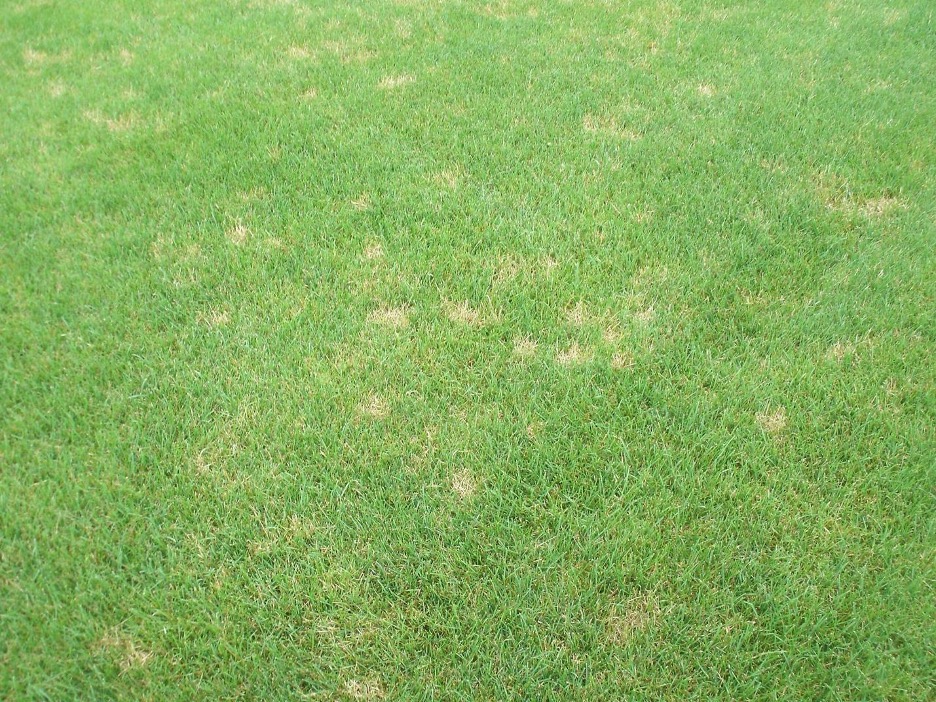
From the driveway, sod webworm damage reads as thinning. Irregular patches, no clean edges, and a stripped or scalped appearance where the leaf canopy is gone but the runners are still there. On St. Augustine the affected zone often takes on a slightly gray or straw cast against the deep green around it, and the whole area sits noticeably lower to the eye.
Pull a few blades and look at them in your hand. Young caterpillars scrape the surface tissue away and leave a thin, translucent, papery window in the leaf, which is what skeletonized means. Older ones chew straight through the edges, leaving distinct notches like tiny bites taken out of the sides of the blade. That notching is the signature. Nothing else in a Miami-Dade lawn does it quite that way.
Look down into the thatch and you may also see small green pellets of frass, which is caterpillar waste, plus loose silken webbing near the soil surface. Both are strong confirmations. What you will almost never see is the caterpillar itself in daylight, which is exactly why this pest fools people for a week or two.
The Moths at Dusk and the Caterpillars After Dark
The adult is a small, dull tan or grayish brown moth with a wingspan under an inch. It does no damage at all. It rests in shrubs, ground cover and thick turf during the day, and it becomes active around dusk, which is why you notice them when you are out watering the pots or walking the dog in the evening. They fly low, erratically, a foot or so above the grass, and settle again quickly.
Those moths lay eggs on the leaf blades. The larvae that hatch spend daylight hours curled up in a C shape down at the base of the plant, in the thatch, completely out of sight. They come up to feed at night. That single behavior explains why damage seems to appear from nowhere: by the time the thinning is obvious from the street, several nights of feeding have already happened, and the population is often into its later, hungrier stages when the caterpillars eat the most.
Why South Miami Gets Hit Harder Than Almost Anywhere
This is where our corner of Florida is genuinely different, and it is worth understanding rather than just enduring.
We have no winter. Not a mild one, none. Lawns from Coconut Grove down through Cutler Bay grow essentially twelve months a year, and there is no cold stretch that knocks an insect population back to zero and forces it to rebuild from a northern migration each spring. Tropical sod webworm overwinters here comfortably and produces overlapping generations, so instead of one clean wave you get continuous, rolling pressure once the rainy season is fully underway. Warm nights and daily storms are ideal for them.
Our soil compounds it. Most of South Miami sits on oolitic limestone with a shallow layer of soil over rock and a pH that runs very high. That chemistry ties up iron and manganese, so St. Augustine here is often working with less available micronutrition than the same grass would have elsewhere. A lawn already fighting for color has less in reserve when something starts eating it. The properties we see recover slowest are usually the ones that were mildly chlorotic before the webworms arrived.
The Soap Flush, and What It Rules Out
The soapy water flush is the standard homeowner check and it takes about five minutes. Mix roughly two ounces of lemon scented dish soap into one to two gallons of water and pour it slowly over a square foot or two of turf right at the boundary between damaged and healthy grass. That edge is where the active feeding is. Then stand there and watch. Within a few minutes the irritant drives caterpillars up out of the thatch, and you will see slim larvae with dark spots along the body wriggling on the surface. Rinse the spot afterward.
The same flush is a useful differential. Chinch bugs, which are the other major pest of St. Augustine here, will also surface, but they are tiny black and white insects rather than caterpillars, and their damage pattern is different: yellowing that turns to dead straw in the hottest, sunniest strips along driveways and sidewalks, spreading outward. Webworm damage does not favor hot spots that way and rarely kills outright. And if nothing comes up at all, you are probably looking at disease or a nutritional issue instead, which points to a completely different plan.
What Actually Stops Them
Timing matters more than product choice. Because the larvae feed after dark, an application made late in the afternoon or early evening puts the material where they will encounter it during their active window. A treatment applied at nine in the morning has already begun degrading in our sun and humidity by the time the caterpillars come up.
Watering behavior around the application matters too. Materials aimed at surface feeding caterpillars need to stay on the foliage, so an irrigation cycle right after the treatment works against you. It also helps not to bag and haul clippings for a mowing or two afterward. And resist the urge to cut low to tidy up the ragged look, because removing more leaf tissue from a plant that is already short on it slows the comeback. Keep St. Augustine tall.
We will be straight with you about limits. One application does not end the season. With overlapping generations running through the warm months, we monitor and treat as pressure returns rather than promising a single permanent fix, and we rotate modes of action so we are not leaning on the same chemistry all year.
How Fast the Lawn Comes Back
Now for the encouraging part. Tropical sod webworm eats leaf tissue. It does not attack roots, crowns or stolons the way grubs or mole crickets do. The plant is still alive under that chewed canopy, and it is growing in the best conditions it will see all year.
Once feeding stops, most South Miami lawns green back up within two to three weeks. Steady moisture, appropriate nutrition and no scalping are the whole recipe. Where recovery drags, there is almost always a second issue underneath, most often the high pH micronutrient tie up common on our limestone, sometimes compaction from equipment, sometimes shade under a big ficus or live oak. That is worth diagnosing rather than treating for insects again.
What to Do Next
Do the soap flush this evening at the edge of the worst area, before you spend money on anything. If caterpillars surface, you have your answer and you can act on it. If they do not, hold off and look harder, because treating for the wrong problem costs you two weeks you do not need to lose.
If you would rather have someone confirm it and handle it, call us at 786-310-1011 or request a free quote at lawnsquad.com. A first visit is a walk of the property, a flush test where it counts, a look at your soil and irrigation, and a plain explanation of what we found. We serve South Miami, Pinecrest, Palmetto Bay, Coral Gables, Coconut Grove and Cutler Bay.
Our VitaminLawn program pairs fertilization and weed control with surface insect monitoring built specifically for tropical St. Augustine on high pH limestone soil, which in this market means iron and manganese are part of the conversation from day one. At thirty days you should see the chewed areas filled in and the color evened out. At ninety days the goal is a lawn dense enough that pressure like this shows up as a minor blemish instead of a crisis. We are independently owned and operated, and we would rather you know how to spot this yourself next August.