Why Should I Seed My New Hampshire Lawn by Early September Instead of Waiting for Cooler Weather?
Short Answer: Get seed on the ground between the middle of August and the first week or so of September. Our growing season closes fast. Kentucky bluegrass can take two to three weeks just to sprout, and every seedling needs roughly six to eight weeks of active growing weather after that to build enough root to survive a New Hampshire winter. Seed planted in late September may germinate and still winterkill, because the plant never got the growth time it needed. Warm soil in August is the advantage, not the obstacle.
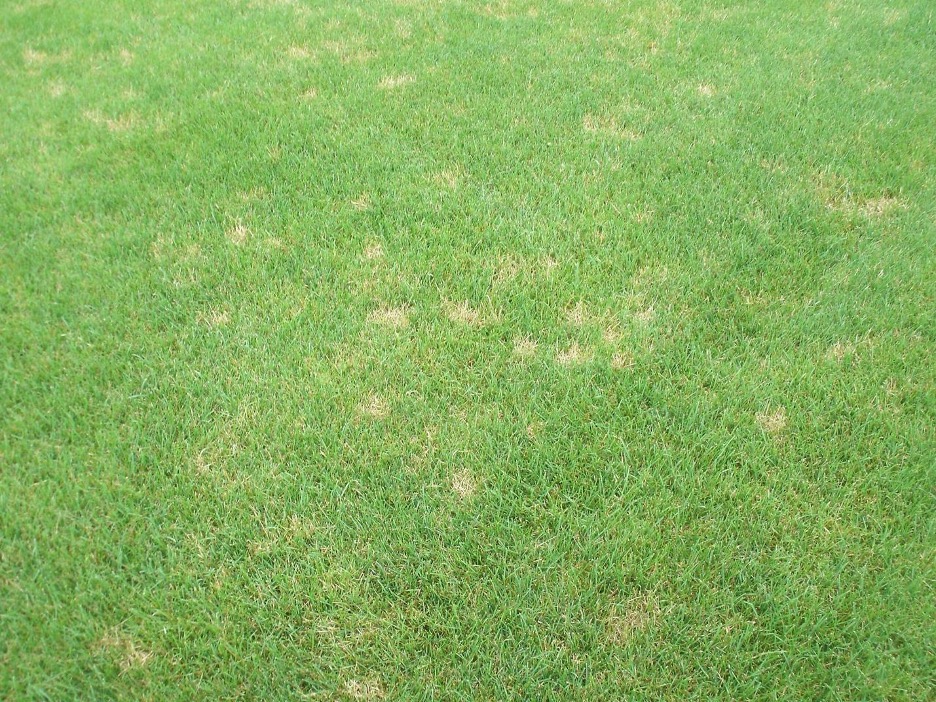
Walk out the back door on an August evening in Bedford or Londonderry and the lawn tells you exactly what kind of summer it had. The shaded strip along the tree line still looks decent. The open middle, the part that bakes from ten in the morning until six at night, has gone the color of a paper bag with thin green threads running through it. Push your fingers into it and you feel sand and small stones, not soil. The mower has not needed a bag in three weeks. And somewhere in the back of your mind is the thought that you will deal with it once the weather breaks.
That instinct is completely reasonable and it is also the single most expensive mistake we see across our service area. Nobody wants to work on a lawn in ninety degree heat. The problem is that the calendar up here does not wait for anyone to feel like it.
What the Seeding Window Actually Means on a New Hampshire Calendar
Most homeowners we talk to think of the fall seeding window as a weather condition. Cooler air, less stress on the plant, better time to work outside. Grass does not experience it that way. A seedling reads soil temperature and day length, and it needs a stretch of both that are still generous enough to support growth.
In southern New Hampshire that stretch is genuinely short. Freezing temperatures typically arrive somewhere from late September into the middle of October depending on where you sit, and the variation inside our service area is bigger than people expect. Low ground along the Souhegan in Milford will frost before an open hilltop lot in Windham. Properties out toward Goffstown and the more rural western edge routinely see it before Nashua does. Heat holds longer in the built up parts of Manchester than in the fields two towns over.
So there is no single date. What there is, reliably, is a closing door that starts closing in the second half of September no matter which town you are in.
The Germination Math Almost Nobody Does Before Buying Seed
Here is the arithmetic that changes how people think about this. Perennial ryegrass is the sprinter in our seed blends and shows green in roughly five to seven days under good conditions. Fine fescue takes a little longer. Kentucky bluegrass, the grass most responsible for the deep color people want in a New England lawn, commonly needs fourteen to twenty one days and sometimes closer to a month if soil is cool or moisture is uneven.
Germination is only the starting line. A grass plant that has just emerged is a thread with almost no root system. It needs something on the order of six to eight weeks of real growing weather to develop a crown and a root mass thick enough to hold through frost heaving, snow load, and the freeze and thaw cycles of a New Hampshire March.
Do that math backward from the first hard freeze and the answer lands in the second half of August. Seed down on Labor Day weekend is workable. Seed down on the first of October is a lottery ticket.
Why Our Sandy Glacial Soil Raises the Stakes
The ground we work in across Salem, Hudson, Derry and the Merrimack corridor is glacial in origin, which is a polite way of saying sand, gravel, and rocks that the ice left behind. Some of the outwash areas near the river are close to pure sand under two or three inches of topsoil. It drains beautifully in April and it abandons you in July.
For seeding, that soil cuts two ways. The good news is that sandy ground warms early and stays workable, and seed slips into contact with mineral soil more readily than it does in heavy clay. The hard news is water. Sand holds very little of it, so a seedbed that was perfect at eight in the morning can be bone dry by two in the afternoon. Add our typically acidic New England soil chemistry, often well below the range grass prefers, and a young plant is asking for nutrients that are chemically locked away from it.
That is why a soil test before renovation is worth far more here than most people assume. Lime corrects slowly, over a season or more, so getting it started in the same fall as your seeding sets up the following spring rather than the current one.
What Actually Happens When You Wait for Cooler Weather
Late seeding fails in a quiet way, which is part of why the lesson does not stick. You seed the last week of September. It rains. In twelve days you see a green haze and you feel good about it. The lawn goes under snow looking passable.
Then April arrives and the areas you seeded are thinner than the areas you did not. What happened is that the seedlings never built the root and crown reserves to handle winter, and frost heaving lifted a percentage of them clean out of that loose sandy soil. You paid for seed, you paid for labor, and you bought yourself a bare patch and a second renovation.
We would rather tell you honestly in August that the window is closing than sell you a September seeding that we know is a coin flip.
Watering Seed Without an Irrigation System
A lot of properties in our area have no in ground irrigation and run on a private well, which makes the watering conversation different here than it is in a suburb full of sprinkler systems. New seed needs the top half inch of soil kept consistently damp, which means light and frequent rather than long and deep. Two or three short cycles a day for the first two weeks, tapering as the seedlings come up, is the pattern that works.
On a well, that is a real commitment, and it is another argument for seeding in August rather than October. In late August you are usually managing moisture against warm days. In October you are managing it against cold nights, heavy dew, and a plant that has already slowed down.
If watering is genuinely not possible on your property, tell us. There are honest ways to plan around it, including waiting for next year and spending this fall on soil correction instead. Seed with no water is money poured on the ground.
The Prep Work That Has to Happen First
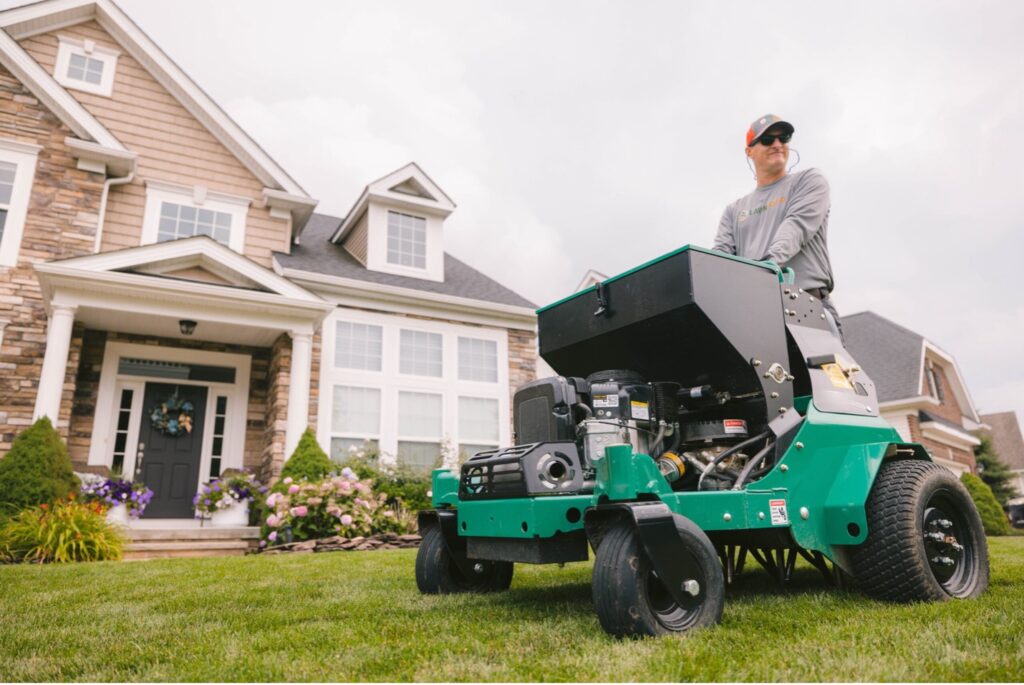
Seed broadcast over a thatchy, compacted lawn mostly feeds birds. Core aeration is what makes the difference, because those cores open the surface and give seed a protected pocket of real soil contact rather than a resting spot on top of dead material. On our compacted lots, particularly newer construction where the topsoil layer is thin over disturbed subsoil, aeration is doing double duty by relieving compaction at the same time.
Mowing height matters in the two weeks before as well. Dropping the deck a notch for the seeding cut lets more light reach the soil surface without scalping the existing turf. Skip that step and your new seedlings are competing for light against grass that is already established.
What to Do Next
If your lawn thinned out this summer, the useful move right now is a walk of the property to figure out how much of it needs seed and whether anything else, grubs or disease or a pH problem, is going to undo the work. Call us at 603-716-9498 or start at lawnsquad.com and we will come out for a free quote. We serve Manchester, Nashua, Bedford, Salem, Derry, Hudson, Londonderry, Hampton, Exeter, Merrimack, Milford, Windham and Goffstown.
A first visit is a walkthrough, not a sales pitch. We look at soil, thatch depth, weed pressure, and the pattern of the damage, and you get a plan with a date on it. Aeration and overseeding itself is usually a single visit measured in hours. At thirty days you should be looking at a visible fill of fine new blades, thinner and lighter green than the mature turf around them, and it will look uneven because it is supposed to. By the following spring, that same seeding reads as one lawn rather than patches.
Ongoing feeding is what keeps it. Our VitaminLawn program builds fertilization and weed control around the bluegrass, fine fescue and ryegrass mix that performs here and around the sandy, acidic soil those grasses have to live in, which is a different recipe than the one that works two states south. Every Lawn Squad location is independently owned and operated, and free quotes and our satisfaction guarantee are standard. The one thing we cannot do is add weeks to a New Hampshire autumn, so the earlier in August we hear from you, the better the date we can give you.