Why Does Aurora’s Fall Aeration and Overseeding Calendar Fill Up in August?
Short Answer: Book in August. The productive aeration and seeding window across the Fox Valley runs from roughly the third week of August through the third week of September, which is about five workable weeks for an entire service area. Soil is warm enough for fast germination and nights have cooled enough that new seedlings are not cooking. Calls that come in during early October usually get aeration alone, because seed dropped that late rarely roots deep enough to survive a northern Illinois winter. Reserving your date early is the single cheapest thing you can do for next year’s lawn.
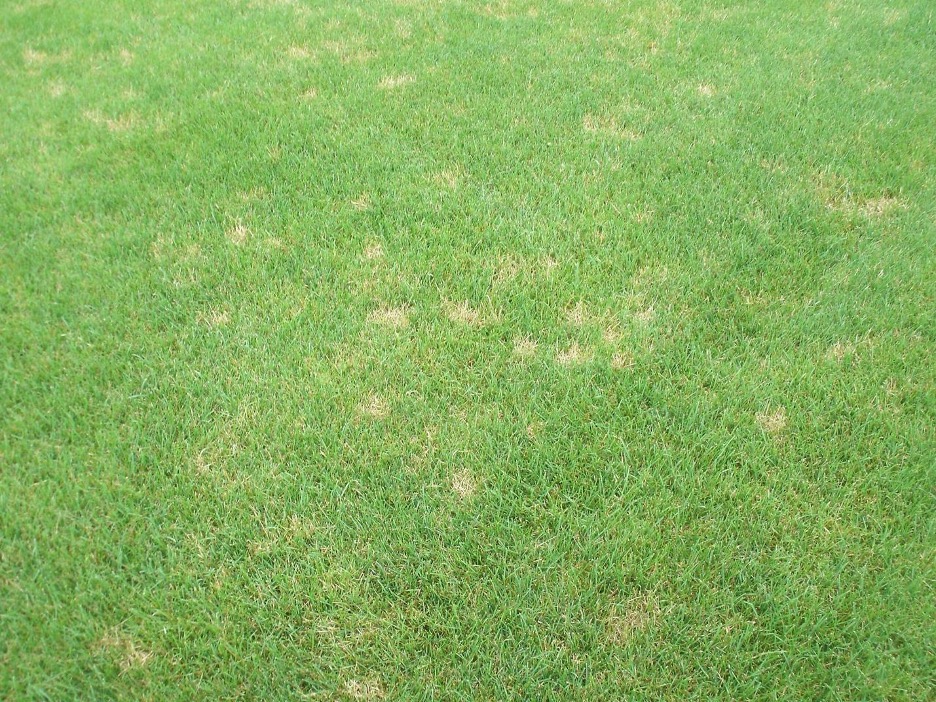
Walk out your back door on an August evening in a Fox Valley subdivision and the story is written in the turf. The strip along the driveway has gone the color of straw. The bluegrass in the middle of the yard is still green but flattened, and where the kids have cut the same corner all summer between the patio and the gate, there is a compacted path you can feel through your shoes. Push a screwdriver into that path and it stops after an inch. Push it into the shaded bed edge and it slides in easily. Same lawn, same day, completely different soil.
Most homeowners we talk to in Aurora, Oswego, and Montgomery are not worried the lawn is dead. They are worried they are about to miss something, and that the window they keep hearing about will close while they are still deciding. That instinct is correct, and it is worth understanding exactly why.
The Fox Valley Window Is Genuinely Narrow
Cool season grasses, meaning the Kentucky bluegrass, turf-type tall fescue, and perennial ryegrass that make up nearly every lawn from Batavia down to Plano, want two things at once in order to establish from seed. They want soil that is still holding summer warmth, because that is what drives germination, and they want air that has stopped punishing a seedling with ninety degree afternoons. In northern Illinois those two conditions overlap for a surprisingly short stretch.
Late August is when it opens. Soil under an established lawn here is still carrying a lot of stored heat, so perennial rye can be up in five to seven days and bluegrass in two to three weeks. By late September the soil has cooled to the point where germination slows noticeably, and anything that sprouts after the first week of October is racing a hard freeze it will probably lose. That leaves roughly five workable weeks. Subtract the days it rains too hard to run equipment and the days the ground is too dry to pull a decent core, and the real number is smaller still.
What Core Aeration Actually Does to Our Clay
The soil under most Fox Valley neighborhoods is heavy silty clay over glacial till, and in the newer subdivisions out toward Oswego and Yorkville, the topsoil layer sitting on top of that is often thin and was spread over ground that a fully loaded truck drove across for months. Clay particles are microscopically flat. Press them together and they stack like a deck of cards, and water and oxygen stop moving through.
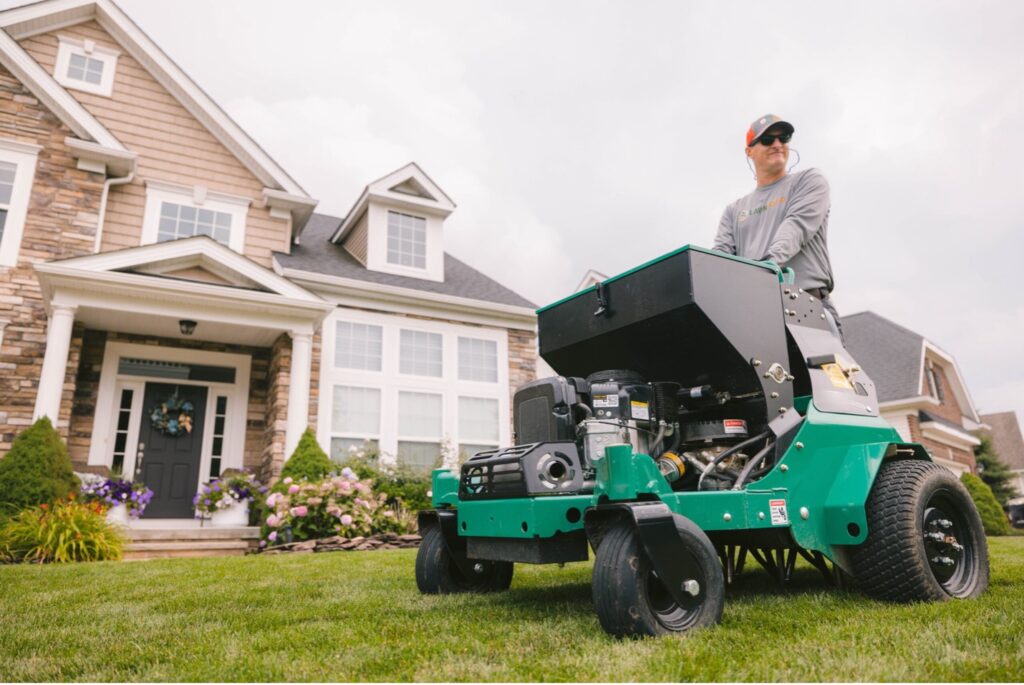
Core aeration pulls thousands of plugs of soil out of that deck and drops them on the surface. It is not the holes themselves that matter most, though they help water and fertilizer reach the root zone instead of running off toward the storm drain. It is that the surrounding soil now has somewhere to expand into. Roots follow the loosened channels down. Over several seasons of consistent aeration on the same lawn, we watch that screwdriver go in deeper every year.
This is also why we are honest that a spike aerator, the kind you strap to your shoes or tow behind a mower, does not accomplish the same thing on clay. Pushing a spike into clay compresses the walls of the hole. You get a hole and a denser ring around it. On sand it is harmless. On the ground under North Aurora it works against you.
Why Seed and Aeration Belong on the Same Visit
Seed does not germinate lying on top of thatch. It germinates when it makes firm contact with soil that stays damp. An open core hole is a small, shaded, moisture-holding pocket, and seed that falls into one has dramatically better odds than seed broadcast over an untouched lawn. That is the whole mechanism, and it is the reason we do the two operations together rather than a week apart.
It is also why we double back over thin areas rather than making one uniform pass. On a typical Naperville lot the south-facing front slope and the parkway strip along the street are the areas that lost the most cover this summer, while the back yard under the maple never thinned at all. Spreading seed evenly across both wastes half of it. We put the seed where the bare soil is.
How the Schedule Actually Works
Here is the part we would rather explain than have you guess at. Aeration is equipment work and it happens on routes. A crew works a neighborhood cluster in a day, because moving a machine between Plainfield and Plano twice in an afternoon costs hours nobody gets back. So when we build the fall calendar we are filling geographic blocks, and once a given week is committed for a given area, adding one more property to it usually means pushing someone else.
What that means for you is simple. A call in early August gets you close to the date you want. A call in mid September gets you whatever is left, which may be the last usable week. A call in October gets you aeration, which still helps compaction going into winter, but we will tell you plainly that seed at that point is a coin flip and we would rather put it down for you in the spring or wait for next fall than take your money for a low-odds application.
What to Do in the Weeks Before the Crew Arrives
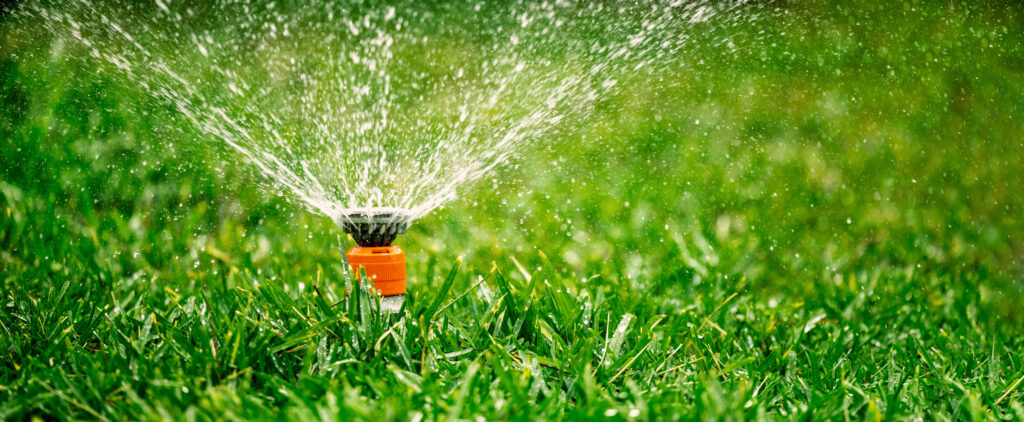
Two things help more than anything else. First, water. If we have been in one of those late summer dry stretches where the ground goes hard, run your irrigation deeply for a couple of days before your appointment. Aerator tines pull long, intact cores out of moist soil and skip across baked clay like a stone on a pond. Second, mark your irrigation heads, invisible fence line, and any shallow low-voltage lighting wire. Flags are cheap and a repair is not.
Beyond that, keep mowing. Dropping the height slightly for the last cut before aeration, down toward two and a half inches rather than three and a half, gets more seed to the ground. Skip the crabgrass preventer entirely this month if you plan to seed, because the same barrier that stops crabgrass stops the bluegrass you are paying for. And leave the cores on the lawn. They look like a goose problem for about ten days, then a rain and a mowing break them down and that soil goes right back where it came from carrying microbial life with it.
What Results Actually Look Like
Set your expectations on a real timeline. At seven to ten days you will see a green haze in the core holes, mostly the ryegrass in the blend. At three weeks the bluegrass shows up and the haze thickens into something you can mow. At thirty days it looks patchy and uneven, and that is normal, not a failure. The first winter is spent building root mass you cannot see. The payoff arrives in April, when the seeded areas green up thick and early, and again the following July, when the lawn that got aerated and seeded holds its color noticeably longer into a dry spell than the one that did not.
Watering during those first three weeks is what separates a good result from a disappointing one. Light and frequent is right for this narrow period, roughly ten minutes in the morning and again in the early afternoon, keeping the top half inch damp. That directly contradicts the deep and infrequent advice that governs the rest of the year, and it is the single instruction homeowners most often reverse.
What to Do Next
Call us at 630-389-4996 or request a free quote at lawnsquad.com, and ask specifically about the fall aeration and overseeding calendar for your neighborhood. We serve Aurora, North Aurora, Batavia, Montgomery, Naperville, Oswego, Plainfield, Yorkville, Plano, Bristol, Mooseheart, and the surrounding Fox Valley.
A first visit is straightforward. We walk the property with you, check compaction and thatch depth, look at how much living turf is actually left in the thin areas, and tell you whether you need overseeding, a full renovation, or honestly neither. If your lawn is thin because of shade or grub feeding rather than compaction, seed alone will not hold, and we will say so before you spend anything.
Most Fox Valley properties do best when aeration and seed sit inside a season-long plan rather than standing alone. Our VitaminLawn program builds fertilization and weed control around the grass types, the clay, and the weather pattern we actually have here, so the fall feeding that follows seeding is timed to push roots rather than top growth. Free quotes and our satisfaction guarantee come standard. Get the date on the calendar now, and spend the rest of August simply watering.