Short Answer: The fescue lawns that look best in November across North Raleigh, Wake Forest, and the Greenville market are the ones that locked in their aeration and overseeding plan in July. The reason is timing and capacity. The ideal aeration window for cool-season grasses in our region is the first three weeks of September, and that window has roughly twelve to fifteen good service days for an entire metro. Customers who wait until late August to schedule end up booked into October when soil temperatures have already dropped below the fescue germination range. The July decisions that matter are: pick your service date, order your seed, plan irrigation for the establishment window, scout the lawn for the worst thin areas, and decide whether warm-season grasses (Bermuda or Zoysia) on your property get a different treatment plan. Skip the July planning and you will pay for it in November with a thinner stand of grass than you should have.
Most homeowners think of aeration as a fall job that gets scheduled in fall. We understand the intuition. The work happens in September, so September is when you call. The problem is that everyone else in your neighborhood has the same intuition, and the calendar window for doing this work right is narrower than people realize. By the time the first cool morning arrives in early September and the phone starts ringing, the best two weekends of the season are already booked.
We talk about July aeration planning every year with our customers in Wakefield, Brier Creek, Falls of Neuse, Wake Forest, Rolesville, Youngsville, Knightdale, and Wendell, then again across the Greenville market in Winterville, Farmville, and Ayden. The pattern is consistent. The customers who get the November lawn they want are the ones who made five specific decisions in July. Here is the full planning framework.
Why September Is the Right Aeration Window in Our Region
Tall fescue and other cool-season grasses germinate when soil temperatures sit between 55 and 75 degrees. In our service area the September three-week window from roughly September 5 to September 25 is when soil temperatures drop into that ideal range while there is still enough warmth in the day for fast emergence and enough remaining season for the new seedlings to develop a real root system before frost.
Aerate in late August and you are seeding into soil that may still be above 80 degrees, which delays germination and invites disease pressure on the freshly opened lawn. Aerate in mid-October and soil temperatures are dropping below the optimum, which slows germination and leaves the new fescue under-rooted heading into winter. The middle of September is the meaningful sweet spot.
For warm-season grasses (Bermuda and Zoysia, common across our service area on full-sun properties and premium installations), aeration timing is different. The correct window for warm-season aeration is late spring through early summer when those grasses are in active growth. By July most of that window has already closed for the year. Bermuda and Zoysia lawns generally do not need a fall aeration in our climate.
The grass-type planning matters more in our service area than people sometimes assume. Across the properties we maintain, the same homeowner often has a fescue front yard and a Bermuda back yard, or a Zoysia front with mixed lawn elsewhere. The aeration plan adapts to each section, not to the property as a whole.
July Decision One: Pick Your Service Date
If your property has fescue and the fescue is showing any thinning from summer stress, get on the September calendar now. Our preferred booking pattern is to confirm dates by July 25. We can usually still accommodate August requests but the best September weekends fill in late July across the Raleigh and Greenville markets.
The mid-September weekends (around the 12th and the 19th) are the gold standard dates in most years. Soil moisture is usually returning by then thanks to early fall rain patterns, soil temperatures are in the right zone, and there is enough remaining warm weather to establish seedlings. A booking in those windows gives you the best chance of strong germination and recovery.
July Decision Two: Order Your Seed
Seed quality matters more than most homeowners realize, and the supply of good seed gets tight in late August. The seed you put down in September is the lawn you will have for the next several years. Cheap seed produces a cheap lawn.
For Raleigh and Greenville fescue lawns, the ideal choice is a turf-type tall fescue blend with at least three named varieties for genetic diversity. Look for blends labeled for the Southeast transition zone with proven brown patch tolerance. Avoid pure Kentucky 31, which is a forage-type tall fescue not well suited to home lawns and contributes to disease pressure rather than reducing it.
Plan on five to seven pounds of seed per thousand square feet for overseeding an existing fescue lawn. For a complete renovation of a thin area, plan on eight to ten pounds per thousand square feet. The lawn-by-lawn details vary, and a quick walk-through during the planning phase nails the right number for your specific property.
July Decision Three: Plan Irrigation for Establishment
The single biggest reason September overseedings fail in our region is not bad seed or bad timing. It is irrigation. Newly germinated fescue needs the top half inch of soil to stay moist for fourteen to twenty-one days after seeding. On the red clay across North Raleigh and Wake Forest, a poorly designed irrigation system or a homeowner who can only water in the evening will struggle to hold that moisture window. On the sandier loam toward Greenville and Pitt County, the soil dries even faster and the watering frequency has to be higher to compensate.
The establishment irrigation pattern is the opposite of normal lawn watering. Instead of deep and infrequent, the new seed needs short and frequent. Three to five light cycles per day in the first two weeks to keep the seed bed damp without saturating it. Once the new grass is at mowing height, you transition back to deep and infrequent.
July is the right month to inspect your irrigation system. Check every head, replace any damaged sprays, adjust patterns to cover thin spots, and verify the controller can run the short-cycle establishment schedule. We see expensive overseeding work undone by an irrigation system that had one broken head in a critical zone.
July Decision Four: Scout the Lawn
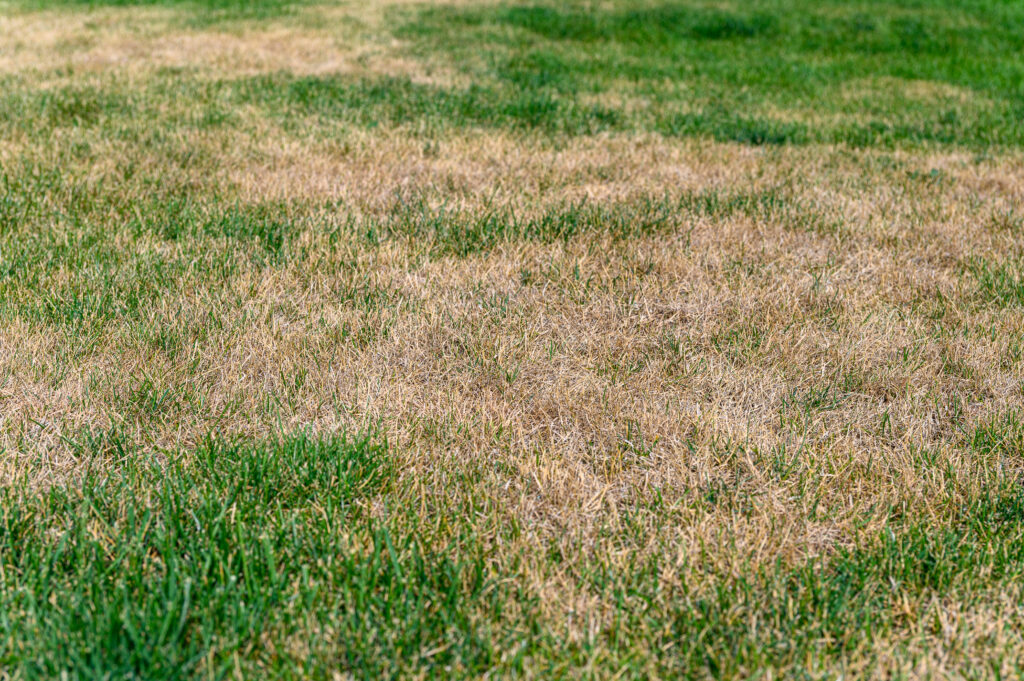
Walk the lawn now and identify the thin areas while you can still see what is grass and what is bare. By September the cool weather and any late summer rain will make the lawn look better than it actually is. The marginal thin spots that are obvious in July hide themselves in early September, and you end up seeding too lightly in the areas that needed the most help.
Mark the worst sections with flags or take a phone photo with notes from each side of the property. Categorize each thin area: is it shade thinning under a maple, is it compaction from foot traffic, is it pet damage along a fence line, is it disease damage from brown patch in June, is it drought thinning along a driveway. The cause of the thinning shapes what we do to fix it.
For shade thinning under mature oaks and pines (common across our service area), the answer may be more than seed. Limbing up the tree canopy, adjusting tree watering, or switching to a more shade-tolerant fescue blend in those sections will all do more than seed alone. For compaction, the aeration itself does most of the work. For pet damage, you also need a behavior plan or the new seed will end up the same as the old grass.
July Decision Five: Decide on Warm-Season Sections
If your property has Bermuda or Zoysia sections, those areas need a different July decision. Warm-season grasses in our region typically do not receive fall aeration, since they are heading into dormancy. What they do need is a planning conversation about scalping next spring, dethatching if thatch layers are building, and weed control to clean up Poa annua and other cool-season invaders that will try to establish in the dormant turf this winter.
Centipede on older Greenville properties is a special case. Centipede is slower growing, lower maintenance, and does not respond well to high nitrogen or aggressive aeration. If you have a centipede lawn, the July planning conversation is usually about iron applications for color, light topdressing to fill small thin areas, and protecting the lawn from over-fertilization which is the single biggest threat to centipede in our region.
The Calendar Reality
Here is what the calendar actually looks like for September aeration capacity in the Raleigh and Greenville markets:
- September 5 to 12: prime window, books out earliest, often full by mid-August.
- September 12 to 19: prime window, generally the best soil conditions of the season.
- September 19 to 26: still prime, sometimes the best week if late summer was dry.
- September 26 to October 3: acceptable but soil temperatures are starting to drop.
- After October 3: increasingly marginal, germination slows, results suffer.
Total prime capacity is roughly three weeks. Across an entire metro that is not a lot of service days, and weather can pull half of those days out (heavy rain, soil too wet to core). The math forces a planning conversation in July.
What to Do Next
If you have not put your September aeration on the calendar yet, this is the month. Book your date, order your seed, inspect your irrigation, walk the property, and identify the thin spots. The thirty minutes you spend on this in July is the difference between a strong November lawn and a thin November lawn.
Lawn Squad of North Raleigh and Greenville serves homeowners across the North Raleigh and Greenville Area.
Call us at 984-243-2925 or request a free quote at lawnsquad.com. Our VitaminLawn program is built around the September aeration and overseeding window for fescue lawns across Wake and Pitt Counties, with warm-season planning for Bermuda, Zoysia, and centipede sections, calibrated to the red clay Piedmont and sandy loam Coastal Plain soils that define our service area.