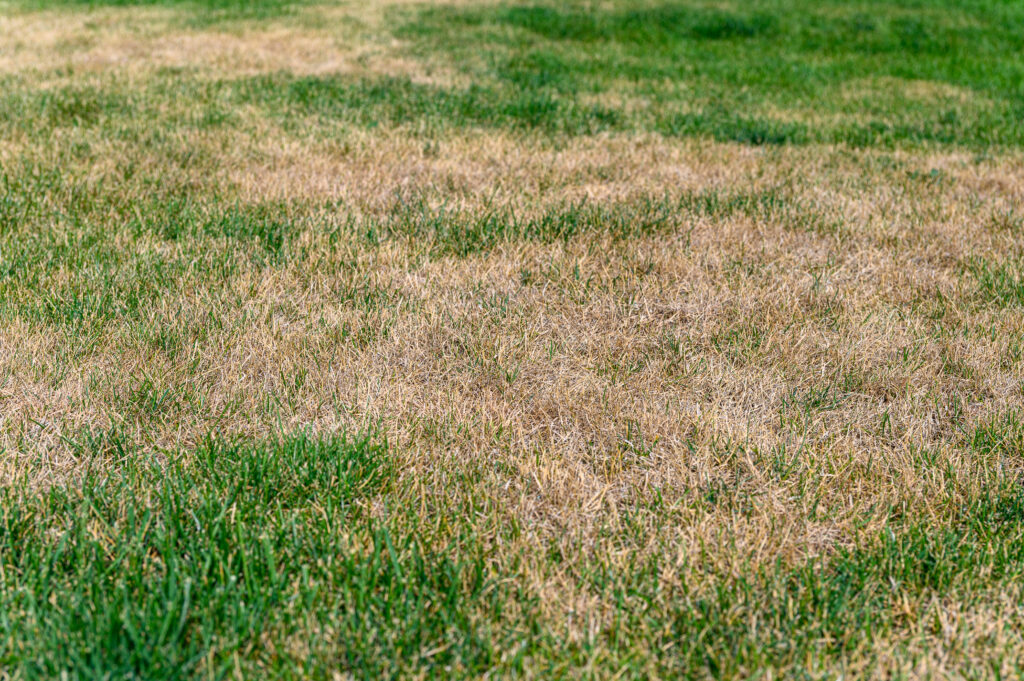
Short Answer: Fall armyworm pressure in Collin and Denton Counties usually arrives in mid-July, peaks from the second week of August through September, and can destroy a Prosper or Frisco Bermuda lawn in 48 to 72 hours once larvae reach late instars. New construction yards across the 380 corridor get hit first and hardest because thin canopy over alkaline builder clay sits next to fresh siding, gutters, and fence tops that moths prefer for egg laying. Scout twice a week, confirm with a soap flush, treat within 24 hours, and document everything for your HOA. Stage 2 water restrictions are not a reason to wait. The product is what stops the caterpillars.
A homeowner off Coit north of 380 called us last September on a Sunday afternoon. Friday his Bermuda was uniform. By Sunday a wedge starting at the south fence had advanced ten feet toward the patio while he watched. He had assumed heat stress and run the irrigation, and lost another four feet by sundown. We pulled into the driveway with bifenthrin and a soap bucket. The Y on the caterpillar heads was on the third one we flushed. He kept the front half. The back third went to re-sod that October.
That call is not unusual in the Prosper, Celina, and north Frisco buildouts. Neighborhoods that doubled in population between 2010 and 2020 are now full of three to five year old builder Bermuda on compacted clay, and that is what fall armyworm moths look for when they ride south winds into Collin County every summer.
Why North Dallas Gets Hit Earlier Than the Rest of Texas
Fall armyworm moths migrate from the Gulf Coast every summer on prevailing south wind. The DFW Airport corridor and the open prairie edges along the Dallas North Tollway extension and Highway 380 act as a kind of funnel. Disturbed soil from ribbon development, greenway easements running between subdivisions, and grass medians on the toll road give the moths exactly the kind of edge habitat they prefer for staging. North Dallas typically sees first flights a week earlier than San Antonio and a week later than the Oklahoma panhandle.
Within the metro, north of LBJ Freeway tends to get hit before south Dallas. That pattern shows up year after year in the call volume. Prosper, Celina, McKinney, and the north side of Frisco usually log the first confirmed infestations between July 10 and July 25. By the second week of August the wave reaches Plano, Allen, and Carrollton in force. South Denton County and the corridor near the Cowboys practice facility at The Star in Frisco often see early pressure as well, likely because of the open practice fields and irrigated commercial turf nearby.
New Construction Bermuda Is the Worst Case Scenario
If your house in Light Farms, Windsong Ranch, Star Trail, Trinity Falls, or another Prosper or McKinney master planned community is under five years old, your lawn is in the highest risk category in North Texas. Four reasons drive it.
The sod is thin. Builder grade Bermuda is laid for closing day, and three growing seasons on alkaline clay is not enough to build the canopy density that masks early larval feeding. The soil under it is compacted from construction equipment and rooting depth is shallow. Irrigated landscape borders create the moisture corridor moths prefer. And you are surrounded by light colored siding, fresh fence tops, new gutters, and clean mailbox posts, exactly the surfaces female moths choose for egg masses. An older Plano street with weathered fences and mature canopy is a less attractive nursery.
Two acres on a Prosper estate lot near the Cowboys practice facility and a Plano townhouse lawn are not the same outbreak. The estate has more linear feet of fence for egg laying but more recovery margin. The townhouse has less attractive oviposition surface but less margin if anything goes wrong. Both need scouting.
The Pest Mix Has Changed in North Texas
Fall armyworm (Spodoptera frugiperda) is still the primary pest behind the late summer outbreaks. The Texas A&M AgriLife Extension office in Collin County offers free pest identification and confirms it on most samples. A second species has appeared on Bermuda lawns in recent seasons. Denton and Collin County extension reports have flagged Cucullia armyworm activity on residential turf, uncommon a decade ago. Damage pattern and treatment are the same. If a county sample ID comes back as something other than fall armyworm, that is not a mistake.
The Scout: Five Minutes Twice a Week
The customers in Prosper and McKinney who never lose a lawn are not the ones with the heaviest spray schedule. They are the ones who walk the yard for five minutes on Wednesday and Saturday from July 15 through October. The cues that matter in North Dallas are specific.
- Tan or gray moths flushing out of the canopy a few feet ahead of your steps at dawn or dusk. Three days from first sighting to first feeding larvae is the typical window.
- Heavy moth clusters at porch lights, security floodlights, or the soffit lights builders run across the back of houses in Light Farms and similar developments.
- Blade tips that look chewed rather than mower cut. This is most visible on Bermuda in late afternoon light when shadows show texture.
- Grackles working a single patch for two or three mornings running. They are eating caterpillars. Trust the birds.
- Any thinning patch on a property that was uniformly green seven days ago. New construction yards show thinning faster because the canopy is already light.
Confirming the Pest Without Guessing
The field test that works in any North Dallas yard takes a kitchen and five minutes. Mix two tablespoons of dish soap into two gallons of tap water. Take it to the active edge of any thin area or any spot where you saw moths. Pour it slowly across about a square yard. Watch the surface for three to five minutes.
Caterpillars surface fast. Fall armyworm larvae range from a quarter inch in early instars to about an inch and a half when mature. Look at the head capsule. A clean inverted Y mark is the species ID. Three thin yellow lines run down the back. Color varies from light green to dark brown depending on age and feeding. More than five caterpillars in a square yard, or any late instar visible, is your trigger to treat that day. Do not wait until evening to decide. The Frisco HOA timeline is unforgiving.
The HOA Timeline and Why 48 Hours Matters
In most Frisco, Prosper, McKinney, and Celina HOAs the sequence is predictable. Day one: late instar feeding begins. Day two or three: visible damage from the street. Day four or five: a neighbor posts to the portal. Week two: the courtesy letter lands. Scout twice a week and treat inside 24 hours of confirmation and the lawn is recovering before anyone files. Wait a week and the lawn is at re-sod stage while the HOA timeline catches you mid-recovery.
Document the event. Photograph the soap flush. Save the product receipt and application date. Most Collin County HOA managers will close a complaint file on a confirmed pest event under active treatment.
Water Restrictions and What to Actually Do
Parts of Collin County moved to Stage 2 water restrictions in 2025. Frisco, Prosper, and McKinney ran on twice a month or once a week schedules through stretches of summer. That does not change armyworm management. Watering harder will not stop caterpillars and can mask the early damage signs scouting is designed to catch. Time treatment for the evening before your scheduled watering day, use a light water in on the permitted day to move granular product into the thatch, and do not run the system off schedule trying to outrun the damage.
Treatment That Works on North Texas Bermuda
Three active ingredients reliably knock down armyworms on the lawns we treat. Bifenthrin gives fast contact knockdown with about three weeks of residual. Spinosad is softer on pollinators, useful near landscape beds with bee activity. Chlorantraniliprole is a longer residual systemic strong on caterpillars and the right choice for a preventive application on a yard with prior damage.
Apply in late afternoon or evening. Caterpillars come out of the thatch to feed at dusk and are exposed. Midday applications miss most of the population. After a granular product, a light water in moves active ingredient into the thatch. Liquid can sit through a dry overnight. Scout again at three weeks. Moths keep arriving on south winds through September and a second wave on the same lawn is common.
What to Do Next
If you have seen moths flushing out of your Bermuda at dusk, a grackle flock working a single patch, or any new thinning between Coit and the Tollway between now and October, run a soap flush before you touch the irrigation controller. If you find caterpillars, treat that day. If you would rather have a team scouting your lawn twice a week from mid-July through first frost, that is what we are built for.
Lawn Squad of North Dallas and Prosper serves Prosper, Frisco, McKinney, Celina, Plano, Allen, Little Elm, and surrounding Collin and Denton County communities.
Call us at 469-629-1599 or request a free quote at lawnsquad.com. Our VitaminLawn program is built around proactive pest monitoring through armyworm season on the builder Bermuda common across the 380 corridor and the Tollway extension. The yards that come through August and September intact are the ones where someone was walking the lawn twice a week.