Short Answer: September is the prime aeration and overseeding window for Connecticut cool-season lawns, but the September outcome is locked in by July. On a Greenwich back-country estate, a Westport beach block, a Madison shoreline property, or a New Haven city yard, the July to-do list looks different. Keep the existing stand alive through coastal humidity, hold off on residual broadleaf herbicides, finish grub prevention before mid-July, get a soil test to UConn, choose UConn-vetted cultivars matched to your microclimate, plan deer protection if you are inland of the Merritt, and book the September date before the estate-property bookings fill the calendar. Below is the playbook we walk our Fairfield and New Haven customers through every summer.
If you live on a back-country road in Greenwich or New Canaan, on a tree-shaded street in Westport, on a Madison or Old Saybrook shoreline block, or in a North Haven cul-de-sac, the lawn in front of your house is a cool-season stand. Kentucky bluegrass, perennial ryegrass, turf-type tall fescue, and fine fescues in the shade. These grasses peak in spring and fall and struggle through the heat and humidity that roll in off Long Island Sound from late June through August. September is when they recover, and it is the one window each year when aeration and overseeding actually produce a denser, healthier lawn for the year ahead.
What most homeowners miss is that the September outcome is decided in July. The phone calls we take from Riverside, Cos Cob, Rowayton, Westport, Southport, Branford, and Guilford in mid-October about a September overseed that failed to germinate almost always trace back to a July decision. A blanket weed treatment in the third week of July. A grub problem nobody caught until the skunks tore up the front yard in late August. A homeowner who tried to order a Bewitched bluegrass and a Rebel IV fescue blend in the first week of September and got whatever was left at the box store instead. Here is the planning checklist that prevents those outcomes on a Connecticut property.
The Coastal Connecticut Seeding Window Is Not the Generic Northeast Window
UConn turfgrass research and the NTEP cultivar trial plots at Storrs document what local experience confirms: the optimal cool-season germination window in our service area opens when soil temperatures at four inches drop into the upper 60s. In Stamford, Norwalk, and Fairfield along the coast, that typically happens in the last week of August. In Ridgefield, Newtown, and the higher elevations of New Haven County, soil temperature drops a week earlier. Long Island Sound buffers the coastal towns with warmer overnight lows well into October, which extends the back end of the window by seven to ten days versus inland Fairfield.
The practical consequence: a Stamford coastal property and a Ridgefield property only six road-miles apart can have night-temperature differences of five to seven degrees in late September and early October. A late-September overseed in Greenwich shoreline is still a viable project. The same calendar date in Redding is pushing the edge of usable germination time. Knowing which microclimate your property sits in changes the renovation calendar, not by much, but by enough to matter.
Decision One: Are You Keeping the Stand Alive Through Coastal Humidity
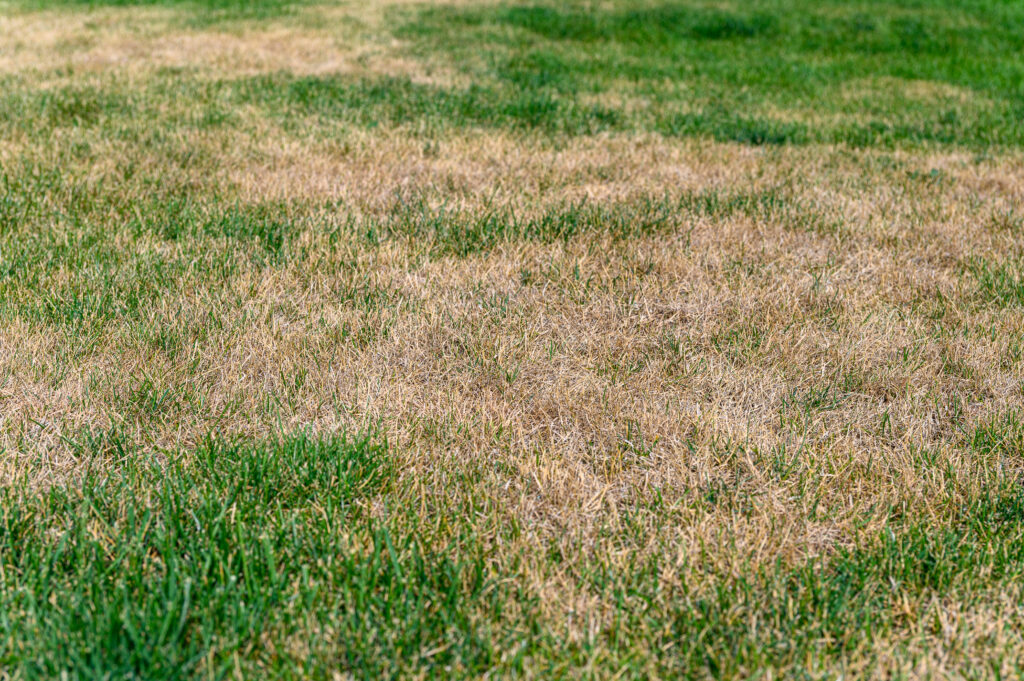
Connecticut summers along the Sound are humid in a way that drives brown patch and dollar spot pressure higher than inland New England. If your existing turf does not arrive at September with living crown tissue across most of the lawn, you are not overseeding. You are starting from bare soil, which produces a thinner, weedier first-year stand.
What it takes to keep the stand alive: an inch of water per week split into two early-morning irrigation cycles, mowing at 3.5 to 4 inches with a sharp blade, no aggressive nitrogen pushes during the heat, and proactive disease management on properties with brown patch history. Estate lawns in Greenwich, Darien, and New Canaan with in-ground irrigation usually have the water side covered. The issue on those properties is irrigation that is set too short and too frequent, which keeps the canopy wet overnight and feeds disease. A July audit of irrigation timing on an estate property is one of the highest-leverage preservation moves available.
Decision Two: The Broadleaf Herbicide Trap That Sinks September
This is the single most common mistake we see across our service area in July. The lawn looks weedy. The homeowner reaches for a broadleaf weed killer, blanket-treats the property, the weeds brown out, and seven weeks later the September overseed germinates in patches or not at all.
The cause is residual herbicide activity. Common active ingredients (2,4-D, dicamba, MCPP, triclopyr, quinclorac) carry labeled wait periods of four to eight weeks before seeding, and the practical residual stretches longer in the dry pockets of rocky CT soil. A late-July blanket application can absolutely shut down a mid-September overseed. The fix is to spot-treat individual weeds with a handheld sprayer in July, not blanket the entire property. The thicker turf you produce from a successful September renovation is the real long-term weed answer. If the lawn has already been blanket-treated, push the seeding date into early October and accept the shorter establishment window.
Decision Three: Finish Grub Prevention Before Mid-July
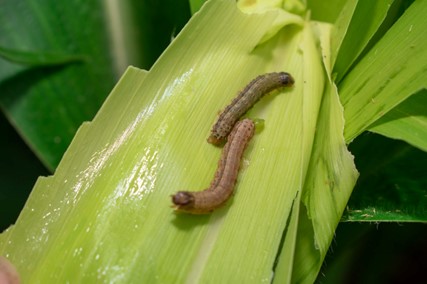
Grub pressure varies across our service area but is consistent enough in suburban Fairfield County, the Branford and Guilford shoreline, and the wooded edges of New Haven County to treat as a default risk. The preventive window for products like chlorantraniliprole and imidacloprid runs from mid-June through mid-July. After that, you are looking at curative products applied to active damage, with more variable results.
What grub damage does to a September renovation: the seedlings germinate fine, then die at the three to four week mark as the roots fail to find soil structure to anchor in. By early October the skunks and raccoons start digging the lawn looking for grubs, tearing up newly seeded zones in the process. Walk the property in July and do a tug test in any thin spots. If a handful of turf lifts out cleanly, grubs are already feeding and a curative product is needed this week. If it resists, the preventive window is still open.
Decision Four: Get a Soil Test to UConn
July is the right month to send a soil sample to the UConn Soil Nutrient Analysis Laboratory. Turnaround runs two to three weeks at this time of year, which gets you results in time to plan amendments at September aeration. The cost is around fifteen to twenty dollars. The information drives every other input decision.
What CT soil tests typically reveal:
- Acidic pH. Most Connecticut soils run 5.3 to 6.0 against the 6.2 to 6.8 ideal for cool-season turf. This is a feature of our glacial geology and decades of acid deposition. Lime applied at September aeration corrects the profile heading into the storage feeding window.
- Elevated chloride on shoreline lots. Properties within a quarter mile of the Sound, especially in Old Greenwich, Rowayton, Westport, Southport, and the Branford and Madison shoreline, often show elevated salt from winter road brine and salt spray. Salt-tolerant cultivar selection becomes relevant.
- Inconsistent phosphorus. Older estate properties with decades of fertilizer history often run high. Newer subdivisions on cleared land often run low.
Plan amendments at aeration, not separately. Lime, gypsum, and starter fertilizer worked into open aeration holes are dramatically more effective than the same products applied to undisturbed turf.
Decision Five: Match Cultivars to Your Microclimate
This is where Fairfield and New Haven County properties diverge from the generic Northeast playbook. The UConn turfgrass program has been running NTEP cultivar trials at the Plant Science Research and Education Facility for years, and the data tells us which named varieties hold up under Connecticut heat, humidity, and soil chemistry. Order seed in late July or the first week of August. The good genetics are sold out at the box stores by Labor Day weekend.
Shoreline properties (Greenwich coast, Rowayton, Westport beach, Southport, Madison, Old Saybrook):
Salt tolerance matters. Lean heavier on turf-type tall fescue (50 to 65 percent of the blend) with named varieties that performed well in salt screening. Keep Kentucky bluegrass to 20 to 25 percent. Add a small amount of slender creeping red fescue for added salt tolerance in transition zones.
Inland Fairfield (Ridgefield, Wilton, Weston, Redding, New Canaan back-country):
Deer pressure and shade dominate. Move the blend toward fine fescues (chewings fescue and hard fescue) in the 35 to 50 percent range for shade tolerance and lower palatability to deer. Keep bluegrass percentages modest and use turf-type tall fescue for sun areas.
Suburban New Haven County (North Haven, Hamden, Branford, Guilford):
A balanced blend works well: 40 to 55 percent turf-type tall fescue, 25 to 35 percent Kentucky bluegrass, 15 to 25 percent perennial ryegrass for fast establishment.
Across all three, avoid contractor mixes loaded with annual ryegrass. They germinate in three weeks, look great in October, and die the following summer leaving you back where you started.
Decision Six: Plan Deer Protection in Wilton, Weston, Redding, and the Inland Towns
Inland Fairfield County has some of the highest deer densities in Connecticut. A freshly seeded lawn with tender new shoots is a deer salad bar from the moment those seedlings break the soil. Properties in Ridgefield, Wilton, Weston, Redding, Easton, and the back-country sections of New Canaan and Greenwich all need a deer plan before the seed goes down, not after.
What works: rotating deer repellent applications timed to the second and fourth weeks after seeding, when seedlings are most palatable. Temporary fencing or repellent stakes around the highest-pressure zones. Avoiding overseed dates that coincide with peak browse pressure in late September. On properties with severe deer pressure, the cultivar blend itself shifts toward fine fescues, which are lower on the deer preference list than tender bluegrass shoots.
Decision Seven: Book the September Date Now, Especially if You Commute
A large share of our Fairfield County customers commute to New York on the Merritt Parkway or the New Haven Line. The reality of that schedule is limited weekday daylight for lawn oversight, which makes the September renovation calendar a coordination problem. The early September dates fill first because estate properties book early to lock them in, and the homeowner who calls in late August is usually getting a late September or early October date by default.
For a commuter household, the right move is to book the renovation in July, lock the early September window, and use the VitaminLawn program to coordinate the July preservation work, the August soil amendments, the September aeration and overseeding, and the October fall fertilization in a single planned sequence. The week-to-week oversight is on us, not on you.
What to Do Next
If you would rather have the July planning, the September execution, and the entire year-round program built and run by people who do this work every week across Fairfield and New Haven Counties, that is what we are here for. We schedule core aeration and overseeding starting in early August for the September window, and the calendar fills fast. The estate properties book first, the commuter households book second, and the late callers take what is left.
Lawn Squad of New Haven and Fairfield Counties serves homeowners from Greenwich, Riverside, Cos Cob, Darien, New Canaan, Wilton, Westport, Weston, Fairfield, Easton, Trumbull, Stratford, and Milford through to Orange, West Haven, New Haven, North Haven, Hamden, Branford, Guilford, Madison, and the shoreline towns east to the Old Saybrook line.
Call us at 203-301-8247 or request a free quote at lawnsquad.com. The VitaminLawn program coordinates July preservation, August soil amendments matched to your UConn soil test, September aeration and overseeding with cultivars chosen for your specific microclimate, fall lime and fertilization, and deer protection on inland Fairfield properties. The September window is the lever. July is when you set it correctly.