Short Answer: Six causes drive most July browning on Grand Strand lawns even with sprinklers running: chinch bug feeding (especially on St. Augustine and Centipede), salt accumulation from spray or well water, hydrophobic sandy soil that sheds water, irrigation coverage gaps, mole cricket tunneling that severs roots, and fungal disease (brown patch, dollar spot) from humid coastal conditions. Each looks like drought but needs a different fix. Watering more makes most of them worse.
You walked out this morning, somewhere between North Myrtle and Pawleys, somewhere along Highway 17 or back in the Conway suburbs, and the lawn that looked great in May has started showing yellow patches. The irrigation has been running. The water bill says you are doing your part. So what is going on?
Across the Grand Strand, July is the month when small lawn problems start showing up in obvious ways. The combination of heat, humidity, intermittent thunderstorms, and the unique pressures of coastal Carolina turf (salt, sand, sun) means that several different issues all look identical from ten feet away. Each one needs a different fix, and watering more solves almost none of them.
Here are the six causes we see most often on Bermuda, Centipede, St. Augustine, and Zoysia lawns from Little River through Pawleys Island, and how to tell which one you are dealing with.
1. Chinch Bugs in the Hot Sunny Zones
Southern chinch bugs hit hardest on St. Augustine and Centipede lawns in our area, though they will attack stressed Bermuda and Zoysia too. By July, populations have built through several spring generations. The damage shows up first in the sunniest, driest part of the lawn: south-facing fronts, driveway and sidewalk edges, around mailboxes and light poles where soil radiates heat back into the turf.
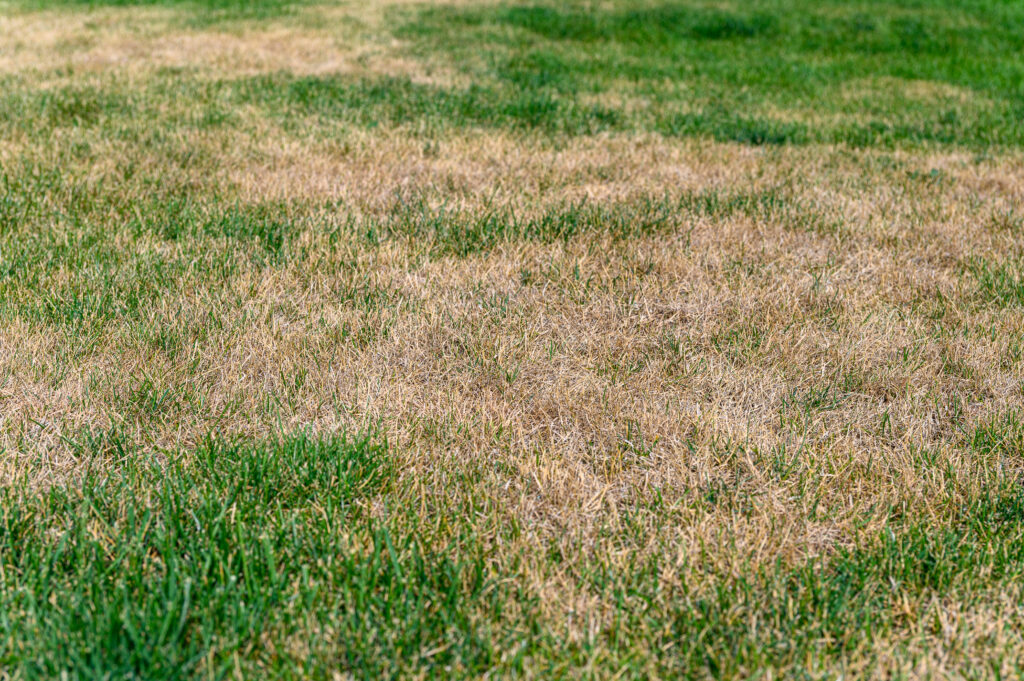
What separates chinch bug damage from drought is the pattern. Drought browns uniformly across exposed zones. Chinch bugs leave irregular patches with an expanding edge. The grass looks “watered but wilting” because the insects inject a toxin while feeding that blocks water uptake. More water does not reach the plant.
The five-minute float test confirms it. Cut both ends off a coffee can, push it two inches into the soil at the edge of a yellow patch, fill with water, and wait five minutes. If 20 or more tiny black-and-white adults or red-and-white nymphs float to the surface, that is your problem. Treatment with a labeled pyrethroid or systemic neonicotinoid stops the damage when applied to the affected area plus a 10-to-15-foot buffer.
2. Salt Accumulation From Spray or Well Water
This one is uniquely coastal. Lawns within a mile or two of the ocean accumulate salt from sea breeze and storm spray. Properties on well water (common in parts of Murrells Inlet, Garden City, and the inland fringe of the Grand Strand) can build salt at the root zone from minerals in the groundwater. Either way, sodium and chloride concentrations climb in the surface soil over weeks, and the grass starts showing what looks exactly like drought stress: tip burn, leaf yellowing, and overall thinning.
The clue is the location of the damage. Salt damage is heaviest on the side of the property closest to the ocean and prevailing wind, or it shows up everywhere irrigated by a well. Drought-stressed grass recovers when you water. Salt-damaged grass keeps declining no matter how much you water, because the water itself is bringing more salt.
The fix is a leaching rinse: a deep, slow irrigation that flushes salts past the root zone. Run the irrigation twice as long as normal for one cycle every week or two, ideally with rain captured in barrels or with a mid-cycle break to allow penetration. Calcium sulfate (gypsum) applied at recommended rates helps displace sodium and rebuilds soil structure. Long-term, plant salt-tolerant varieties in the most exposed zones (Centipede and Floratam St. Augustine handle salt better than many alternatives).
3. Sandy Soil Has Gone Hydrophobic
Grand Strand soils are sand-heavy. Sand drains fast, which is normally a feature in our high-rainfall climate. The downside is that sand can develop a waxy organic coating during long hot stretches that causes the soil to repel water instead of absorbing it. The sprinklers run, water hits the lawn, and it beads up and runs off into the street or pools in low spots without reaching the root zone.
The test takes one minute. Stick a screwdriver into a brown zone right after the irrigation cycle. If you cannot push it six inches in with steady pressure, the water never penetrated. The grass is thirsty even though the irrigation log says it is not.
The fix is a soil wetting agent (also called a soil surfactant). Granular and liquid forms are available at most garden centers and online retailers. One application breaks down the waxy coating and restores normal water absorption within about a week. Aeration and topdressing in early fall add longer-term improvement, but the wetting agent is the immediate July intervention.
4. Irrigation Coverage Gaps You Cannot See From the Window
Just because the sprinklers run does not mean every square foot of grass is getting water. Common hidden problems we find on Grand Strand systems: heads that have shifted or settled over time, heads partially blocked by mulch creep or overgrown shrubs, clogged nozzles from sand and shells in the supply line, broken nozzles spraying the driveway instead of the lawn, and pressure dropping at the end of a zone so the farthest heads do not throw their full pattern.
The audit is worth an hour. Run each zone manually during daylight. Stand back and watch the throw patterns. Walk the lawn after a cycle and feel for dry strips. Set six straight-sided cans across one zone, run it for 15 minutes, and measure the depth in each can. If some cans hold half an inch and others a quarter, you have a coverage problem that no amount of additional run time will solve.
Many of the worst-looking patches in our service area are not pest or disease at all. They are head 4 in zone 2 spraying at the wrong angle for the last six months.
5. Mole Crickets Tunneling Under the Surface
Mole crickets are one of the signature pests of Coastal Carolina turf. They tunnel through the top inch or two of soil, feeding on roots and creating raised, soft trails that show up most clearly in the morning. Damage looks like irregular yellowing combined with the lawn feeling spongy underfoot. Heavier infestations leave visible soil mounds and small entry holes.
By July, second-generation nymphs are active and feeding heavily. The damage compounds with each week. The diagnostic move is to mix two tablespoons of lemon-scented dish soap into two gallons of water and pour it over a one-square-yard area at the edge of a suspicious zone. Wait three to five minutes. Mole crickets crawl to the surface where you can see them, distinctly shaped with shovel-like front legs.
Treatment for mole crickets is timing-sensitive. The most effective window in our area is June through early July when nymphs are small. By late July, larger nymphs are harder to control and may require multiple applications. A labeled bifenthrin or imidacloprid product applied to the affected zones and watered in promptly handles most infestations.
6. Fungal Disease From Humid Nights and Storm Cycles
Grand Strand humidity, combined with summer thunderstorms and warm nights, creates ideal conditions for several turf pathogens. The most common in our area are brown patch (large circular yellow to brown patches with darker advancing rings, common in shaded or low-airflow zones), dollar spot (small silver-dollar-sized bleached patches), and gray leaf spot on St. Augustine (small gray-brown lesions on individual blades).
Disease damage looks like drought from the curb but has distinct close-up signatures. Pull individual blades and look. Drought-stressed blades fold lengthwise and feel papery. Disease blades show lesions, spots, or webbing in early morning dew. A darker ring at the edge of a yellow patch is often the active fungal front.
Fungicide rotation (azoxystrobin, propiconazole, chlorothalonil) is the curative option. Cultural moves that reduce fungal pressure include raising mowing height by half an inch in summer, watering only at sunrise so the canopy dries quickly, and pulling nitrogen back during peak disease pressure. Heavily nitrogen-fed lawns get hit much harder than moderately fed ones.
How to Diagnose Yours
Walk the lawn early in the morning before the sun is high. Bring a screwdriver, an old coffee can with both ends cut off, and a hose. Look at each problem patch and ask:
- Is the patch in the hottest, sunniest zone? Run the float test for chinch bugs.
- Is it closest to the ocean or salt source? Salt is a likely contributor.
- Does the screwdriver penetrate easily? If not, hydrophobic soil.
- Is one zone of the lawn always worse? Audit the irrigation coverage.
- Does the lawn feel soft or spongy underfoot? Soap flush for mole crickets.
- Are individual grass blades showing lesions, spots, or rings? Disease.
It is common to find more than one cause active at the same time. Address the most urgent driver first (insects, then disease, then water mechanics, then fertility) and the others often improve along the way.
What to Do Next
If your lawn is browning despite regular watering, the next step is a real diagnosis instead of more irrigation. Most Grand Strand homeowners who walk the lawn with a screwdriver and a coffee can find one or two clear causes pointing to a specific fix.
Lawn Squad of Myrtle Beach serves homeowners across the Grand Strand, from Little River and North Myrtle Beach through Myrtle Beach, Surfside, Garden City, Murrells Inlet, Pawleys Island, and inland through Conway.
Call us at 843-702-6210 or request a free quote at lawnsquad.com. Our VitaminLawn program is built specifically for coastal Carolina warm-season turf, the sandy soils that demand a different approach, and the salt-and-sun pressures that define Grand Strand lawn care. We diagnose first, then prescribe. The lawns that look best at the end of July are the ones where the right intervention happened in week one of damage instead of week six.