
Short Answer: Brown patch and take-all root rot both show up on North Atlanta warm-season lawns starting in June, and homeowners regularly treat one for the other. Brown patch hits Zoysia and St. Augustine hardest, appearing as circular patches with a yellow-orange ring at the active edge, with foliage symptoms above ground. Take-all root rot attacks the roots and stolons themselves, showing as irregular thinning patches with yellow-orange tips where the roots have rotted underneath. The pull test separates them: take-all root rot pulls up easily because the roots are gone. Brown patch stays rooted because the disease is on the leaves. The treatments are different. Brown patch responds to foliar fungicide and cultural changes. Take-all root rot needs soil acidification, peat moss topdressing, and a fungicide drench. Get the diagnosis right in June and you save the lawn. Get it wrong and you spend three weeks treating the wrong disease.
If you have walked your Roswell, Marietta, Johns Creek, or Sandy Springs lawn over the last week and noticed circles of yellowing turf you did not see in May, you are not alone. We have already had the first reports of brown patch on Zoysia properties across North Fulton, and the take-all root rot calls are starting to come in from the Cherokee County St. Augustine yards we serve. June is the disease window in North Atlanta, and it catches more homeowners by surprise than any other month.
Here is the part that trips people up. Brown patch and take-all root rot can look very similar from the back porch. Both produce circular or irregular patches of off-color turf. Both peak in the warm humid pattern that defines a North Georgia June. And both can take a Zoysia or St. Augustine lawn down to bare soil if treated wrong. But the cause is different, the treatment is different, and the recovery time is different. The diagnosis is worth getting right.
What Brown Patch Looks Like and How to Confirm It
Brown patch is caused by Rhizoctonia solani, a soil-borne fungus that goes opportunistic when nighttime temperatures stay above 65 degrees and morning humidity stays above 90 percent. In other words, a typical North Atlanta night from mid-June through August.
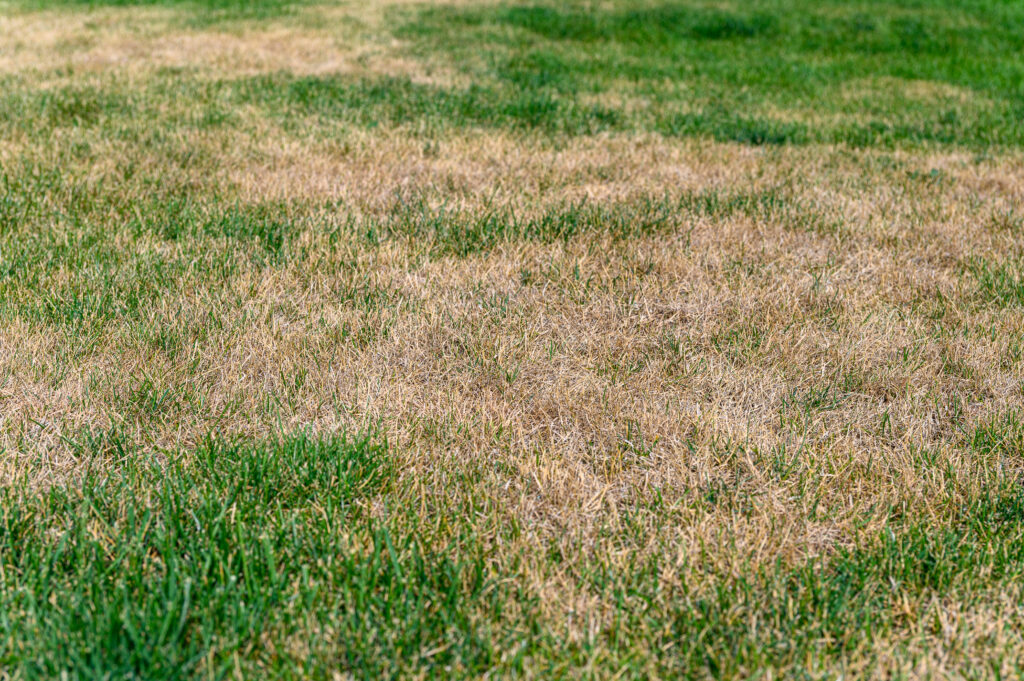
The visual signature is consistent. Patches start as small (a few feet across) and roughly circular, then expand outward. The center of the patch may turn brown and thin while the active outer ring shows a yellow to orange color where the fungus is moving. On a Zoysia lawn the patches can reach ten to twenty feet across by July if untreated. On St. Augustine the patches tend to be smaller but more numerous.
To confirm: pull a few blades from the active edge of the patch and look at the sheath where the blade meets the runner. Brown patch leaves a distinctive water-soaked, brown-edged lesion on the sheath. The roots are usually still intact. If you tug at the turf, it stays rooted even though the foliage looks unhealthy. That root-still-attached detail is the single most important diagnostic clue.
What Take-All Root Rot Looks Like and How to Confirm It
Take-all root rot, caused by Gaeumannomyces graminis, is an entirely different beast. It attacks the roots, rhizomes, and stolons underground rather than the leaves. By the time you see foliar symptoms above ground, the disease has been working for weeks below.
The above-ground signs are easy to mistake for drought or fertility issues. Irregular patches of yellow-orange turf, often with a slight chlorotic (pale green to yellow) cast that comes on gradually. The patches do not have the distinct outer ring of brown patch. Instead, the turf inside the patch thins out and develops a stringy, sparse appearance.
The confirmation test is the pull test. Grab a handful of turf at the edge of the affected area and lift firmly. Take-all root rot turf pulls up like loose carpet because the roots have been chewed by the fungus. You will see short, brown, rotted root stubs instead of healthy white roots. On St. Augustine the stolons will often appear black at the nodes where they should be green. That blackening is the disease working.
Why the Two Get Confused
Both diseases hit Zoysia and St. Augustine harder than Bermuda. Both show up in June and July in North Atlanta. Both produce a yellowing pattern that looks similar at a glance. And both are favored by the same environmental conditions: warm humid weather, irrigation timing problems, and certain fertility imbalances.
The mistake we see most often is the homeowner who Googles “yellow patches in lawn,” sees brown patch images, buys a foliar fungicide, applies it on a take-all root rot infection, and watches the lawn keep declining for three weeks. The foliar fungicide cannot reach the disease because the disease is below ground, on the roots, where surface-applied chemistry does not penetrate. By the time the diagnosis gets corrected, half the lawn is gone.
The opposite mistake also happens. A homeowner sees yellowing patches, assumes take-all root rot because they read about it on a neighborhood forum, and tries soil acidification on a brown patch infection. The pH change does nothing for foliar fungus, and meanwhile the brown patch keeps expanding.
How We Treat Brown Patch on North Atlanta Lawns
Brown patch on Zoysia and St. Augustine responds well to a foliar fungicide rotation. The two most common active ingredients on home lawns are azoxystrobin (a strobilurin) and propiconazole (a DMI). Rotating between the two helps avoid resistance and covers a broader window of the disease lifecycle.
The fungicide treatment alone is half the answer. The cultural changes are the other half. Shift watering to early morning only (4 a.m. to 8 a.m.), so the canopy dries out within an hour of sunrise. Raise the mowing height to the upper end of your grass’s range (2 to 2.5 inches for most Zoysia, 3 to 4 inches for St. Augustine). Avoid nitrogen applications until the active disease has been knocked back, because nitrogen feeds the disease as much as the lawn. Aerate in early fall if soil compaction is part of the issue, but not now.
With timely intervention, brown patch patches usually start showing fresh green growth within two to three weeks. The visible recovery line where the patch was usually heals by August on a treated lawn. Without intervention, the patches expand and merge.
How We Treat Take-All Root Rot
Take-all root rot is harder to manage because the disease is in the root zone. Foliar fungicides do not reach it effectively. The treatment plan combines three things.
First, soil pH adjustment. Take-all thrives in alkaline soil and is suppressed by mildly acidic conditions. Applying granular sulfur or ammonium sulfate to pull soil pH down toward 6.0 to 6.5 creates an environment less favorable to the disease. Most North Atlanta red clay soils run slightly acidic already, but lawns that have been heavily limed over the years can drift higher and become susceptible.
Second, peat moss topdressing. A light topdressing of sphagnum peat moss (roughly a quarter inch across affected areas) creates surface conditions that favor recovery and suppresses the pathogen at the soil-root interface. The peat releases natural organic acids and improves the microbial balance around the root zone.
Third, a fungicide drench. Granular fungicides labeled for take-all root rot (typically containing azoxystrobin, propiconazole, or fluoxastrobin) are watered in heavily so the chemistry reaches the root zone. Standard foliar applications will not work because the disease is below the leaves. Two applications spaced three to four weeks apart usually catch the active phase.
Recovery from take-all is slower than brown patch. We tell customers in Milton and Cumming who have take-all on St. Augustine to expect six to eight weeks before visible improvement, and full recovery may take into next spring. Some severely damaged areas need sod replacement after the disease is suppressed.
Prevention for Both Diseases
A good June program addresses both diseases preventively, especially on Zoysia and St. Augustine lawns that have a history of either. The preventive playbook overlaps in useful ways. Water in the early morning, never at night. Mow at the upper end of the grass’s range. Keep nitrogen modest in early summer. Maintain proper soil pH (6.0 to 6.5 for most warm-season grass in our region). Aerate if compaction is reducing root health. Avoid scalping, which stresses the lawn and opens the canopy to disease.
For properties with recurring brown patch, a preventive fungicide application in early June (before symptoms appear) can be cost-effective. For properties with recurring take-all root rot, soil pH management and an early peat topdressing each spring set the lawn up to resist re-infection.
When to Call vs When to Wait
If you see a small patch (under three feet) and you can identify it confidently as brown patch with the root-attached test, a homeowner can often manage it with a cultural change plus an over-the-counter fungicide. If the patch is expanding visibly week over week, if multiple patches are present, or if the pull test reveals take-all root rot, the disease has moved past the DIY window. The treatment becomes both more expensive and less likely to fully recover the lawn the longer it goes untreated.
The customers in our service area who keep their Zoysia and St. Augustine lawns in good condition through summer are the ones who pay attention to the first patches in early June rather than waiting until late July. The difference between a two-week intervention and a six-week intervention is often the difference between a lawn that recovers completely and a lawn that needs sod patches.
What to Do Next
If you have patches you cannot diagnose with confidence, send us a photo or have us come walk the lawn. Twenty minutes on site usually answers the question and gets the right treatment started before the disease expands.
Lawn Squad of North Atlanta serves homeowners across North Metro Atlanta.
Call us at 678-250-6490 or request a free quote at lawnsquad.com. Our VitaminLawn program includes proactive disease monitoring for North Atlanta Bermuda, Zoysia, and St. Augustine lawns. We watch for brown patch and take-all root rot through the June and July window so you do not have to learn the difference the hard way on your own yard.