Short Answer: Fescue lawns in Knoxville survive June heat through three coordinated decisions: raise the mowing height to 4 inches and never go lower, water deeply once or twice a week instead of daily, and stop fertilizing with nitrogen until September. East Tennessee sits in the transition zone where fescue is fighting climate, not designed for it, so your job in June is to reduce stress and keep crowns alive. The yards that look best in late August are the ones where the owner stopped trying to make June into a growth month and started treating it as a survival month.
If you walk your Knoxville fescue lawn on a humid morning in early June, you can already feel what is coming. The grass is still green, the soil under the rocks in your side yard is still damp, and the front yard looks fine from the porch. By the second week of the month, the south-facing slope along the driveway starts to lose color. The strip near the road thins out. The fescue you reseeded last September, the patch that looked thick and proud in April, suddenly looks tired.
This is the part of the year that humbles every transition zone homeowner. Knoxville is one of the toughest places in the country to grow a lawn because we sit at the edge of two grass worlds. Cool-season fescue thrives north of us. Warm-season Bermuda and Zoysia thrive south of us. We get the worst of both climates: summers hot enough to stress fescue and winters cold enough to brown out Bermuda. Your June strategy depends on which grass you have and what you are willing to accept.
Why Knoxville Is the Hardest Place to Grow Fescue
Tall fescue is a cool-season grass. Its peak growth happens between 60 and 75 degrees, which describes April, May, October, and November in East Tennessee. June, July, and August in Knoxville regularly push daytime temperatures into the upper 80s and 90s with overnight lows that stay in the 70s. That overnight heat is the part that quietly does the damage.
Fescue plants respire (burn stored energy) at night. When the temperature stays warm overnight, the plant burns more energy than it produced during the day. Stretch that pattern across a 10-day humid spell in late June, and fescue crowns weaken. Once a crown dies, that part of the lawn does not come back until you reseed in September.
Add to that the soil reality in our service area. Knoxville sits on a mix of red clay and limestone bedrock that creates rocky, shallow soil in much of West Knox, Farragut, and the ridges between Fountain City and Halls. Roots cannot reach water that has soaked deeper than 4 inches. So while fescue further north can pull from a deeper profile, your Knoxville lawn is working with a shallower bank account.
Mowing Height: Why 4 Inches Beats Every Product
The single most important thing you can do for fescue in Knoxville in June is raise the mower. If your deck has been at 3 inches all spring, move it up to 4. If it was at 2.5, this is the moment that decision starts costing you grass.
Tall fescue at 4 inches shades its own root zone. Soil temperature under 4-inch fescue can run 10 to 15 degrees cooler than soil under 2-inch fescue on the same afternoon. That temperature difference means roots stay active longer into the summer, water evaporates more slowly from the surface, and weed seeds that need light to germinate stay buried.
There is no fertilizer, no fungicide, no irrigation upgrade that beats a 4-inch mowing height for transition zone fescue survival. We say this to every customer in Knoxville and we will say it to you too: if you only change one thing this summer, raise the mower.
Sharpen the blade while you are at it. A dull blade tears the leaf tip rather than slicing it. Torn tips lose more water and become entry points for the brown patch fungus that loves Knoxville humidity. A sharp blade is a free upgrade.
Watering Strategy: Deep and Infrequent on Clay
Most Knoxville homeowners water their fescue wrong in June, and they do it with the best of intentions. They see the lawn looking dry, they turn the sprinkler on for 15 minutes every evening, and they think they are helping. They are not.
Daily shallow watering trains roots to stay near the surface, which is exactly where the soil gets hottest. It also keeps leaf blades wet overnight, and wet blades plus warm humid air is the recipe for brown patch disease. Almost every brown patch outbreak we diagnose in Knoxville traces back to an evening sprinkler schedule.
The right watering schedule for a Knoxville fescue lawn in June is 1 inch of water per week, delivered in one or two cycles, between 4 and 8 a.m. only. Set a tuna can or rain gauge on the lawn while the sprinkler runs to measure how long it takes to apply half an inch. Then water that long, once or twice a week, depending on what we get from afternoon thunderstorms.
On rocky or sloped lots, especially around Hardin Valley and the Bearden ridges, run the cycle in two passes 30 minutes apart so the water has time to soak in rather than running off the slope.
Shade Management: Use It, Don’t Fight It
Fescue tolerates shade better than Bermuda or Zoysia. If you have mature trees in your yard, those shaded areas are where your fescue has the best survival odds in June. The catch is that tree roots compete for the same water your fescue needs.
What we tell Knoxville homeowners with established oaks, maples, or poplars: do not fight the shade. Mow the shaded zones at the same 4-inch height. Water them slightly more often than the sunny areas, because tree roots will pull moisture out of the top profile fast. Skip fertilizer in those zones during summer. And accept that the lawn under heavy canopy will always be thinner than the open areas, because that is biology.
If your shaded fescue thins out by August, plan to reseed it in late September. Spring overseeding into shade rarely works in Knoxville because the seedlings cannot establish a strong root system before summer heat arrives.
Why You Should Stop Fertilizing With Nitrogen Now
Nitrogen pushes leaf growth. Leaf growth in June and July, when fescue should be conserving energy, is exactly what you do not want. We have seen Knoxville homeowners apply a heavy spring fertilizer in late May, then watch their lawn burn out in July, and assume the problem was lack of fertilizer. It was the opposite.
Hold all nitrogen applications on Knoxville fescue from now until early September. The next meaningful feeding should land in mid-September when temperatures drop back into the cool-season comfort zone and the grass is recovering from summer stress. That September application is the most important fertilizer event of the year for fescue. Save your fertility budget for then.
If your lawn is showing yellow color in June, the cause is usually iron deficiency from leached topsoil, not nitrogen need. A light foliar iron application will green it up without pushing growth that the roots cannot support.
Brown Patch Disease: The June Threat You Watch For
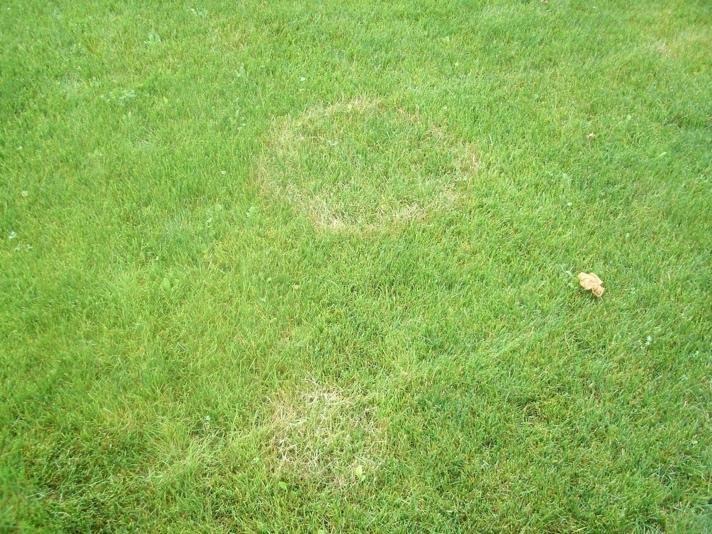
Brown patch is the disease that kills more Knoxville fescue lawns than any other single cause. It shows up when nighttime temperatures stay above 65 degrees, humidity is high, and the leaf blades stay wet overnight. East Tennessee checks all three boxes by mid-June most years.
The early signs are circular tan to brown patches anywhere from 6 inches to 3 feet across. The patch edge often has a darker smoke ring in the morning when dew is on the grass. Individual blades inside the patch show small irregular lesions with dark borders.
The cultural fix is what we already covered: water in early morning, never evening; mow at 4 inches; avoid summer nitrogen. The chemical fix, when brown patch is already active, is a preventive fungicide rotation. Two products with different modes of action applied 21 to 28 days apart will hold the disease through the worst of the summer. We do this on the lawns where we know brown patch was an issue the prior year.
What to Do Next
If you would rather let someone else handle the timing on watering audits, mowing height conversations, fungicide rotation, and the September renovation that sets up the next 12 months, that is what we do every day across the Knoxville metro.
Lawn Squad of Knoxville serves homeowners across Knoxville Metro and East Tennessee.
Call us at 865-564-9525 or request a free quote at lawnsquad.com. Our VitaminLawn program is built around the transition zone reality for East Tennessee, with fescue-specific timing for summer stress periods, brown patch prevention, and the fall renovation that decides what your lawn looks like next spring.