Aeration vs Overseeding for Columbus Lawns: Which Pays Off Sooner?
Short Answer: For Columbus area cool-season lawns, aeration alone produces visible improvement faster but smaller in scope. Overseeding alone produces bigger improvement but takes longer to show. The two services together (aeration plus overseeding done in the same fall visit) produce the highest-value lawn renovation work available, with results that compound over multiple seasons. If you must choose only one in a given year, aeration usually pays off sooner because compaction relief produces effects within weeks while overseeded grass takes months to fully establish. Most lawns benefit from both on a 1 to 2 year cycle.
If you have a thin Columbus area lawn and you are trying to decide between aeration and overseeding, the question itself reveals one of the most common confusions in lawn care: these are not really alternatives. They are services that solve different problems and work better together than either does alone.
That said, if you can only afford one in a given year or you want to know which produces faster visible results, here is the honest comparison for cool-season lawns across Columbus, Dublin, Powell, Westerville, and our broader service area.
What Aeration Does (Quick Recap)
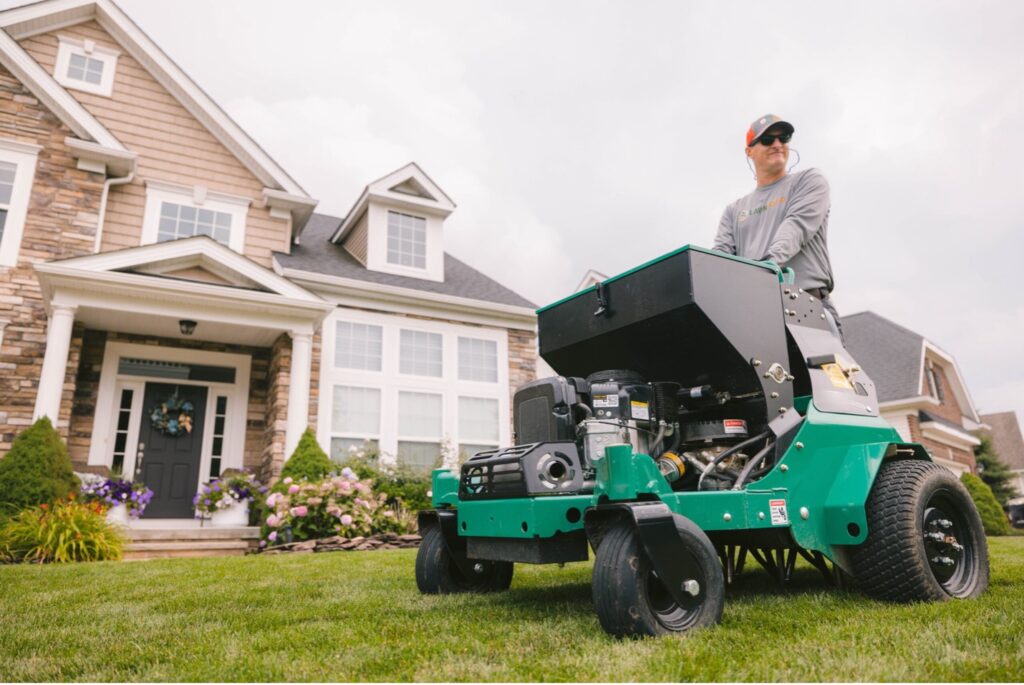
Core aeration uses a machine with hollow tines that pull plugs of soil from the lawn, leaving thousands of small holes about 2 to 3 inches deep. The plugs break down naturally over a few weeks and reincorporate into the surface soil.
The purpose is to relieve compaction. The holes let water, oxygen, and roots move into the soil profile. Soil microbes recover. The grass that was already there grows better because root function improves.
What Overseeding Does (Quick Recap)
Overseeding spreads new grass seed across an existing lawn. The seed germinates, develops roots, and grows into mature grass over several months. The result is more grass plants per square foot than the lawn had before.
The purpose is to increase density. The lawn that was thin or had bare spots fills in with new grass that adds plants where there were not enough.
Aeration: Speed and Limits of Results
Visible changes from aeration appear in 4 to 6 weeks during active growing season. Roots grow into the holes, water absorption improves, and grass density increases as existing plants thrive in better conditions.
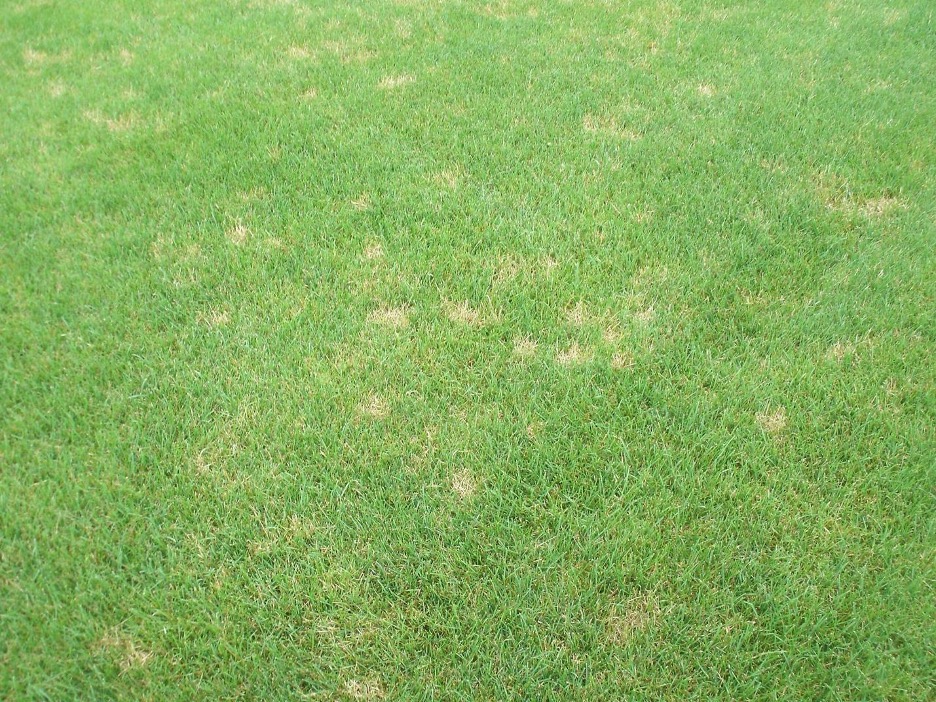
The limits: aeration cannot create grass where none exists. If your lawn has bare spots, aeration alone will not fill them. The plants that are there grow better, but the spots in between stay bare.
So aeration is the right standalone choice when:
The lawn is reasonably dense but the soil is compacted.
You have water absorption problems from heavy clay.
You want faster results than overseeding alone produces.
You did major overseeding in a recent year and want to support what is already there.
Overseeding: Slower But Bigger Impact
Visible changes from overseeding take longer. Seed germinates in 1 to 3 weeks for tall fescue, 3 to 4 weeks for Kentucky bluegrass. The new grass needs another 2 to 3 months of growth before it looks like the rest of the lawn. Full establishment takes 4 to 6 months.
The benefit: overseeding can transform a thin lawn into a thick one over a season or two. Where aeration improves what is there, overseeding adds what is missing.
So overseeding is the right standalone choice when:
The lawn has bare spots or significant thinning.
You want to introduce improved grass varieties (modern turf-type tall fescue blends).
The soil is reasonable but plant density is the issue.
You are willing to wait longer for results in exchange for bigger transformation.
The Combined Approach (Almost Always Best)
Combining aeration and overseeding in the same fall visit produces dramatically better results than either alone. The reasons are mechanical:
Aeration creates ideal seed-to-soil contact for the new seed. Seed that falls into aeration holes germinates at much higher rates than seed broadcast on undisturbed soil.
The improved soil conditions from aeration support the new grass through establishment. Compacted soil produces struggling seedlings. Aerated soil produces strong establishment.
The existing grass benefits from both services simultaneously, becoming healthier and denser as the new grass fills in.
For cool-season Columbus lawns, the aeration-plus-overseeding combination in early fall is the highest-value lawn service available. We do this on most properties every 1 to 2 years and see consistent results.
Best Timing for Columbus
Early fall (September through early October) is the prime window for both services on cool-season grass. Soil is still warm enough for fast germination, but air temperatures are cooling into the recovery range for both new and existing grass.
Spring is the secondary window. Spring aeration alone is acceptable. Spring overseeding produces weaker results because new seedlings face summer stress before they fully establish. Pre-emergent herbicide applications also typically prevent spring overseeding from working at all.
Avoid summer for either service. Heat stress prevents recovery, and new seedlings will not survive summer conditions.
Cost Comparison
For a typical Columbus area residential property:
Core aeration alone: $150 to $300.
Overseeding alone: $200 to $500 depending on seed type and rate.
Combined aeration plus overseeding: $300 to $700.
The combined service typically costs less than the two individual services priced separately because the labor overlaps. Most companies offer the combination at a meaningful discount versus separate scheduling.
How Often to Do Each
Annual aeration: appropriate for newer construction lawns, high-traffic properties, or heavily compacted soils. Most properties for the first 5 years.
Aeration every 2 years: appropriate for established lawns on reasonable soil with moderate traffic. Most mature Columbus lawns.
Overseeding every 2 to 3 years: maintains density on tall fescue lawns that do not self-repair like bluegrass.
Annual overseeding: appropriate for lawns recovering from significant damage or for high-use properties where wear is constant.
Combined annual aeration and overseeding: appropriate for lawns being actively renovated or for premium properties where maximum density is the goal.
What Aeration Alone Does Not Fix
Bare spots and severely thin areas. The plants that exist grow better, but new plants do not appear from aeration alone.
Disease pressure. Active brown patch or dollar spot needs fungicide regardless of aeration.
Insect damage. Grub damage needs separate treatment.
Soil chemistry imbalances. pH and nutrient corrections are separate work.
What Overseeding Alone Does Not Fix
Compacted soil. New seedlings struggle in compacted soil just as much as established grass does.
Drainage problems. Wet areas remain wet after overseeding.
Shade issues. New grass in heavy shade thins as quickly as old grass did.
Soil chemistry imbalances. New seed needs the same amendments existing grass needs.
What to Do Next
If you are trying to decide what your Columbus area lawn needs this fall, we walk properties across Dublin, Powell, Westerville, and our broader service area to assess compaction, density, and overall condition. Most lawns benefit from the combined aeration-plus-overseeding approach, but we tell you straight which would actually help your specific yard.
What to Do Next
If you would rather have someone else handle the timing decisions, product selection, and application for your Columbus lawn, we are here for that.
Lawn Squad of Columbus serves Baltimore, Blacklick, Brice, Canal Winchester, Carroll, Columbus, Delaware, Dublin, Galloway, Grove City, Groveport, Hilliard, and surrounding areas.
Call us at 740-248-5880 or request a free quote at lawnsquad.com. Our VitaminLawn program is built specifically for the grass types, soils, and weather patterns in our service area. Most homeowners see noticeable improvement within the first two applications.