Short Answer: Aeration removes plugs of soil to relieve compaction. Power raking pulls thatch (dead organic matter) from above the soil. They solve different problems. Most Northeast Ohio lawns need aeration more often than power raking because our heavy clay soils compact more often than they accumulate excessive thatch. Compacted lawns where water pools or the screwdriver test fails need aeration. Lawns with a thick spongy mat above the soil need power raking. Many properties benefit from neither in a given year. Here is how to tell which your Cleveland area lawn actually needs.
If you are getting quotes for spring or fall lawn services across the Cleveland area, you have probably heard about both aeration and power raking. The two get talked about as if they are interchangeable, and some companies use the words loosely. They are very different services that solve very different problems. Doing the wrong one wastes money and stresses the lawn for no benefit.
Across our service area covering Avon, Avon Lake, Beachwood, Brecksville, Westlake, Strongsville, and surrounding communities, here is the practical guide to telling which service your specific lawn actually needs.
What Aeration Does
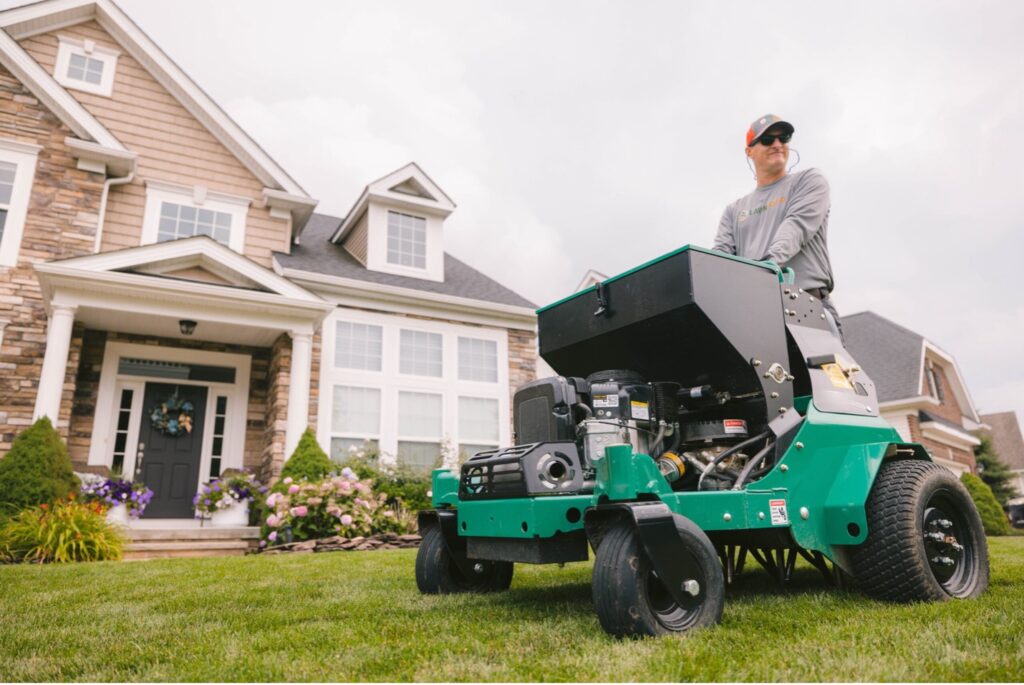
Core aeration uses a machine with hollow tines that pull plugs of soil from the lawn, leaving thousands of small holes about 2 to 3 inches deep. The plugs are left on the surface where they break down naturally over a few weeks.
The purpose is to relieve compaction. When soil is compacted, grass roots cannot penetrate well. Water runs off rather than soaking in. Oxygen cannot reach the root zone. Fertilizer and herbicides have a hard time getting where they need to be.
The holes from aeration solve all of that. Roots grow down into the open spaces. Water and fertilizer reach the root zone directly. The soil itself begins to recover its structure as the plugs break down and microbial activity returns.
What Power Raking Does
Power raking uses a machine with vertical rotating tines that pull thatch (the dead organic matter accumulated between live grass and soil) up onto the lawn surface. The thatch is then raked or bagged for removal.
A thin layer of thatch (under half an inch) is normal and beneficial. It provides insulation, retains moisture, and protects the crowns. A thick layer of thatch (over an inch) becomes a problem. It blocks water and fertilizer from reaching the soil, harbors pests and disease, and starts holding the grass crowns up off the soil where they cannot anchor properly.
Power raking removes that excess layer, exposes the soil and crowns, and lets air, water, and nutrients reach the right places again.
How to Tell If You Need Aeration
Five signs your Cleveland area lawn needs aeration:
Water pools or runs off rather than soaking in during normal watering. Compacted soil cannot absorb water at the rate sprinklers deliver.
You can barely push a screwdriver or pencil into the soil. Healthy soil should accept a screwdriver to about 6 inches deep. If you cannot get past 2 inches, that is heavy compaction.
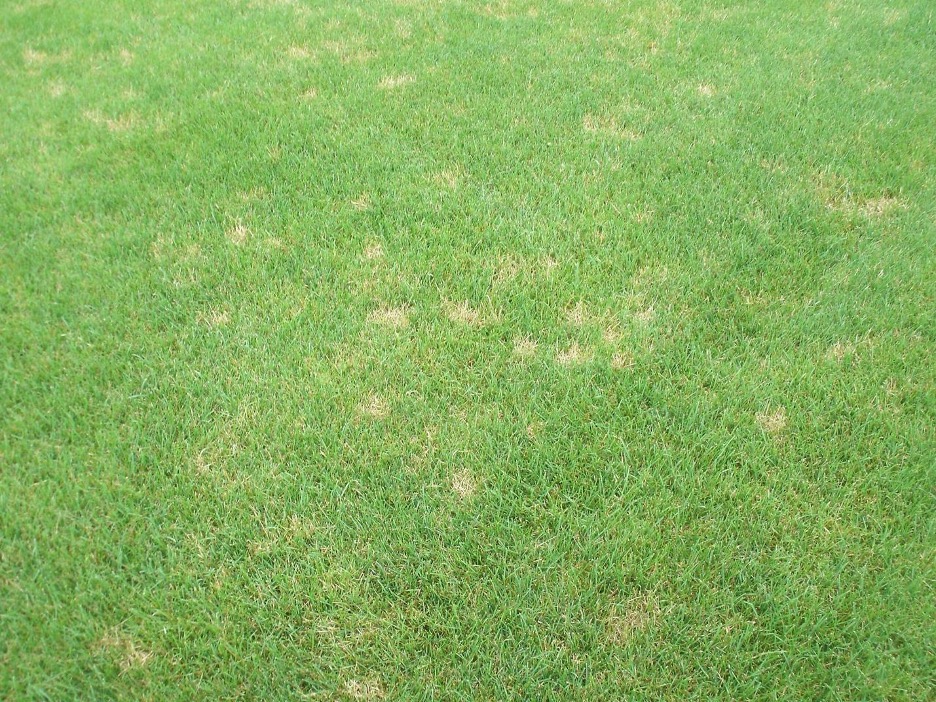
The lawn looks worn or thin in high-traffic areas. Compaction shows up first where soil is being pressed.
Standing water appears after rains in spots where it never used to.
Roots are short. Pull a plug or use a soil probe to look at root depth. Healthy fescue or bluegrass should have roots reaching 4 to 6 inches deep by mid-season. Compacted lawns often have roots only 2 to 3 inches deep.
Most Cleveland area properties with clay soil benefit from aeration every 1 to 2 years. Newer construction lawns where heavy equipment compacted the soil during building benefit from annual aeration for the first 5 years.
How to Tell If You Need Power Raking
Five signs your lawn needs power raking:
You can push your fingers down into the lawn and feel a thick spongy layer above the soil. That is the thatch.
Watering produces a lot of runoff because water is bouncing off the thatch instead of soaking through.
Fertilizer applications do not seem to deliver expected results. The product is sitting on thatch and not reaching soil.
The lawn feels uneven or bouncy underfoot rather than firm.
You can pull up handfuls of dead, brown, fibrous material from the thatch layer easily.
Bermuda grass develops thatch faster than cool-season grasses, but most Cleveland lawns are cool-season blends. Excessive thatch is much rarer here than in southern markets.
Why Most Cleveland Lawns Need Aeration More
The honest answer that most companies will not tell you. The vast majority of Cleveland area lawns benefit more from aeration than from power raking. Compaction is nearly universal in our heavy clay soils. Excessive thatch is much rarer and tends to show up only on lawns that have been heavily fertilized year after year.
If you are unsure which service you need, aeration is almost always the safer bet. It rarely hurts and almost always helps. Power raking, done unnecessarily or aggressively, can damage healthy turf by pulling up live tissue along with the thatch.
When You Need Both
Some lawns benefit from both, typically older Kentucky bluegrass-heavy lawns with both heavy thatch and compacted soil. The order: power rake first to remove the surface layer, then aerate to break up the soil. Doing both is intense and may stress the lawn temporarily, so we sometimes split them across spring and fall.
Best Timing for Cleveland Cool-Season Lawns
Best timing for both services on cool-season grasses (Kentucky bluegrass, tall fescue, perennial ryegrass) is early fall, typically September through early October. Soil is still warm enough for fast recovery, but air temperatures are cooling into the recovery range for the lawn.
Fall aeration also pairs perfectly with overseeding. The open holes create ideal seed-to-soil contact for new seed.
Spring is sometimes used as a secondary window but produces less benefit because the lawn has limited recovery time before summer stress.
Avoid both services during summer heat or winter cold. The lawn cannot recover from the disturbance and you can do real harm.
Spike Aeration vs Core Aeration
Two types of aeration exist. Core aeration (which we always recommend) uses hollow tines that pull plugs out, leaving empty space that gradually fills with healthier soil.
Spike aeration uses solid tines that simply push down into the soil, like jabbing a fork into the ground. This actually compacts the soil around the spike, making the problem worse. If you see a service offering aeration at suspiciously low prices with quick equipment that just rolls across the lawn, ask whether they are pulling cores or just pushing spikes. The two are not equivalent.
What to Expect After Each Service
Aeration leaves visible plugs on the lawn for 2 to 3 weeks. The lawn looks slightly disturbed initially but greens up quickly within 4 to 6 weeks as roots take advantage of the opened soil.
Power raking produces a much messier visual result. There will be piles of debris that need to be raked or bagged, and the lawn looks brown and beat-up for 2 to 3 weeks. Recovery is slower because power raking is more disruptive.
Both services pair well with overseeding (especially valuable on cool-season lawns) and with a fertilization application that takes advantage of improved soil access.
Cost Comparison
Typical pricing for Cleveland area residential properties:
Core aeration: $150 to $350 depending on lot size.
Power raking: $200 to $450 depending on lot size and thatch level.
Aeration plus overseeding: $300 to $700 depending on size and seed rate.
Combined aeration plus power raking: $400 to $800.
What to Do Next
If you are not sure whether your Cleveland area lawn needs aeration, power raking, or neither, we walk properties across our service area to probe the soil, check the thatch layer, look at root depth, and tell you honestly what would help most. Sometimes the right answer is to do nothing this year and save the money. If you would rather have someone else handle the timing decisions, product selection, and application for your Cleveland lawn, we are here for that.
Lawn Squad of Cleveland serves Amherst, Avon, Avon Lake, Bay Village, Beachwood, Berea, Brecksville, Brook Park, Broadview Heights, Brunswick, Cleveland, Columbia Station, and surrounding areas.
Call us at 440-271-3113 or request a free quote at lawnsquad.com. Our VitaminLawn program is built specifically for the grass types, soils, and weather patterns in our service area. Most homeowners see noticeable improvement within the first two applications.