Short Answer: When your Cleveland area lawn looks worse than the neighbor’s despite similar care, the gap is usually one of six things: different sun exposure, different soil conditions or pH, different mowing practices, different watering practices, different professional treatment programs, or different grass density built up over years. Most are reversible. Once you know which is driving the difference on your property, the path forward becomes clear. Here is how to think through each cause for your specific situation across the Cleveland area.
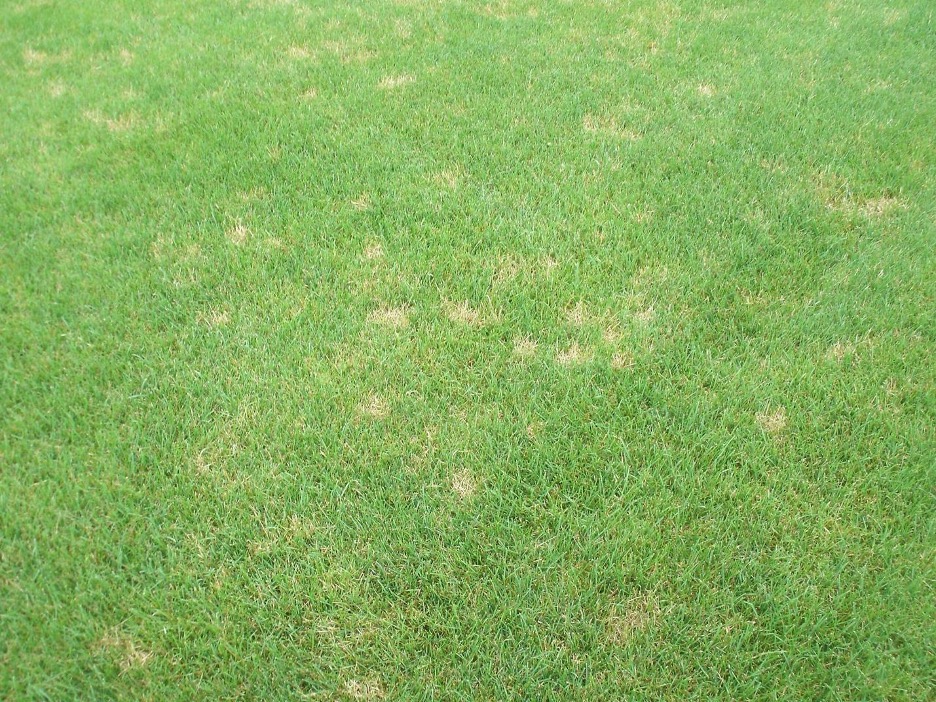
Few things are more frustrating than walking outside on a May morning and seeing your neighbor’s lawn looking lush and dense while yours is patchy and tired. The lots are similar, the conditions seem the same, and yet there is a visible difference at the property line.
Across our Cleveland area service zone (Avon, Avon Lake, Beachwood, Brecksville, Westlake, Strongsville, and our broader area), we walk a lot of lawns where homeowners are dealing with this exact comparison. Here are the six reasons we see most often.
1. Different Sun and Shade Exposure
Two yards across the street can have very different sun exposure depending on house orientation, tree placement, and surrounding structures. North-facing yards get less direct sun than south-facing yards. Lawns under mature tree canopies receive far less light than open yards.
Cool-season grasses common in Northeast Ohio (tall fescue, Kentucky bluegrass, perennial ryegrass) need at least 4 to 6 hours of direct sun daily to thrive. Under that threshold, the lawn thins gradually regardless of how perfectly it is maintained.
If your yard has more shade than your neighbor’s, that is likely a meaningful part of the gap. Selective tree thinning, switching to more shade-tolerant grass varieties (fine fescue blends), or accepting that shaded areas will not match sun-exposed ones are the realistic options.
2. Different Soil Conditions and pH
Soil varies significantly even within a single Cleveland area neighborhood. Newer construction often has compacted, disturbed soil with poor structure. Older lots have established soil with better drainage but may have unique problems like clay layers or buried debris.
Soil pH varies too. Northeast Ohio soils tend to run slightly acidic, but levels vary house to house. A lawn growing in optimal pH (6.5 to 7.0 for cool-season grass) will dramatically outperform one in poor pH even with identical care.
The diagnostic is a soil test. The OSU Extension Service offers affordable testing. Pull samples from your lawn and compare to similar spots in the neighbor’s yard if you can. If the numbers are different, you have part of your answer.
3. Different Mowing Practices
This is often the invisible difference. Your neighbor may be mowing at 3.5 inches with sharp blades on a regular schedule. You may be mowing at 2 inches with dull blades when you have time. Both lawns receive sun and water but only one is being managed in a way that builds density.
Mowing too short is the single most common mowing mistake we see across Cleveland. Cool-season grasses need height to support their root systems and shade the soil from weed seeds. A 3 to 4 inch cutting height is the standard recommendation for most Northeast Ohio lawns.
Mowing frequency matters too. The “one-third rule” says you should never remove more than one-third of the blade height in a single mow. Letting the lawn get tall and then cutting it short shocks the grass.
4. Different Watering Practices
Most homeowners water wrong without realizing it. Daily light watering trains roots to stay near the surface where they bake in summer heat. Watering at night feeds disease. Watering inconsistently produces stress cycles that weaken the lawn.
Your neighbor may be watering deeply 2 times per week in early morning. You may be watering 15 minutes daily at 6 PM. Same overall water volume, very different lawn results.
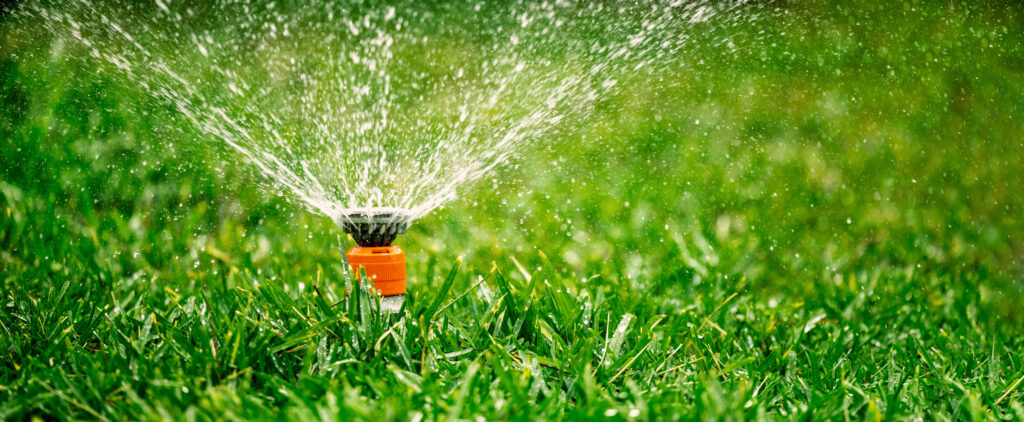
The right approach for Cleveland cool-season lawns: 1 to 1.5 inches per week total, split into 2 deep cycles, applied between 4 AM and 9 AM. Most automatic sprinkler systems can be programmed this way easily.
5. Different Professional Treatment Programs
If your neighbor is on a professional lawn care program and you are not, that gap alone often explains the visible difference. Professional fertilization, weed control, and disease prevention add up over time. A lawn that has been on a program for 3 years looks dramatically different from one that has not.
Even if you are both on programs, the quality of the program matters. Some companies apply minimum-rate fertilizer with weak weed control. Others apply professional-grade products at proper rates with attention to soil chemistry. The difference shows up in the lawn over time.
6. Different Grass Density Built Up Over Years
Two lawns side by side may have different grass varieties or different density histories. Maybe your neighbor has a turf-type tall fescue blend installed 5 years ago and yours is older common fescue. Maybe their lawn has been overseeded annually for a decade and yours has not.
Density also matters. A lawn that has been overseeded annually for years will be much denser than one that has only been mowed and fertilized. Density makes the lawn more resistant to weeds, more tolerant of drought, and visually thicker.
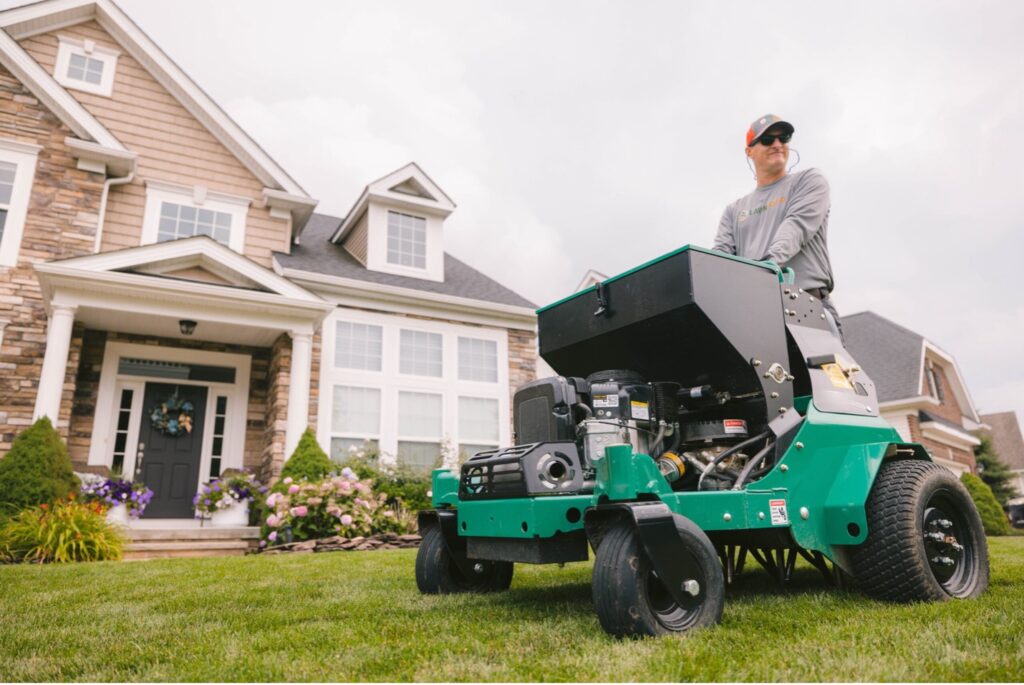
Conversion to better grass varieties through aeration and overseeding over 2 to 3 years can close most of this gap.
How to Diagnose Your Lawn
Walk the property with a critical eye. Compare exposure, soil feel, and density to your neighbor’s. Talk to the neighbor about their care routine. The gap is rarely mysterious once you know what to look for.
If the gap is meaningful and you want to close it, prioritize based on what you can control. Mowing and watering are immediate. Fertilization and weed control come next. Soil amendment and overseeding are bigger investments but produce lasting change.
Realistic Timeline for Closing the Gap
If you make changes today, you should see meaningful improvement within one full season (about 6 months) and dramatic improvement within 2 years. Lawn care produces compounding benefits. Each year builds on the last.
Quick fixes that produce 90-day transformation rarely exist. But sustained improvement over 12 to 24 months is reliable when the right things are being done consistently. The neighbors whose lawns look great did not get there overnight either.
Cleveland-Specific Considerations
A few factors matter more in Cleveland than in other markets:
Lake-effect weather creates micro-climates within our service area. Properties closer to Lake Erie experience different humidity, temperature swings, and disease pressure than inland properties.
Heavy clay soils across much of Northeast Ohio compact easily and benefit from regular aeration more than sandier areas would.
Salt damage from heavy winter de-icing is a recurring spring issue along driveways and walkways.
Snow mold pressure is consistent year to year due to our reliable snow cover.
Each of these affects how Cleveland lawns develop and recover compared to other regions.
What to Do Next
If your Cleveland area lawn is visibly worse than the one next door and you are ready to close the gap, we walk Avon, Beachwood, Brecksville, Strongsville, and our broader service area regularly to identify the specific causes and put together realistic plans. If you would rather have someone else handle the timing decisions, product selection, and application for your Cleveland lawn, we are here for that.
Lawn Squad of Cleveland serves Amherst, Avon, Avon Lake, Bay Village, Beachwood, Berea, Brecksville, Brook Park, Broadview Heights, Brunswick, Cleveland, Columbia Station, and surrounding areas.
Call us at 440-271-3113 or request a free quote at lawnsquad.com. Our VitaminLawn program is built specifically for the grass types, soils, and weather patterns in our service area. Most homeowners see noticeable improvement within the first two applications.