The short answer: Raleigh area lawns need fertilizer applications spread throughout the growing season, typically starting in early February and continuing through late November. The exact timing depends on your grass type, but most lawns benefit from six to eight fertilizer applications per year.
For cool season grasses like fescue, focus heavier fertilization in spring and fall when the grass grows most actively. For warm season grasses like Bermuda and zoysia, concentrate fertilization during the warm summer months.
Quick overview:
- Early February: First fertilizer application to break winter dormancy
- March through June: Regular applications every 35 to 42 days
- July through August: Lighter feeding for cool season grasses, continued feeding for warm season
- September through November: Final applications to prepare for winter
Keep reading to learn the specific timing that works best for Raleigh, Wake Forest, Knightdale, Rolesville, and surrounding Wake County communities.

The Complete Fertilization Approach: Our Round-Based Program
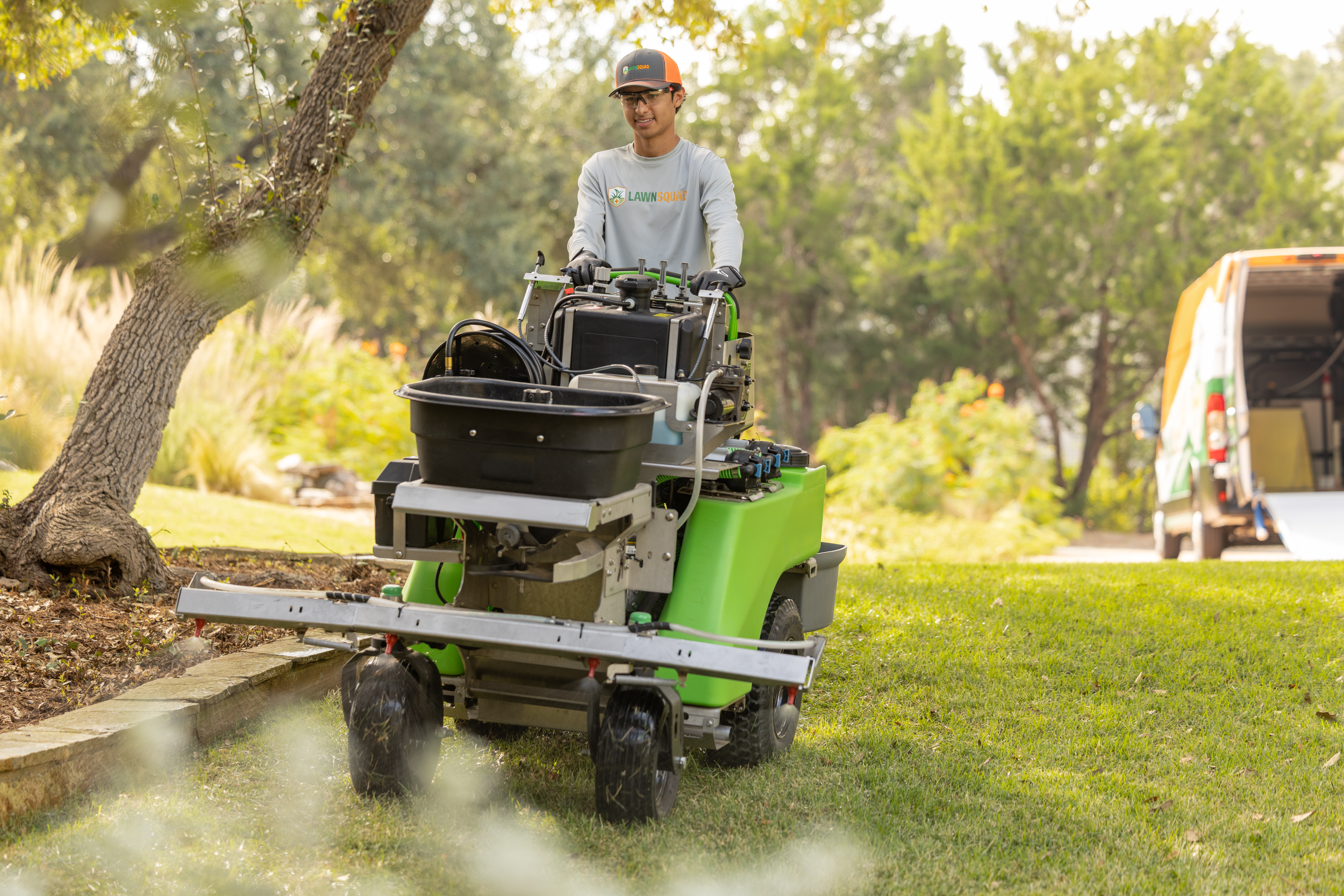
At Lawn Squad of North Raleigh-Greenville, we developed our fertilization schedule specifically for the transition zone climate that covers Wake County and the greater Raleigh area. Our program uses a round-based system with treatments spaced approximately 35 days apart.
This timing matches your lawn’s natural growth patterns and nutrient needs throughout the season. Each round builds on the previous one, creating consistent feeding that promotes steady, healthy growth rather than sudden flushes followed by nutrient deficiency.
Whether you fertilize your own lawn or hire professionals, understanding why timing matters helps you make better decisions and get better results from every application.
Why Fertilization Timing Matters More Than Most Raleigh Homeowners Realize
Fertilizer applied at the wrong time does more harm than good. This surprises many homeowners who assume that feeding their lawn is always beneficial. The reality is more complicated.
When you fertilize cool season grass during hot summer months, you force growth when the plant wants to conserve energy. This stresses the grass and makes it more vulnerable to disease and drought damage. The fertilizer you paid for actually weakens your lawn.
When you fertilize warm season grass before it breaks dormancy, the nutrients wash away or feed weeds instead of your turf. You waste money and give weeds a competitive advantage.
Raleigh sits in the transition zone, meaning both cool season and warm season grasses grow here. This creates confusion because national lawn care advice rarely accounts for our unique climate. What works in Minnesota or Florida does not work in Wake County.
The humid summers, mild winters, and clay-heavy soils common throughout Raleigh, Wake Forest, Knightdale, and Rolesville require a fertilization approach designed for local conditions.
Fertilization Guide for Cool Season Lawns in the Raleigh Area
Fescue is the most common cool season grass in the Raleigh area. Bluegrass and ryegrass also appear in some lawns. These grasses grow most actively when temperatures range from 60 to 75 degrees, which means spring and fall are prime growth periods.
Round 1: Early February
Your first fertilization of the year should happen in early February. This application helps your lawn break winter dormancy and start the growing season strong.
Use a balanced fertilizer that provides nitrogen for green growth along with phosphorus and potassium for root development. Many Raleigh area soils lack certain nutrients, so a soil test before this application helps you choose the right formula.
Combine this fertilization with pre-emergent herbicide to prevent crabgrass and other summer annual weeds. The timing works perfectly because both treatments need to happen before soil temperatures reach 55 degrees.
Round 2: Mid-March
The second fertilization happens about 35 days after Round 1, typically in mid-March. Your lawn is now actively growing and can use more nutrients.
This application continues building the nutrient base while your grass fills in bare spots and thickens up. March fertilization in the Raleigh area takes advantage of ideal growing conditions before summer heat arrives.
Round 3: Late April
By late April, your fescue lawn is growing vigorously. This round maintains the feeding schedule and supports continued growth.
Pay attention to weather patterns during this application. If April brings unusual heat, your lawn may start slowing down earlier than normal. Adjust nitrogen rates accordingly to avoid pushing growth during stress periods.
Round 4: Early June
The June fertilization requires careful consideration for cool season lawns. Temperatures in Raleigh often climb into the 80s and 90s, which slows fescue growth significantly.
Use a lighter nitrogen rate for this application. The goal is maintenance feeding, not aggressive growth promotion. Too much nitrogen now stresses the grass heading into summer dormancy.
Consider adding root stimulant products during this round. Stronger roots help your lawn survive summer heat and drought.
Round 5: Late July (Optional or Light)
July and August are the most stressful months for cool season lawns in the Raleigh area. High temperatures, humidity, and disease pressure challenge even healthy fescue.
Some programs skip summer fertilization entirely for cool season grasses. Others apply a very light feeding with slow-release nitrogen. The key is avoiding any application that forces growth during heat stress.
If your lawn shows signs of disease or drought stress, hold off on fertilization until conditions improve.
Round 6: Late August to Early September
As temperatures begin moderating in late August, your cool season lawn prepares for its fall growth surge. This is one of the most important fertilizations of the year.
September growth determines how thick and healthy your lawn enters winter. A strong fall feeding promotes tillering (new grass plant development) and root expansion.
Combine this fertilization with pre-emergent herbicide to prevent winter annual weeds like poa annua.
Round 7: Mid-October
October fertilization continues supporting fall growth. Your fescue is now growing at its fastest rate of the year, taking full advantage of cooler temperatures and fall rainfall.
This application should include balanced nutrition to support both top growth and root development. Healthy roots store carbohydrates that help your lawn survive winter and emerge strong in spring.
Round 8: Late November
The final fertilization of the year happens in late November, often called a “winterizer” application. This feeding provides nutrients your lawn stores over winter and uses for early spring green-up.
Use a fertilizer with higher potassium content for this round. Potassium improves cold hardiness and disease resistance during winter months.
Critical warning: Never apply fertilizer to frozen ground or when heavy rain is forecast within 24 hours. Runoff wastes your investment and harms local waterways.
Fertilization Guide for Warm Season Lawns in the Raleigh Area
Bermuda, zoysia, and centipede grasses are common warm season options in Wake County. These grasses grow most actively when temperatures stay above 80 degrees, making summer their peak season.
Dormancy Period: November through March
Warm season grasses go completely dormant during Raleigh winters. The grass turns brown and stops all growth. Do not fertilize during this period.
Any fertilizer applied to dormant warm season turf feeds weeds, not your lawn. Wait until you see consistent green-up before starting your fertilization program.
Round 1: Late April to Early May
Begin fertilizing warm season lawns when the grass shows active green growth throughout the lawn, not just in sunny spots. In the Raleigh area, this typically happens in late April or early May.
Start with a moderate nitrogen application. The grass is just waking up and cannot process heavy feeding yet.
Round 2: Early June
By June, your Bermuda or zoysia is growing aggressively. This is the time for your strongest nitrogen application of the year.
Warm season grasses thrive in conditions that stress fescue. Take advantage of peak growing season with consistent feeding.
Round 3: Early July
Continue the feeding program through July. Your warm season lawn is at maximum growth rate and can handle regular nitrogen applications.
Watch for signs of nutrient deficiency like yellowing or slow growth. These indicate your lawn needs more frequent or heavier feeding.
Round 4: Early August
August fertilization keeps your warm season lawn thick and competitive against weeds. Healthy, dense turf naturally crowds out weed seedlings.
Consider adding iron supplements during summer months. Iron promotes deep green color without forcing excessive growth.
Round 5: Early September
As days shorten and temperatures moderate, warm season grass growth begins slowing. This round should use a lighter nitrogen rate than summer applications.
The goal shifts from promoting growth to maintaining health as the lawn prepares for dormancy.
Round 6: Early October
The final warm season fertilization happens in early October. Use a formula higher in potassium to improve cold hardiness and help your lawn store energy for winter dormancy.
After this application, stop fertilizing until next spring’s green-up.
How to Calculate Fertilizer Amounts for Your Raleigh Lawn
Proper fertilizer application requires knowing your lawn size and understanding nitrogen rates. Too little fertilizer produces poor results. Too much burns grass and wastes money.
Step-by-step process:
- Calculate your lawn’s square footage (total lot minus house, driveway, patios, and beds)
- Determine the nitrogen rate per 1,000 square feet (typically 0.5 to 1 pound for maintenance, up to 1.5 pounds for aggressive feeding)
- Read your fertilizer bag to find the nitrogen percentage (the first number in the N-P-K ratio)
- Calculate pounds of product needed: (lawn square footage ÷ 1,000) x (desired nitrogen rate ÷ nitrogen percentage)
Example calculation:
- Lawn size: 8,000 square feet
- Desired nitrogen rate: 1 pound per 1,000 square feet
- Fertilizer nitrogen percentage: 25% (shown as 25-0-10 on bag)
- Calculation: (8,000 ÷ 1,000) x (1 ÷ 0.25) = 8 x 4 = 32 pounds of product needed
Calibrate your spreader to apply this amount evenly across your entire lawn. Uneven application creates stripes and burned areas.
What About Soil Testing in the Raleigh Area?
Soil testing removes the guesswork from fertilization. A simple test reveals your soil’s pH level, nutrient content, and organic matter percentage.
Raleigh area soils vary significantly. Sandy soils in eastern Wake County drain quickly and often lack nutrients. Clay soils in western areas hold nutrients but may have drainage problems. pH levels range from acidic to neutral depending on location.
Without a soil test, you might fertilize heavily while your lawn cannot absorb nutrients due to pH problems. Or you might add nutrients your soil already contains in excess.
Lawn Squad’s ELITE program includes soil testing in Round 1. This allows us to customize fertilization and amendment recommendations for your specific property.
If testing yourself, collect samples from multiple areas of your lawn and send them to the NC State Extension Soil Testing Lab. Results typically arrive within two to three weeks.
Common Fertilization Mistakes Raleigh Homeowners Make
After serving homeowners throughout Wake County, from Raleigh to Wake Forest to Knightdale to Rolesville, we see the same fertilization mistakes repeatedly.
Mistake #1: Fertilizing on a calendar instead of by lawn need April 15th might be the “right” date in a generic guide, but your lawn’s actual needs depend on weather, soil conditions, and grass type. A cold spring delays fertilization needs. A warm winter accelerates them.
Mistake #2: Using the wrong fertilizer type Quick-release fertilizers provide fast green-up but burn easily and require frequent reapplication. Slow-release formulas cost more upfront but feed steadily over weeks. Most Raleigh lawns benefit from slow-release products, especially during summer.
Mistake #3: Ignoring soil pH When soil pH falls below 6.0 or rises above 7.0, grass cannot efficiently absorb nutrients. Fertilizing acidic soil without adding lime wastes your investment. Get a soil test before assuming more fertilizer solves yellowing or slow growth.
Mistake #4: Fertilizing drought-stressed lawns Fertilizer needs water to move into the soil and reach grass roots. Applying fertilizer during drought, without irrigation, leaves product sitting on the surface where it can burn grass or wash away in the next rain.
Mistake #5: Skipping fall fertilization Many homeowners stop lawn care after summer ends. Fall is actually the most important fertilization period for cool season grasses in the Raleigh area. September and October applications produce thicker lawns the following spring.
Liquid vs. Granular Fertilizer: Which Should You Choose?
Granular fertilizer comes in pellet form that you spread with a broadcast or drop spreader. It releases nutrients slowly as pellets break down, providing feeding over several weeks. Granular products are easier for homeowners to apply evenly and store between applications. Best for: Homeowners doing their own lawn care, larger properties, and situations where convenience matters.
Liquid fertilizer dissolves in water and sprays onto the lawn. It absorbs quickly through grass blades and roots, providing fast results. Liquid applications require calibrated spray equipment and more frequent applications. Best for: Professional applications, quick green-up needs, and combining with other liquid treatments like weed control.
Lawn Squad uses both liquid and granular products depending on the treatment and lawn conditions. This flexibility allows us to match the right product type to each situation.
Your Raleigh Area Fertilization Calendar at a Glance
Cool Season Lawns (Fescue, Bluegrass)
| Round | Timing | Application Notes |
|---|---|---|
| 1 | Early February | Balanced fertilizer with pre-emergent |
| 2 | Mid-March | Continue feeding during active growth |
| 3 | Late April | Maintain momentum before summer |
| 4 | Early June | Light application as growth slows |
| 5 | Late July | Optional/skip during heat stress |
| 6 | Late August | Begin fall feeding program |
| 7 | Mid-October | Support peak fall growth |
| 8 | Late November | Winterizer application |
Warm Season Lawns (Bermuda, Zoysia, Centipede)
| Round | Timing | Application Notes |
|---|---|---|
| 1 | Late April | Begin after full green-up |
| 2 | Early June | Strongest application of the year |
| 3 | Early July | Continue aggressive summer feeding |
| 4 | Early August | Maintain thick, competitive turf |
| 5 | Early September | Reduce nitrogen as growth slows |
| 6 | Early October | Final feeding before dormancy |
The Bottom Line
Fertilization timing in the Raleigh area depends on your grass type, local weather patterns, and soil conditions. Cool season lawns need heavier feeding in spring and fall. Warm season lawns need heavier feeding in summer. Both require consistent applications spaced throughout the growing season.
Key principles to remember:
- Match your fertilization schedule to your grass type’s active growth periods
- Space applications approximately 35 days apart during the growing season
- Reduce or skip nitrogen during periods of heat or drought stress
- Test your soil to ensure proper pH and avoid wasting fertilizer
- Never skip fall applications for cool season lawns
Following proper fertilization timing creates a lawn that stays green longer, resists weeds naturally, and recovers quickly from stress.
Let Lawn Squad Handle It For You
Every Raleigh area lawn faces different challenges. Soil composition varies across Wake County neighborhoods. Shade patterns affect growth rates. Previous lawn care history influences current nutrient needs.
Lawn Squad’s programs account for all these variables. Our technicians know the Raleigh, Wake Forest, Knightdale, and Rolesville areas and adjust fertilization rates based on what your specific lawn needs.
PRO Program includes:
- Eight fertilizer applications throughout the growing season
- Pre-emergent herbicide in three rounds
- Broadleaf weed control in seven rounds
- Grub prevention included
- Surface insect control throughout the season
- Unlimited service calls between scheduled visits
ELITE Program adds:
- Soil testing to customize your treatment plan
- Disease control in four rounds
- Summer and fall aeration
- Root stimulant application
- Maximum protection with 14 billable treatments
Tired of guessing when to fertilize? Frustrated with yellow grass despite regular feeding? Ready for a lawn that looks professionally maintained because it is?
Contact Lawn Squad of North Raleigh-Greenville today at (984) 279-7215 or visit lawnsquad.com/contact-us to get a free quote and start a fertilization program designed specifically for your Raleigh area lawn.